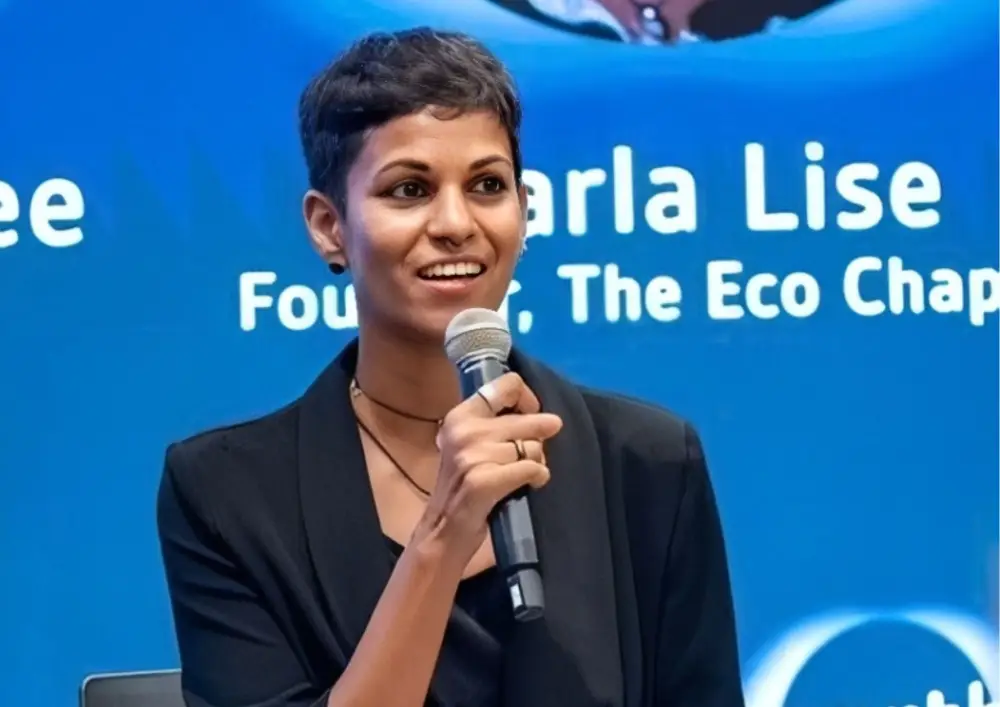
At NewInAsia, we spotlight emerging storytellers who are reshaping how Asia thinks about sustainability, society, and systems change. This month, we’re proud to feature Marla Lise as our Fellow of the Month.
Marla is a regenerative storyteller, environmental advocate, and founder of The Eco Chapter, a consultancy blending eco-literacy and systems thinking. Her editorial work is rooted in lived experience — from rescuing wildlife in Latin America to reframing success in Singapore’s high-pressure economy.
Through every piece, she invites readers to question dominant narratives and imagine a more connected, compassionate future.
Highlights
From Rescue Work to Regenerative Storytelling
Q: You’ve built a career at the intersection of education, storytelling, and sustainability. How do those strands come together in your approach to editorial work at NewInAsia?
A: I’ve always felt a strong connection to the natural world. As a child, I was constantly bringing home stray cats — my parents would let me keep them for a week before we took them to the shelter. That instinct to protect eventually led me to study Animal Science in Australia, followed by a master’s in Environmental Science back in Singapore.
But I struggled to find hands-on opportunities to work with wildlife here. What started as a short trip overseas became nearly four years of backpacking and volunteering across South and Central America — first in wildlife rescue, then in marine conservation after I became a dive master.
While volunteering, I noticed something troubling: even when science was available, it was often inaccessible. The problem wasn’t intelligence — it was language. Scientific communication can be so technical and closed-off that it alienates the very communities it’s meant to serve.
That’s what led me to train as an English teacher. It allowed me to break down those barriers and also gave me the freedom to keep volunteering. In 2023, after working as a sustainability manager, I decided to focus fully on combining science, storytelling, and education. That’s how The Eco Chapter was born — a regenerative storytelling consultancy that uses narrative and systems thinking to empower change.
My editorial work at NewInAsia is an extension of that mission. It allows me to reach audiences who might not naturally engage with environmental topics — people more focused on finance, politics, or current affairs. I hope to spark broader conversations about the polycrisis we’re all facing. Because we won’t find solutions if only a few people are listening.
Rethinking What It Means to “Succeed”
Q: Your articles challenge traditional ideas of success — particularly in Singapore’s education system and economy. What draws you to reframing these dominant narratives?
A: I’ve spoken to so many people in Singapore about what success means, and the answers are usually the same: power, financial wealth, material possessions, and social status. Through my writing, I want to offer an alternative.
What if success meant having time for your family? Or slow mornings, close friendships, deep rest, and the freedom to live with intention? A slower, more human way of being.
The narrative we’ve been sold is that if you want to live a more sustainable or eco-centric life, you have to “give up” everything else. But that’s not true. There are people all over the world living with very little, yet they’re rich in joy, community, and connection to nature. Even some billionaires have walked away from material wealth to live more meaningful lives in nature.
The idea that we have to choose between wealth and well-being is a false dichotomy. We need to shift that story — and there are cracks in the system where that shift is already happening. All of our systems — education, economy, consumption — are man-made. That means they can be unmade and remade. We just need enough people to believe that we are enough, we have enough, and we don’t need to keep chasing a version of success that’s unsustainable.
Writing with Purpose, Not Just Poetry
Q: As someone who guides others in purposeful communication, what’s been most distinct or surprising about NewInAsia’s editorial voice?
A: It’s very different from my usual tone. I naturally gravitate toward metaphors, analogies, and poetic storytelling — but editorial writing requires more structure, more clarity, and less flourish.
It’s been a great challenge for me. It’s helped me become more intentional with my words and more focused on the core message. And I’ve come to really value that kind of discipline in storytelling.
Letting the Story Shift
Q: Was there a moment in the editorial process that reshaped how you viewed your topic?
A: Yes — when I realised we sometimes have to use quotes that are already collected, rather than starting with the interviews ourselves. That was a shift in process for me. I usually begin with the person I want to profile, then shape the narrative around their lived experience.
Learning to build stories around pre-existing material has made me more flexible. It’s also shown me how many different angles a single issue can have, depending on the lens you use.
The Story Singapore Needs to Tell Itself
Q: If you could create a dream editorial series for NewInAsia, what would it spotlight — and why now?
A: I would focus on Singapore’s ecological insecurities in the face of the climate crisis. We’re a small country, and we often forget how reliant we are on our neighbours — many of whom are already dealing with extreme climate impacts like flooding, pollution, and rising heat.
There’s a false sense of invincibility here. But we won’t be shielded forever. And we can’t expect other nations to support us if we aren’t actively trying to change ourselves.
That means rethinking education, reimagining business, and changing how we live and consume. We waste so much — resources, time, labour, and energy — much of which comes from people and places already under environmental strain.
I want to tell stories that don’t just raise awareness, but also ignite action. Because we can’t afford to stay passive while the world changes around us.
Rewriting the Lens on Sustainability and Success
In her writing and reflections, Marla Lise invites us to question the systems we live in — and the stories that uphold them. Whether she’s reframing what it means to succeed or spotlighting Singapore’s blind spots in a time of ecological crisis, her work pushes past surface narratives and into deeper conversations.
As an Editorial Fellow, Marla brings a rare combination of clarity, compassion, and courage to the page. Her voice challenges assumptions while offering grounded hope — a vision not just of what’s wrong, but of what’s possible. We’re excited to see how her stories continue to evolve, and how they help readers across Asia imagine more regenerative futures.
If you’re curious to explore more of her insights, you can read her pieces on “Ignore Singapore’s School Reform at Your Own Risk,” and “Why Singapore’s Greatest Vulnerability May Be Its Confidence.“
Highlights
Read the Chinese article here.