
A strategy can look compelling in the boardroom and still become remarkably difficult to execute once it reaches the people responsible for turning it into daily action.
Companies invest heavily in strategic planning, market forecasting, digital transformation, and multi-year growth roadmaps. Yet months later, ambitious targets can give way to operational friction: departments pursue conflicting priorities, managers work toward KPIs that no longer reflect strategic intent, and frontline realities struggle to reach decision-makers.
For Prof. Ahmad J. Naous, a Lebanese economist, business strategist, management educator, and founder of Stratexology, this disconnect has been a recurring theme throughout his work in strategy execution and performance management.
His conclusion is straightforward: organizations do not necessarily need more plans. They need systems that connect strategic intent with operational reality — and continuously adapt as that reality changes.
Highlights
- What Happens When Companies Penalize Employees for Following the Strategy?
- Are Your KPIs Quietly Rewriting Your Strategy?
- Why Does the Boardroom See Progress While the Frontline Sees Friction?
- What If Measuring Performance Isn’t Enough?
- Why Does Performance Often Get Worse Before Strategy Starts Working?
- What Can Leaders Change Before Execution Starts to Break Down?
- The Real Test of Strategy Begins After the Presentation Ends
What Happens When Companies Penalize Employees for Following the Strategy?
Naous points to his experience advising a diversified family-owned conglomerate operating across Southeast Asia.
The company was attempting to move from traditional retail distribution toward a unified omnichannel digital platform. Its C-suite, supported by a Western consulting firm, had developed an extensive strategy map for the transformation.
On paper, the direction was clear.
But when Naous spoke with regional branch managers in Indonesia and the Philippines, he encountered a different reality. The leadership team measured branch managers on monthly physical retail volumes and local profit margins. At the same time, the new corporate strategy required them to redirect inventory toward online orders.
Following the strategy could therefore reduce local branch stock — and potentially affect the metrics tied to their bonuses.
The problem was not necessarily the strategy itself. The organization’s incentives were working against it.
For Naous, the experience exposed a fundamental execution problem: leadership can establish a destination, but employees will continue responding to the systems, incentives, and measurements governing their everyday work.
Are Your KPIs Quietly Rewriting Your Strategy?
Naous says he encountered a different version of the problem while working with a fast-scaling financial technology company in South Asia.
Leadership had established an ambitious three-year objective to expand financial inclusion across underserved rural districts. According to Naous, the CEO’s emphasis on social impact was genuine, but the performance framework remained centered on conventional measures such as quarterly transactional volume and user acquisition costs.
Six months later, frontline relationship officers were onboarding inactive accounts to meet acquisition targets, while longer-term retention and trust-building within local communities suffered.
The metric had effectively begun driving behavior independently of the strategic objective leadership designed it to support.
For leaders, this raises an uncomfortable question: Are employees executing the strategy — or simply optimizing whatever the organization has chosen to measure?
Why Does the Boardroom See Progress While the Frontline Sees Friction?
Across his work, Naous identifies four recurring structural problems.
The first is operational disconnect. Executives often express strategic objectives at a high level—growing market share, entering a new region, or becoming more sustainable—while employees operate in concrete circumstances involving customers, supply chains, budgets, pricing, and immediate problems. Unless those objectives translate into meaningful operational behavior, employees naturally return to what existing systems reward.
The second is top-down isolation. When strategy travels downward as instruction but operational information does not travel upward with equal effectiveness, leadership loses access to the realities affecting implementation.
Third is misalignment with regional dynamics. Naous argues that rigid annual planning becomes particularly problematic in fast-changing growth markets, where regulations, technology adoption, and commercial conditions can evolve faster than conventional strategy cycles.
Finally, organizations can become overly dependent on financial metrics. Profitability remains essential, but execution also depends on employees, customers, suppliers, and communities. Ignoring these relationships can weaken the conditions required to achieve longer-term results.
What If Measuring Performance Isn’t Enough?
Naous’s thinking emerged from his work with traditional strategic performance management, including Kaplan and Norton’s Balanced Scorecard.
The Balanced Scorecard expanded organizational measurement beyond financial results to include customers, internal processes, and learning and growth. But Naous says his experience applying scorecards across complex markets eventually led him to another question: What happens when an organization measures performance carefully but still struggles to execute?
His response developed into Stratexology, an approach intended to connect strategy, execution, and shared value through continuous feedback between leadership and operations.
Rather than viewing strategy as a static document that cascades downward and leadership revisits during quarterly or annual reviews, Stratexology treats it as a dynamic system that responds to operational information.
It also broadens how value is considered. Instead of evaluating success exclusively through shareholder returns, Naous incorporates Creating Shared Value (CSV), considering outcomes for employees, customers, partners, communities, and other stakeholders alongside economic performance.
Why Does Performance Often Get Worse Before Strategy Starts Working?
Naous visualizes this challenge through what he calls the Stratexology U-Curve.
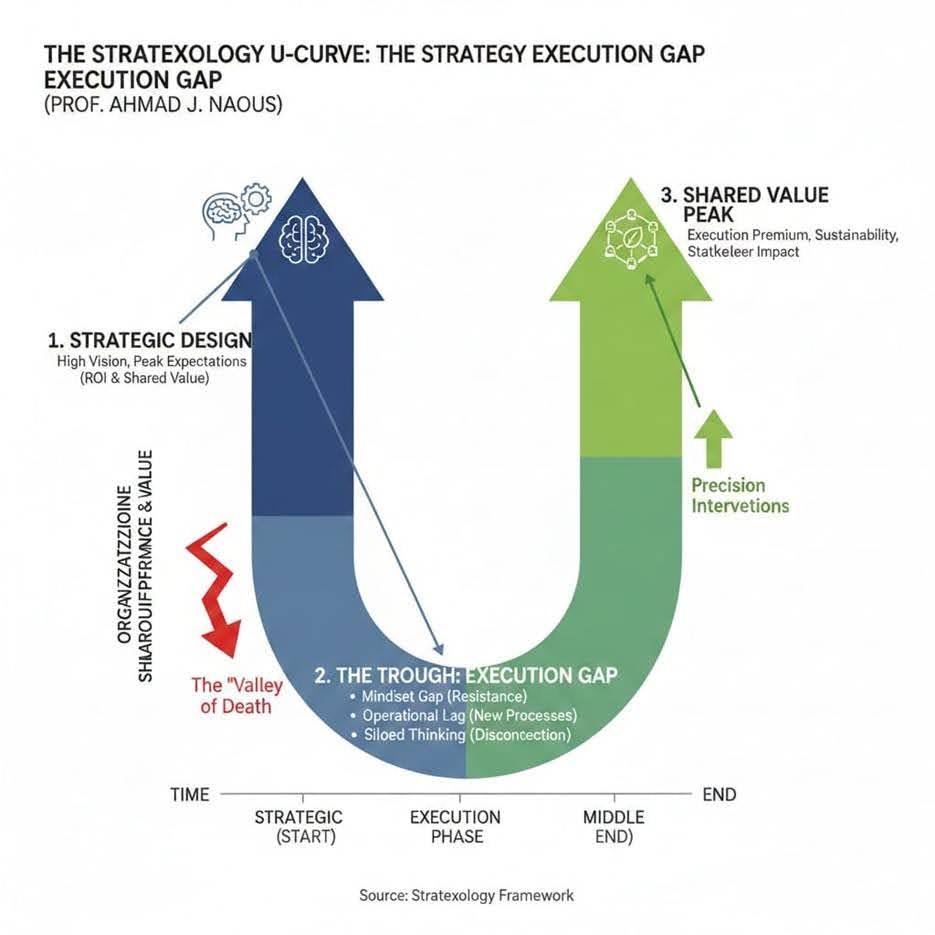
At the beginning sits Strategic Design: expectations are high, leadership sees potential returns, and the organization has a clear vision of the value it wants to create.
Then execution begins — and the curve falls.
Naous calls this the Execution Gap, or the “Valley of Death.” It represents the period when mindset resistance, operational lag, and siloed thinking can drag performance away from the organization’s initial expectations.
The goal is not to assume this friction can be eliminated entirely. Instead, leaders use targeted interventions and operational feedback to move the organization upward toward what the framework describes as the Shared Value Peak — sustained performance accompanied by broader stakeholder impact.
What Can Leaders Change Before Execution Starts to Break Down?
For Naous, strengthening execution begins before leaders introduce another set of targets.
First, examine incentives before cascading new KPIs. If a strategy requires departments to collaborate while bonuses remain tied exclusively to individual departmental performance, the organization may be creating conflict by design.
Second, shorten the distance between action and feedback. Rather than discovering problems during quarterly post-mortems, Naous advocates more frequent strategic reviews focused on operational learning, removing obstacles, and adapting to changing conditions.
Third, incorporate human and social value alongside economic outcomes. Employee engagement, customer trust, community impact, and sustainable stakeholder relationships can influence whether an organization is capable of delivering its longer-term objectives.
Finally, pay closer attention to middle management.
C-suite leaders may establish strategic intent, but middle managers translate that intent into everyday priorities. Giving them greater strategic context — while creating channels for operational constraints to travel upward — allows them to function as strategic translators rather than simply recipients of executive instructions.
The Real Test of Strategy Begins After the Presentation Ends
Naous’s experiences point toward a deceptively simple idea: a strategy cannot be separated from the organizational system expected to deliver it.
An ambitious transformation means little if employees are rewarded for preserving the old model. A social-impact objective can lose its meaning when the metrics encourage volume rather than lasting engagement. And a carefully designed strategy can become disconnected from reality when information moves downward more effectively than it moves upward.
This is the divide Stratexology attempts to address by treating strategy and execution as parts of a continuous system — one in which boardroom assumptions are repeatedly tested against what is actually happening on the ground.
For leaders, that shifts the question from “Do we have the right strategy?” to something more demanding:
“Have we built an organization capable of executing it?”
Because ultimately, the quality of a strategy is not demonstrated by how convincing it appears in a presentation.
It is demonstrated by what happens after people leave the boardroom.
About Prof. Ahmad J. Naous
Prof. Ahmad J. Naous, Ph.D., CPSSE, is a Lebanese economist, business strategist, management educator, and founder of Stratexology. He is an expert in strategy execution, Balanced Scorecard consulting, and humanitarian advocacy dedicated to creating shared value across global markets.
Highlights
- What Happens When Companies Penalize Employees for Following the Strategy?
- Are Your KPIs Quietly Rewriting Your Strategy?
- Why Does the Boardroom See Progress While the Frontline Sees Friction?
- What If Measuring Performance Isn’t Enough?
- Why Does Performance Often Get Worse Before Strategy Starts Working?
- What Can Leaders Change Before Execution Starts to Break Down?
- The Real Test of Strategy Begins After the Presentation Ends
Read the Chinese article here.