For most of the last century, the career ladder and the location ladder moved together.
You earned more by moving toward expensive cities. Historically, that high expense was simply the cost of access. It bought you entry to better jobs, better networks, and better futures. Higher salary and higher cost of living were treated as the same climb.
That assumption is starting to crack.
Alexander Linton has spent the past decade testing it directly. Linton is a chartered accountant by training and holds an Executive MBA from NUS. He has personally bought property across nine countries. Additionally, he has relocated his own life through the UK, the Middle East, and Asia multiple times.
He founded RUMAVI, an independent property and relocation advisory firm operating across six Southeast Asian markets. In this role, he models the true costs of relocation once you strip away the usual marketing fluff. His detailed calculations specifically analyze visa structures, tax exposure, school fees, and exit liquidity. He targets those hidden financial variables that rarely show up in a standard pitch deck. Ultimately, he relies on direct experience rather than abstract theory. He developed this unique vantage point by risking his own capital and running these exact calculations for his own moves.
His recent observation was simple. A six-figure salary in a prestigious city can buy a materially worse standard of living. Conversely, the exact same salary can buy a much better lifestyle if earned and spent somewhere cheaper.
It’s not a new idea in the abstract. However, the massive scale of this financial gap demands proper examination. Furthermore, remote work has made this comparison entirely actionable for ordinary professionals, rather than just retirees or the independently wealthy.
Highlights
The Bundle That Quietly Came Apart
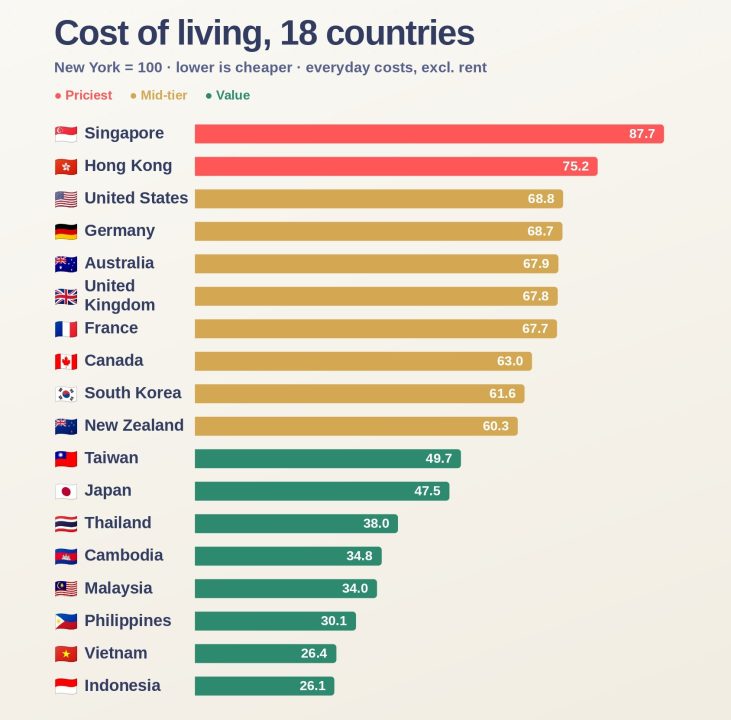
Source: Alexander Linton (LinkedIn), based on the Numbeo Cost of Living Index 2026.
For decades, where you lived was mostly decided for you. Your employer was in a city; you lived near it. The cost of that city was simply the price of the job. If you wanted the opportunity, you accepted the overhead that came bundled with it.
Remote work broke that bundle.
Today, professionals can earn a salary from anywhere with a laptop and a stable connection. Consequently, income geography and spending geography have become two separate decisions instead of one. A professional can, in principle, hold a Singapore-denominated income while living somewhere where the Singapore cost structure doesn’t apply.
This is not a hypothetical advantage for a small number of digital nomads. It’s increasingly structural. Hybrid and fully remote arrangements have become normalized across consulting, technology, finance-adjacent, and creative industries. Not coincidentally, these exact sectors produce some of the highest-earning, remote-capable professionals.
For this group, something more deliberate replaces the old logic of “earn more by moving to where the money is”. Instead, they optimize income where it’s strongest and optimize spending where it goes furthest.
The Number That Isn’t on the Salary Slip
It’s tempting to treat this purely as a cost-of-living story — and cost of living is a meaningful part of it. But professionals making this calculation are rarely optimizing for cheapness alone. They’re optimizing for what the savings buy back.
Housing is the clearest example, because it tends to be the largest single line item in any budget, and the gap between cities is often not incremental but structural.
Singapore’s Additional Buyer’s Stamp Duty forces foreign buyers to pay 60% of a property’s value. Consequently, the surcharge alone on a S$1 million purchase adds S$600,000 to the bill. This massive fee applies before buyers pay any other transaction costs.Linton makes this comparison concrete in his own analysis. That same S$600,000 could instead cover entry costs across three separate properties in three different Southeast Asian markets. Amazingly, those combined entry costs would sit under S$50,000.
The point isn’t that one structure is objectively wrong. Singapore’s premium reflects genuine scarcity, strong governance, and demand that many buyers are willing to pay for. The point is that the gap is now large enough and visible enough that professionals are starting to ask what else the capital could be doing.
Beyond Real Estate: Healthcare, Education, and Time
Beyond housing, the calculation extends into healthcare, education, and time.
Private healthcare in several Southeast Asian markets has reached a standard that rivals Western systems at a fraction of the price, narrowing what was historically one of the strongest arguments for staying in a high-cost country. International schooling has expanded enough in regional hubs that families relocating with children are no longer making an obvious trade-off between cost and education quality — though the trade-off hasn’t disappeared, it has simply narrowed in specific cities rather than vanished entirely.
And there is a less quantifiable factor that shows up repeatedly in how people describe these decisions: time and stress recovered from shorter commutes, lower-pressure environments, and more disposable income relative to local cost. It’s difficult to put a number on, but real enough that people consistently report it as a primary motivator.
What Money Can’t Buy Back
None of this means the prestige cities are losing their pull — and a fair accounting of this shift has to take seriously why people choose to stay, not just why people choose to leave.
Cities like Singapore, Hong Kong, Sydney, London, and New York remain magnets for talent for reasons that have nothing to do with affordability. They concentrate capital, decision-makers, and deal flow in ways that are extremely difficult to replicate remotely. For professionals whose careers depend on proximity — finance, certain legal and advisory work, or anything built on dense in-person networking — physical presence in these cities represents a vital career input rather than a lifestyle preference.
There’s also a stability premium that’s easy to underweight from the outside. Regulatory predictability, enforceable legal systems, currency stability, and institutional depth carry real value, particularly for anyone planning a multi-decade career or raising a family with long-term horizons.
Redefining Safety and Institutional Value
This is where Linton’s own work draws a sharper distinction than “cheap versus expensive.”
In his analysis of safety across Southeast Asian markets, he treats safety not as a crime statistic but as a bundle: legal reliability, political predictability, infrastructure that works, economic stability, and trustworthy healthcare — the unglamorous backbone that determines whether a lower cost of living is actually a discount, or simply a different risk being paid for differently.
By his own ranking, Singapore, Malaysia, Thailand, and Vietnam lead on this combined measure, which is a notably narrower list than the countries that lead purely on cost.
That distinction matters for a senior audience more than a backpacking one. A lower cost of living that comes attached to weaker legal protections or institutional inconsistency isn’t a saving. It’s a deferred cost that may not show up until something goes wrong.
And prestige itself has functional value that resists being reduced to a spreadsheet line. Certain addresses, certain professional ecosystems, and certain cities carry signaling value in hiring, fundraising, and business development that a cheaper city, however pleasant, may not replicate for years, if ever.
What the Spreadsheet Leaves Out
The professionals making this shift successfully tend to be honest about what doesn’t show up on a monthly budget but compounds over the years.
Career advancement that depends on visibility, mentorship, or being physically present for the right conversations can suffer in a remote or relocated arrangement, regardless of how good the internet connection is. Networking effects compound over years of proximity in ways that are hard to manufacture from a distance, no matter how active someone is on video calls.
Long-term stability — visa security, healthcare system depth in an emergency, the legal protections available if something goes wrong — varies considerably across the markets currently popular with relocating professionals. The cheapest option on a monthly budget is not always the most resilient one over a ten-year horizon.
This is, in practice, where independent advisory work like Linton’s tends to focus: less on which destination is “best” in the abstract, and more on which trade-offs a specific person or family is actually equipped to absorb. The honest answer is rarely a ranking. It’s a set of conditional trade-offs that depend on income source, family structure, risk tolerance, and what stage of a career someone is in.
The End of the Default
What’s emerging isn’t a verdict that cheaper cities are better, or that prestige cities are overpriced relics of an outdated career model.
It’s something more specific: location has become a genuine variable in financial and career planning, rather than a fixed cost absorbed without examination.
For a growing number of professionals, particularly those with remote-capable careers, the decision is no longer simply “where can I get the highest salary.” It’s a more layered question involving income potential, cost structure, healthcare and education access, long-term stability, and what kind of daily life the arithmetic actually produces once the math is run honestly.
That doesn’t make the decision simpler. If anything, it makes it harder because it removes the easy default of just following the highest number on an offer letter.
But it does mean more professionals are treating where they live as a decision worth making deliberately — one input among several in a broader strategy, rather than an assumption inherited from where the job happened to be.
Editor’s note: This article was inspired by a LinkedIn post by Alexander Linton, founder of RUMAVI, an independent property and relocation advisory operating across six Southeast Asian markets. His original observation on the gap between salary and cost of living served as the starting point for this broader editorial discussion.
Highlights
Read the Chinese article here.
Related posts:
 Beyond The Box Office: How Film Co-Productions Are De-Risking Market Entry In Asia
 The Danger of Copy-Paste Expansion: Why Successful Singapore Strategies Often Crash and Burn in Japan
 Why Singapore’s Greatest Vulnerability May Be Its Confidence
 The AI Race Has Changed: GITEX AI Asia 2026 Signals the End of Model Wars