
What scientific engineering and product building taught me about careers that cross borders – By Javier Martínez Samblas
A career rarely follows a perfectly straight line. Yet traditional CVs often expect us to present our professional lives as if they do.
For professionals whose experience spans different industries, disciplines or countries, that can mean losing the context that makes their work meaningful. I encountered this problem while rebuilding my own CV, and it eventually led me to question how we document, verify and carry our professional identities throughout our careers.
Highlights
- When My CV Stopped Telling the Whole Story
- What Scientific Engineering Taught Me About Evidence
- Why Career Mobility in Asia Makes Portability Essential
- Digital Credentials Are Only Part of the Solution
- Four Principles for a Portable Professional Identity
- Building Self: An Experiment in Professional Portability
- Final Thoughts: What Needs to Change as Careers Evolve?
When My CV Stopped Telling the Whole Story
During a period of uncertainty at work, I rebuilt my CV. Nothing in it was false, yet the document felt misleading.
It listed software engineering, telecommunications, machine learning, computer vision and scientific research as separate entries. On the page, the dates lined up neatly. But the reasons one experience led to another, and the evidence connecting them, largely disappeared.
That was when I stopped treating a CV as a neutral container.
A CV is useful because recruitment systems expect it, but its brevity imposes a particular way of presenting a person: title, employer, dates and a few compressed bullet points.
The more varied the career, the more this compression hurts. People whose work crosses disciplines, sectors or countries are asked to make themselves look linear for the convenience of a document.
I wanted one clean link that worked on any device and could show more than a job chronology.
That question eventually led me to build a product, but the product came after a more important realisation: professional identity should travel with the person, rather than being reconstructed inside every employer form, social network or national system.
What Scientific Engineering Taught Me About Evidence
My scientific-engineering background includes experience at Universidad Carlos III de Madrid (UC3M) and CERN, spanning beam instrumentation, accelerator physics, machine learning and computer vision for beam measurements and online calibration.
In scientific engineering, software meets physical systems, imperfect data, and operational constraints.
A clean output is not enough. You need to know where the data came from, how it was transformed, what uncertainty remains, and whether another person can inspect the reasoning.
Polish without provenance is not reliability.
Professional profiles often reverse that logic. We compress the evidence until only the claim remains: proficient in this, responsible for that, passionate about something else.
Then we ask a recruiter in another industry or country to supply the missing context.
Hybrid careers suffer most because the reader cannot see the connections between fields.
A portable professional identity is therefore more than a visually appealing CV. It is a maintained record that connects claims to context through work samples, publications, projects, credentials, and a clear explanation of what the person actually did.
It should make uncertainty visible instead of smoothing every gap into confidence.
Why Career Mobility in Asia Makes Portability Essential
The Asian perspective is not simply a case study added to a European founder’s story. Mobility is part of the region’s economic structure.
The Asian Development Bank’s 2026 Asian Economic Integration Report estimates that outbound migrants from Asia reached 100 million in 2024, double the 1990 figure.
About 61.2% lived outside the region and 38.8% within it. Roughly one-third of Asian migrants were highly skilled, with approximately 70% of that group concentrated in six destination economies.
Every move creates a translation problem.
A qualification must be recognised. A role title must make sense in another labour market. A project completed for a local employer may need explanation for a regional or global audience.
Language changes, professional norms differ, and the platform used to establish credibility in one market may carry little weight in another.
The burden is not limited to migrants.
A professional in Jakarta can work for a Singapore company, serve clients in Australia and learn through a global online course without moving house.
The career crosses borders even when the person does not.
A PDF assembled for one application is a poor long-term record for that reality.
Digital Credentials Are Only Part of the Solution
Asian institutions are already developing parts of the answer.
ASEAN’s mobility framework includes mutual recognition arrangements for seven professions. Its Qualifications Reference Framework helps countries compare national qualifications, although only four ASEAN member states have completed national framework referencing so far.
This matters because portability starts with trust.
A person should not have to prove the same degree or certification from scratch each time they cross a boundary.
Yet formal credentials solve only part of the problem. They do not explain a portfolio, a career pivot, work completed across several functions or skills learned outside a degree programme.
Singapore offers a useful glimpse of the next layer.
Its Careers and Skills Passport consolidates government-verified employment, qualifications and skills data.
A 2025 public-sector report stated that the service had been used by more than 262,000 people and had facilitated over 642,000 file downloads.
That is more than a new job-search feature. It treats career information as infrastructure that individuals can access and reuse.
For builders, the lesson is to keep verification and expression separate but connected.
Institutions are best placed to attest that a credential is genuine. Individuals still need a way to explain why it matters, demonstrate what they have created and adapt its presentation without rewriting the underlying facts.
Four Principles for a Portable Professional Identity
My experience suggests four requirements for building a professional identity that can move across platforms, industries and borders.
1. Start with evidence the person already trusts.
A system can organise existing source material, but it should not invent missing qualifications or turn uncertainty into flattering fiction.
2. Separate the record from its presentation.
The same verified experience may need to appear in a concise job application, a public professional profile or a detailed portfolio.
Reformatting should not require re-entering information or changing the underlying facts.
3. Preserve meaning across different contexts.
A job title rarely travels as well as a short explanation of the problem, the work and the result.
Good portability involves translation between professional cultures, not just compatibility between file formats.
4. Give individuals control over their information.
People should decide what is public, what remains private, what is current and which platform receives their information.
A profile trapped inside one marketplace may be convenient until that marketplace changes its rules.
Building Self: An Experiment in Professional Portability
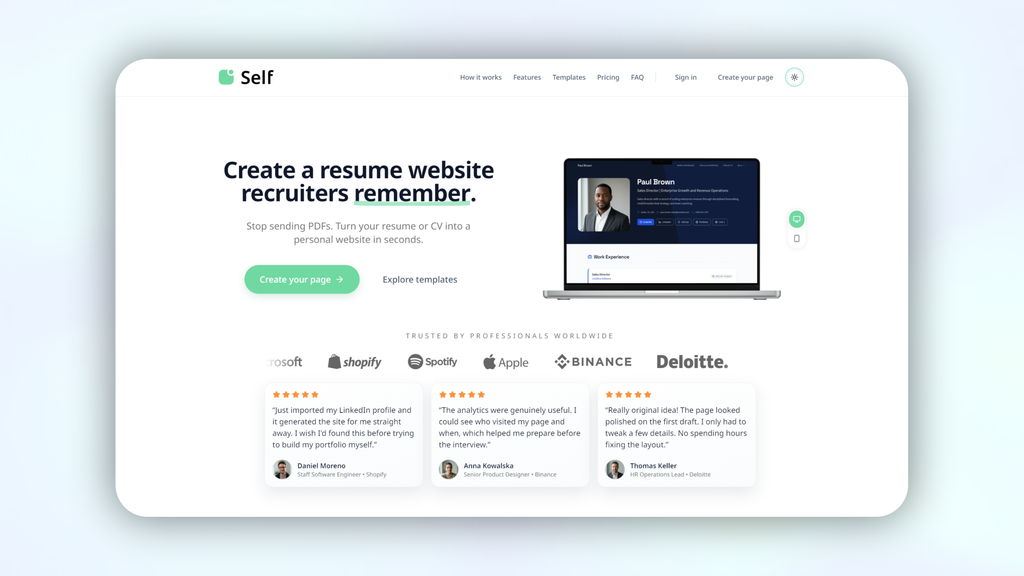
I built Self as one attempt to bridge the gap between a static CV and a general website builder.
It begins with career material a person already has, structures it into a responsive page and allows the person to review, edit and publish the result.
The page complements the formal CV rather than pretending to replace it.
That distinction matters.
A website cannot make an unsupported claim true, and a product cannot solve credential recognition on its own.
Portability depends on cooperation among individuals, employers, education providers, governments and software platforms.
The product is useful only if it reduces formatting work while preserving the person’s control and the reader’s ability to evaluate the evidence.
This is also why I am cautious about describing artificial intelligence as the answer.
AI can help translate unstructured material into a clearer format, but it can also make weak claims sound persuasive.
The engineering obligation is to preserve facts, show the source of important information and leave unresolved details unresolved.
Final Thoughts: What Needs to Change as Careers Evolve?
The need for portable professional identities will grow as the nature of work changes.
World Bank research on East Asia and the Pacific estimated that industrial robot adoption created about 2 million jobs for skilled formal workers and displaced approximately 1.4 million low-skilled formal workers across five ASEAN countries between 2018 and 2022.
The point is not that technology produces a tidy net gain.
It is that workers on opposite sides of this shift need different ways to make their current skills visible and connect new learning with past experience.
Employers can help by asking for evidence that travels: links to work, verifiable credentials and concise explanations of individual contributions.
Education providers can issue records that people can reuse outside their institution’s own portals. Regional bodies can extend recognition beyond the small set of regulated professions.
Product teams, meanwhile, can make export, access and user control core features rather than afterthoughts.
Professionals can begin more simply.
Keep a source record of projects, outcomes, credentials and links while the details are still fresh. Update it as the work changes.
Treat the CV as one view of that record, not as the record itself.
Asia’s economies are integrating while careers are becoming less linear.
If professional identity remains locked into static files and closed platforms, every move will continue to erase context.
A better system allows people to carry the evidence of their work, explain it to a new audience, and revise it without starting from zero.
That is the standard I wanted when my own CV stopped making sense, and it is the standard I now believe we should build towards.
About the Author
Javier Martínez Samblas is a software developer and founder and CEO of Self. His background spans software engineering, telecommunications, machine learning, computer vision, and scientific research, including scientific-engineering experience at Universidad Carlos III de Madrid (UC3M) and CERN.
LinkedIn: Javier Martínez Samblas
Highlights
- When My CV Stopped Telling the Whole Story
- What Scientific Engineering Taught Me About Evidence
- Why Career Mobility in Asia Makes Portability Essential
- Digital Credentials Are Only Part of the Solution
- Four Principles for a Portable Professional Identity
- Building Self: An Experiment in Professional Portability
- Final Thoughts: What Needs to Change as Careers Evolve?
Read the Chinese article here.