
A study commissioned by the Singapore Business Federation, the Restaurant Association of Singapore, and the Singapore Retailers Association projects that Singapore residents will spend an additional S$1.05 billion annually in Johor Bahru once the Johor Bahru–Singapore Rapid Transit System (RTS) Link begins operations. The line is now in its final integration testing stage between Singapore and Malaysia, with passenger service still targeted for January 2027.
Visitors from Johor Bahru are also expected to spend an additional S$756 million in Singapore, leaving a net outbound spending increase of around S$290 million a year. That represents roughly 0.4% of Singapore’s total retail and F&B sales in 2025 — hardly an existential threat by itself, but significant enough that Singapore’s own retail and restaurant industry bodies commissioned the research and publicly highlighted its findings.
That alone makes the report worth paying attention to.
Not because Singaporeans shopping across the Causeway is new. It isn’t. What is changing is how easily crossing the border could fit into ordinary life.
The instinctive explanation for Singaporean spending in Johor has always been simple: Malaysia is cheaper. But price alone increasingly feels insufficient to explain what is happening.
Highlights
- If Malaysia Is Becoming Less Cheap, Why Are Singaporeans Expected to Spend More?
- The Hidden Cost of Going to JB Was Never Just Travel Time
- Five Minutes Gets the Headlines. Predictability May Matter More.
- More Passengers Won’t Automatically Mean More Customers
- The RTS Could Remove One Friction — And Expose All the Others
- But What Happens If Johor Starts Optimising for Singaporeans?
- Final Thoughts: The Bigger Question Isn’t Where S$290 Million Goes
If Malaysia Is Becoming Less Cheap, Why Are Singaporeans Expected to Spend More?
If exchange rates were the only driver, the strengthening of the Malaysian ringgit against the Singapore dollar in 2026 might have been expected to weaken some of Johor Bahru’s appeal. Instead, the study projects cross-border spending to increase further once the RTS begins operating.
Part of the explanation lies in what Singaporeans are expected to spend on.
The projected outflow is concentrated in groceries, pharmacies and drug stores, dining, and beauty services. These are not once-a-year purchases or tourist splurges. They are recurring household expenses — the things people build routines around.
There is a meaningful behavioural difference between saying, “Let’s spend the weekend in JB,” and organising a Saturday around groceries, lunch, a haircut and a pharmacy run. In the second case, the border has not disappeared, but it has become less important to the consumer’s decision.
The geographical impact within Singapore reinforces the point. Retailers and F&B operators in the west, north, north-east and east are expected to see the greatest net outflow, while Singapore’s central districts could actually gain from Johor Bahru visitors spending on premium retail, entertainment and dining.
So this is not simply a story of Singapore losing and Johor winning. Different businesses, categories and neighbourhoods will experience the shift differently.
The exchange rate may have made Johor attractive. What the RTS potentially changes is something else: the economics of time and, perhaps more importantly, the economics of uncertainty.
The Hidden Cost of Going to JB Was Never Just Travel Time
Andrew Khoo, Executive Chairman and Group CEO of MUI Group, has watched the relationship from both sides of the Causeway. Before taking on MUI’s retail, hotel and F&B portfolio in Malaysia, he ran F&B operations in Singapore as COO of Swensen’s.
“When I was running F&B operations in Singapore, a trip to Johor Bahru had to be worth the effort,” he says. “You had to factor in the traffic, immigration queues and uncertainty over when you would get home. That friction mattered.”
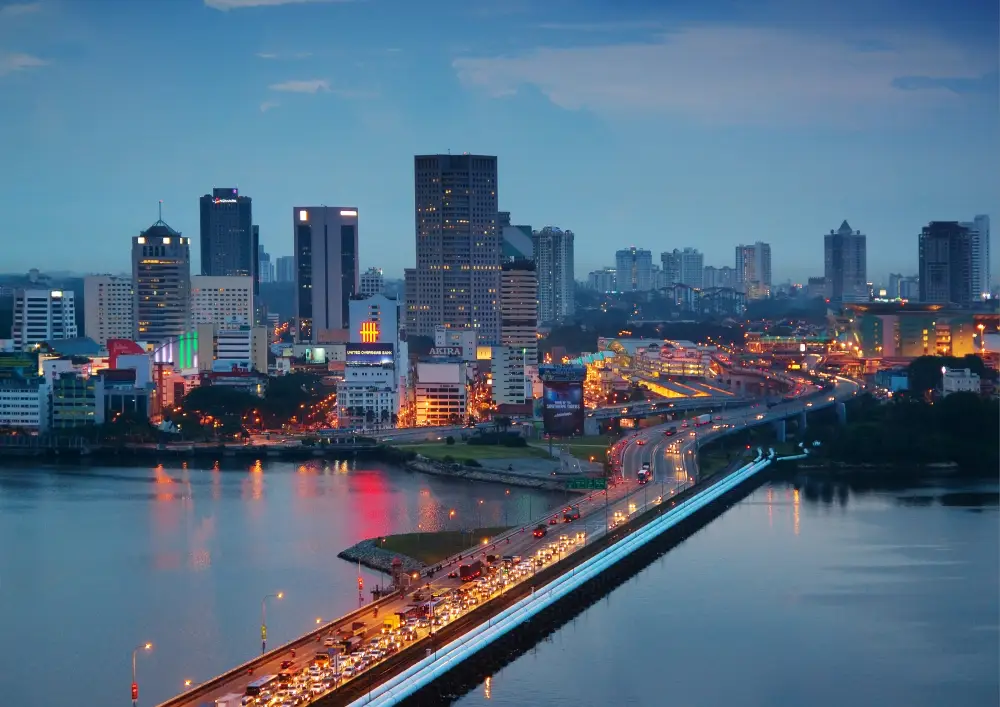
Singapore residents already make an estimated 19.4 million round trips to Johor Bahru each year, according to the study. Its base case projects that the RTS Link could add another 11.2 million — an increase of 51%.
“The RTS is not creating a completely new consumer behaviour,” Andrew says. “It is making an existing behaviour easier and potentially much more frequent.”
Five Minutes Gets the Headlines. Predictability May Matter More.
The Land Transport Authority has said the train journey between Woodlands North and Bukit Chagar should take around five minutes, with passengers clearing both Singapore and Malaysian immigration at their point of departure. The SBF study estimates average RTS ridership of around 39,700 trips a day.
Five minutes makes for an eye-catching number. Predictability may prove more consequential.
People can build routines around journeys they know they can complete with reasonable certainty. A trip that once had to justify the possibility of a long traffic jam or immigration queue starts looking different when its travel time becomes easier to plan.
Andrew believes that could move some Johor trips from occasional excursions towards monthly or even weekly routines. But he is careful not to overstate the shift.
There will still be bargain hunting, particularly when exchange rates favour Singaporean visitors. Even before the RTS opens, the study estimates Singaporeans already spend around S$1.7 billion annually in Johor Bahru, compared with approximately S$1.3 billion flowing in the opposite direction.
Currency still matters. It simply isn’t something businesses can build a lasting strategy around.
“A weaker ringgit is not a business strategy,” Andrew says.
More Passengers Won’t Automatically Mean More Customers
For businesses, Andrew argues, the biggest mistake would be assuming that increased cross-border traffic automatically translates into customers.
If someone in Singapore starts considering a Johor restaurant, retailer, salon or other service as part of their normal spending habits, businesses have to think about the entire journey rather than simply what happens after that person walks through the door.
Can customers check whether a product is in stock before leaving Singapore? Can they reserve it in advance? Are payments straightforward? Can an appointment reliably finish on time? And what happens if someone needs to return a purchase after crossing back into Singapore?
Businesses could also have to rethink staffing, inventory and opening hours around more predictable cross-border peaks, particularly on weekends, public holidays and evenings. Locations near transport nodes may compete on speed and convenience; destinations farther away will need to offer an experience compelling enough to justify the additional journey.
The RTS Could Remove One Friction — And Expose All the Others
As the inconvenience of crossing the border falls, consumers may become less tolerant of inconvenience once they arrive.
A five-minute train journey means less if the product someone travelled for is out of stock. A predictable crossing is less valuable if an appointment runs an hour late. And lower prices lose some of their appeal if the experience is unreliable.
In that sense, the RTS could shift some of the competitive burden from the journey to the businesses at the other end of it. Problems once overshadowed by Causeway traffic — stock availability, queues, service consistency, booking systems and returns — become harder to overlook when getting there is easier.
For Andrew, the measure that matters isn’t how much a Singaporean customer spends on their first visit.
It’s whether they come back.
But What Happens If Johor Starts Optimising for Singaporeans?
There is another risk in viewing the projected S$1.05 billion purely as an opportunity to capture Singaporean spending.
If businesses in Johor respond to increased Singaporean demand by raising prices, prioritising visitors or designing their offering primarily around cross-border traffic, they risk weakening the local customer base that sustains them every day.
Andrew says pricing should remain transparent and consistent, avoiding anything resembling “tourist pricing.” More importantly, Malaysian customers should not feel displaced or treated as less important because more Singaporeans are arriving.
That complicates the idea that Singapore and Johor are simply becoming one consumer market.
Prices, incomes, customer expectations, competitive conditions and the effects of increased cross-border spending remain different on each side. Even within Singapore, the study suggests the impact will vary significantly by geography and retail category.
What may be emerging instead is a more integrated consumer corridor: two distinct markets in which a growing number of people are increasingly comfortable organising parts of their lives across both.
Andrew’s approach is to build businesses that Malaysians genuinely want to visit while making the same experience convenient and relevant for Singaporean customers. The opportunity is not necessarily to redesign Johor around Singaporean demand, but to build businesses strong enough locally to appeal across the Causeway too.
Final Thoughts: The Bigger Question Isn’t Where S$290 Million Goes
The S$290 million net spending outflow will understandably attract attention in Singapore. But it may not be the most consequential number in the study.
The bigger question is what happens when an international border becomes predictable enough to fit comfortably into an ordinary day.
For years, the price difference helped make Johor Bahru attractive to Singaporeans. The RTS cannot guarantee that people will spend more, nor can it guarantee that individual businesses will benefit. What it can do is remove some of the time and uncertainty that previously made frequent trips harder to justify.
If crossing into Johor becomes easy enough to combine groceries, a meal, a haircut and a pharmacy visit in a predictable afternoon, the trip begins to look less like tourism and more like everyday consumption.
And once consumers begin organising parts of their lives around a Singapore–Johor corridor, businesses on both sides face a different competitive question.
It is no longer simply whether they are cheaper than the alternative across the border.
It is whether they are worth crossing for — and dependable enough to keep crossing for.
Highlights
- If Malaysia Is Becoming Less Cheap, Why Are Singaporeans Expected to Spend More?
- The Hidden Cost of Going to JB Was Never Just Travel Time
- Five Minutes Gets the Headlines. Predictability May Matter More.
- More Passengers Won’t Automatically Mean More Customers
- The RTS Could Remove One Friction — And Expose All the Others
- But What Happens If Johor Starts Optimising for Singaporeans?
- Final Thoughts: The Bigger Question Isn’t Where S$290 Million Goes
Read the Chinese article here.
Related posts:
 Indonesians Are Rethinking Ramadan Spending — And Discounts Aren’t the Answer
 The Hidden Reason Global Brands Fail in Korea and How One Expert Fixes It
 Singapore or Australia? Why APAC Expansion Starts with Traction, Not a Regional Headquarters.
 Uncertainty Isn’t Just Testing Indonesia’s Consumers. It’s Testing the Companies Selling to Them.