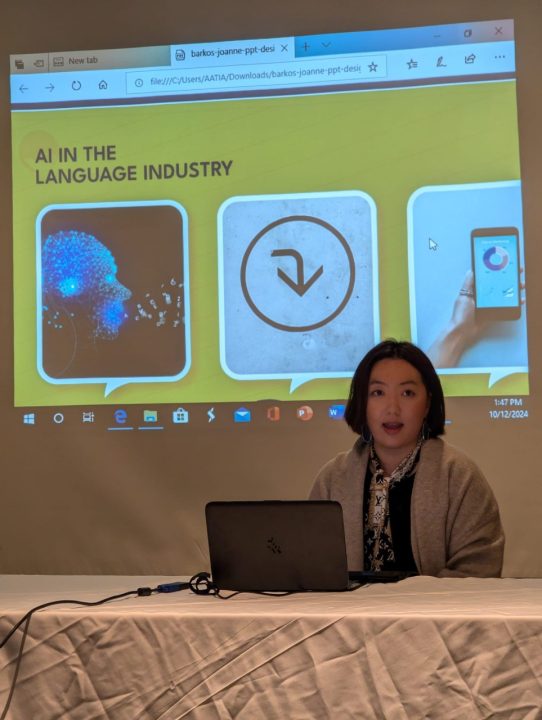
If you’ve ever wondered why global companies struggle to break into Korea despite strong products, Joanne (Chaewon) Kim has the answer — and it’s not just language.
A trilingual expert in Korean market strategy, Joanne has helped European startups generate seven-figure revenue and top rankings in Korea through culturally intelligent localization.
As the founder of Barkos and Business Development Manager at MAF, she brings together sales acumen, linguistic expertise, and deep empathy for local nuance. In this conversation, Joanne breaks down the invisible mistakes brands make, the power of localization done right, and how culture drives conversion.
Highlights
What Companies Get Wrong in Their First 90 Days
Q: You’ve helped global companies like MAF enter the Korean market with real revenue impact. What do most companies get wrong in their first 90 days — and what should they focus on instead?
A: Many companies underestimate the importance of localization. Think about it — if a product in your market isn’t available in your language, would you really trust it enough to use or pay for it? Probably not.
The challenge is that localization isn’t just about translation. It encompasses everything — the product, customer support, tools, tone, and even how your messaging feels. And that’s not something you can “figure out” within the first 90 days.
If I were to give concrete advice, I’d say companies should:
- Align terminology early across teams.
- Translate key content, including website, FAQs, and user journeys.
- Localize product strings before launch.
Without these basics, any marketing or business development activity in Korea will likely be a waste of time.
The Invisible Layers of Culture
Q: You often advocate for “cultural intelligence” in localization. Beyond language, what invisible layers do companies need to navigate to build trust and traction in Korea?
A: Korean communication is highly contextual and nonverbal. People often express disagreement or hesitation indirectly — through facial expressions, tone, or polite phrases like “We’ll think about it,” which might actually mean “No.” Westerners often miss these cues and end up pushing too hard, which can backfire quickly.
Also, trust isn’t given immediately. Koreans won’t open up or make commitments until a relationship has been built. Cold calls usually don’t work here. Cold emails can work — but only if they’re localized and supported by a Korean-language website or materials that show credibility.
Simply put: before trying to sell, invest time in relationship-building and localization. Otherwise, even the best product will fail to gain traction.
Turning Localization into Strategy
Q: You’ve worked across localization, marketing, and business development. How do you align these functions so localization isn’t siloed — but actually drives strategy?
A: That’s one of the hardest challenges I see. Many small or scaling companies treat localization as an afterthought — something to “add on” once marketing or sales begin. But if you plan to go global, localization isn’t optional — it’s a must.
Localization should come before market entry, not after. It’s what determines whether users even give your product a chance. You don’t need to localize everything at once, but you do need a clear system: aligned terminology, tone guidelines, and a shared understanding of what your brand sounds like in the target language.
When localization informs marketing and sales from the beginning, it stops being a cost center and starts becoming a growth engine.
Translating More Than Words
Q: From your work with Barkos and MAF, what’s your process for translating not just words, but intent and tone — especially when adapting Western content for Korean users?
A: My process is hybrid. I start with AI-assisted translation to generate a rough draft, then I refine it manually for tone and context.
There are three main steps I follow:
- Check terminology consistency. AI often misses industry-specific terms, so I correct and align them with client glossaries.
- Adjust tone. AI translations can sound overly formal or robotic. I make sure the content sounds natural and culturally appropriate for Korean audiences.
- Polish punctuation and expression. For instance, excessive exclamation marks or quotation marks — common in Western marketing — can feel awkward in Korean. I tone those down and find subtler ways to convey enthusiasm.
Ultimately, good localization is about making readers feel like the message was written for them, not just translated to them.
How to Enter Korea in 2026
Q: If a founder or startup wants to enter Korea in 2026, what 1–2 strategic moves would you tell them to prioritize from day one — based on everything you’ve seen go right (and wrong)?
A: First, understand the market deeply. It sounds cliché, but it’s true. Attend local events, talk to industry peers, and observe how consumers behave. Korea moves fast, and trends change quickly. Without that local awareness, you’ll always be one step behind.
Second, prioritize customer experience from day one. In Korea, first impressions spread quickly — both good and bad. If users have a negative experience early on, recovery is nearly impossible. Exceptional service and responsiveness build credibility faster than any ad campaign.
So, my two rules: know your market, and take customer feedback seriously. That’s how sustainable growth begins.
Final Thoughts: Crossing Borders, Building Bridges
Over the last several years, Joanne has worked with more than 50 clients across 12+ countries — from Asia and Europe to Australia and the Americas. Her career is a testament to the power of localization as a business strategy.
At MAF, she led the Korean market entry from the ground up, driving over $2 million in revenue in the first year, retaining key enterprise clients, and boosting brand awareness by 400% through targeted press and events.
But her impact goes beyond metrics. Whether she’s translating a product interface or speaking on international panels, Joanne’s mission remains consistent: to help stories and services cross borders with empathy and clarity.
For founders eyeing Korea in 2026 and beyond, her message is simple — localization is not a checkbox. It’s your competitive edge.
Highlights
Read the Chinese article here.