Singapore has spent the last few years building itself into a hub for AI and deep-tech innovation. But for three founders working at the intersection of technology and care, the harder and more important question isn’t how much AI Singapore can build. It’s the problems that AI is actually pointed at.
As the Singapore Centre for Social Enterprise (raiSE) puts it, some of the greatest opportunities lie in applying AI in ways that strengthen people and organisations rather than simply cutting costs or automating existing work. That distinction matters across industries, with some examples showing themselves in healthcare, eldercare, rehabilitation, and social services, where technology has to contend with complex workflows, human relationships, and the realities of the communities it is meant to serve.
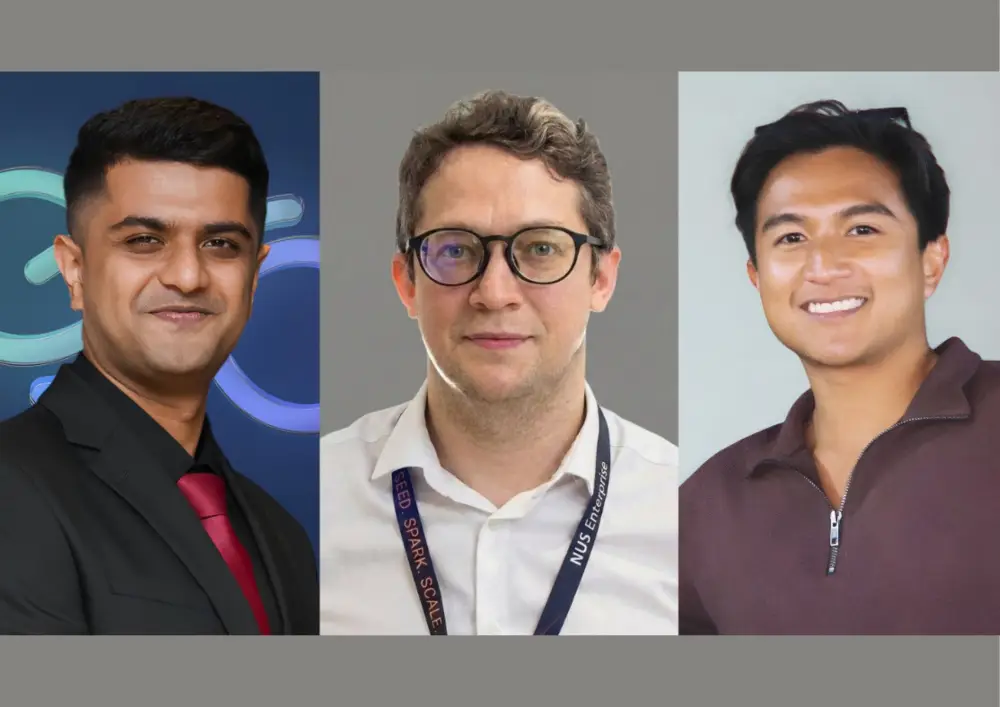
We spoke with founders from three organisations confronting those realities from different directions: Ryan Sacatani, Co-founder and COO of AdminLess AI; Volodymyr Iermolaiev, CEO and Co-founder of Ajentik AI; and Ajinkya Bhat, Founder and CEO of Seamless XR.
Across social service administration, eldercare coordination, and stroke rehabilitation, their experiences raise a more useful question than what AI can do: what has to happen before people actually trust it enough to use it?
Highlights
- What Happens When You Build the AI First?
- The Problem Has to Hurt Before the Technology Matters
- Trust Isn’t an AI Problem. It’s a Workflow Problem.
- If Users Have to Fight the Technology, You’ve Already Lost
- Efficiency Isn’t Impact. What Happens With the Time You Save Is.
- What If Success Means the AI Becomes Invisible?
- Singapore’s AI Opportunity: Putting Human Needs at the Centre.
What Happens When You Build the AI First?
AdminLess AI’s clarity on this point came from getting it wrong first.
Its original product was an AI assistant sold to small law firms. It had paying customers, but the team observed that customers continued paying each month without meaningfully changing how they worked. The experience highlighted a fundamental problem: the company had built something for a market, then gone looking for people to fit it.
That experience reshaped how AdminLess AI now approaches its work with Social Enterprises and social service organisations, such as SG Assist in eldercare and PPIS in its work empowering women in the Malay-Muslim community.
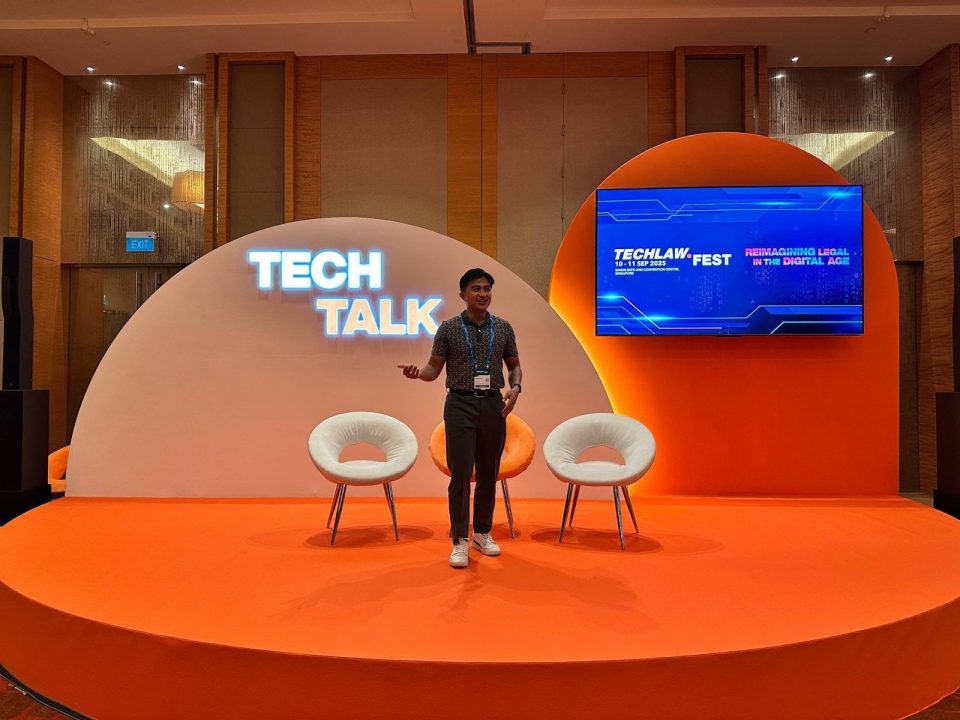
AdminLess AI no longer provides off-the-shelf products. Instead, the team builds around each organisation’s actual workflow, with the organisation owning what gets built. AdminLess AI points to organisations previously spending around S$5,000 a month in licence fees for systems that only partially fit their needs. The company says AI has dramatically reduced the cost of developing software tailored to those workflows.
Its test for genuine social innovation is simple:
“Do you start from their problem, or with your own capability? If AI is not the answer for a workflow, we don’t use it.”
The Problem Has to Hurt Before the Technology Matters
For Volodymyr, the starting point at Ajentik AI was personal before it was professional.
He describes living the reality of the “sandwich generation,” struggling to bridge clinical information between home and health systems. His co-founders encountered the same broader problem from different directions: Jefri, after more than a decade in healthcare, watching clinician burnout affect elder care, and Pei Yi, during her medical school geriatrics rotation, where she saw clinicians spending hours reactively gathering information from caregivers.
That collective frustration led to Elderwise, Ajentik’s voice AI designed to help scale Comprehensive Geriatric Assessments (CGAs). Volodymyr describes CGAs as a gold standard that has been shown to improve outcomes for elderly patients, but one that is difficult to make widely accessible because of the clinician time involved.
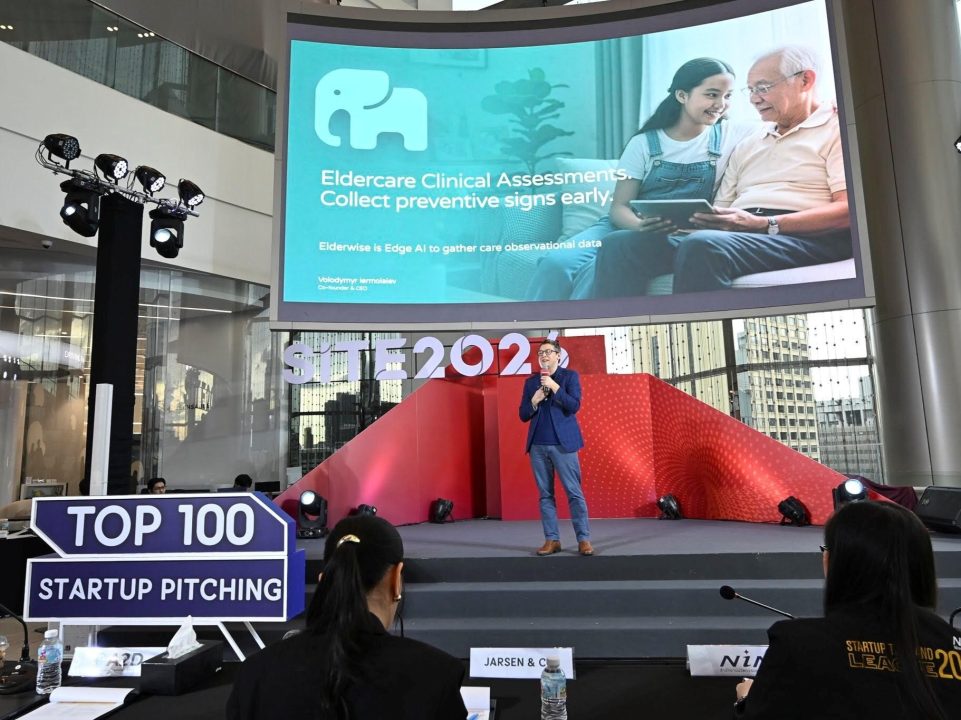
“Technology alone isn’t the hero here; the human connection is,” Volodymyr says.
For Ajentik AI, that means thinking beyond data collection. Building voice AI for middle-aged and older caregivers also requires designing for empathy, tone, patience, and multilingual support.
Ajinkya’s path to Seamless XR began with his PhD research at the National University of Singapore, but the direction of the product came from occupational therapists.
During discovery, his team asked therapists a simple question: if they could solve one problem for them today, what would it be?
The answer centred on stroke patients who had lost sensory function. Clinicians lacked an objective way to reliably track whether, or how quickly, that sensation might recover. At the same time, public healthcare providers were dealing with another problem: sensory loss could be underdiagnosed because standard-of-care testing was manual, subjective, and difficult to fit into the schedules of clinicians who, Ajinkya says, may see 16 to 20 patients a day.
“We never set out to build an ‘AI-powered’ solution,” Ajinkya says. “The algorithm was developed in that direction because we understood the core bottleneck was the need for a clinician to administer the test.”
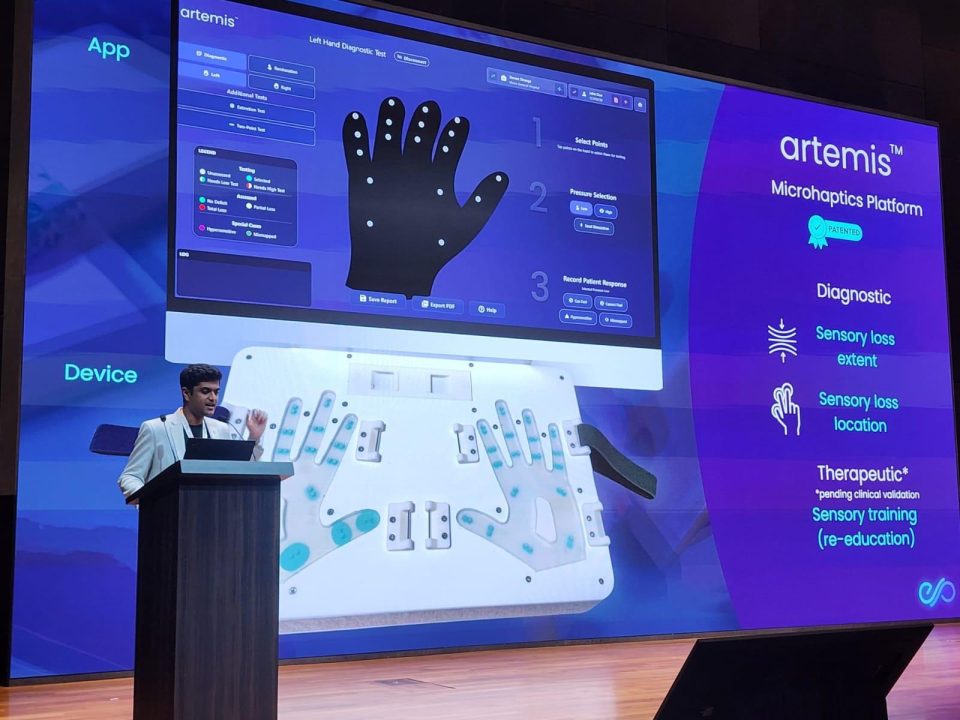
That bottleneck led to Artemis, Seamless XR’s sensory deficit assessment platform. The device is designed to automate assessment and generate an objective report without requiring a clinician to administer the test, opening the possibility of point-of-care use where clinicians may not be available.
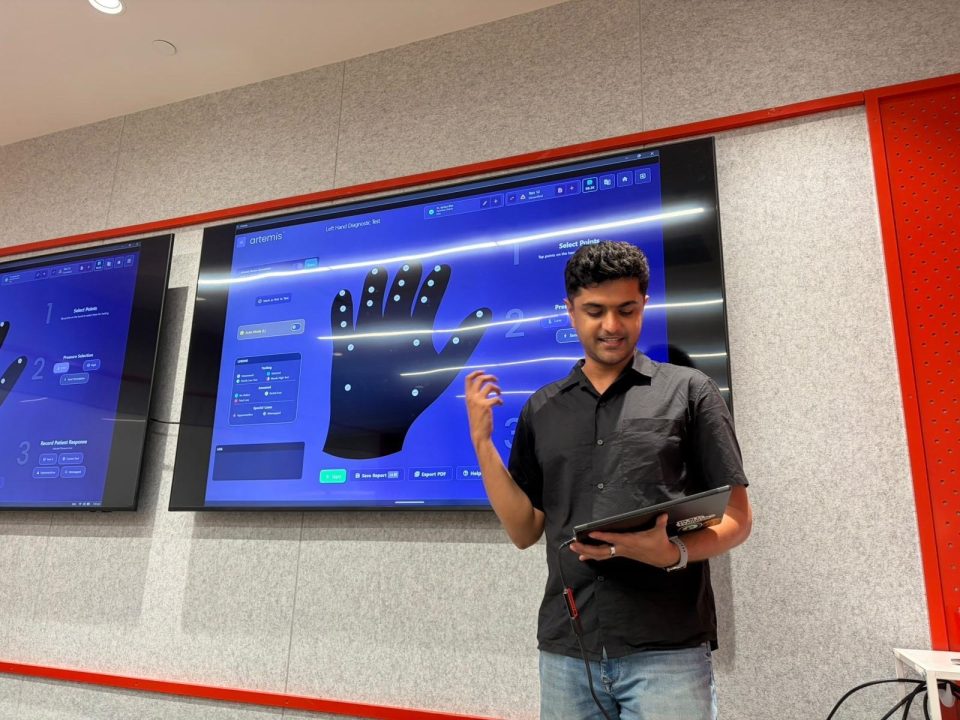
Seamless XR is also studying an intervention mode of Artemis at Ng Teng Fong General Hospital (NTFGH), using visual feedback and tactile stimulation to support sensory rehabilitation for stroke patients.
Ajinkya sums up the philosophy behind it:
“You have to start with the problem and keep it at the centre of everything you build. AI is an add-on: sometimes a feature, sometimes a workflow improvement, but rarely the actual core of what makes a product valuable.”
Trust Isn’t an AI Problem. It’s a Workflow Problem.
For AdminLess AI, one of the biggest lessons was that paying for technology and actually using it are two very different decisions.
“In professional services, your process is your risk management. Every step exists because someone got burned once without it. Asking someone to change their workflow is not asking them to try a tool. It is asking them to take on unfamiliar risk on work they are personally accountable for.”
In the social sector, the team encountered a different assumption: many organisations had never considered that they could own software built specifically around their processes, rather than rent someone else’s system and work around its limitations.
When AdminLess AI tells an organisation that it will build around its existing process and that the organisation will own what is created, the team says the conversation changes.
For AdminLess AI, trust doesn’t come from explaining the AI model. It comes from starting with routine administrative work people already don’t want to do, keeping humans involved in decisions that matter, and delivering something small quickly enough for users to see it working in their own day-to-day cases.
If Users Have to Fight the Technology, You’ve Already Lost
Ajinkya’s team at Seamless XR took an equally hands-on approach.
Occupational therapists at NTFGH allowed the Seamless XR team to shadow them for an entire day, observing workflows across acute care, outpatient care, and the community hospital next door.
That exposure directly reshaped Artemis. An early version of the device assessed touch sensation at 80 points on each hand. Based on clinician feedback, the team reduced this to 18 points per hand — enough, Ajinkya says, to provide clinically relevant information within the time constraints of an actual rehabilitation session.
With patients, the challenge was different: the automated diagnostic interface had to be simple enough to use independently in community settings.
Ajinkya says Seamless XR has stress-tested the interface with users as old as 92, using large buttons, an obvious touchscreen interface, and minimal complexity. Some users, Ajinkya says, ended up treating the experience almost like a game.
“I believe largely that the technology needs to stay hidden,” he says. “What matters is the experience, not how it works under the hood.”
The stakes of that simplicity become clearer in community care. Ajinkya says voluntary welfare organisations they spoke with reported therapist-to-patient ratios as stretched as one to 100, or even one to 150. Ajinkya believes a new tool, therefore, needs to be learnable within roughly 15 to 30 minutes and usable immediately.
Ajentik faced a related challenge with caregivers. Its user interviews suggested that middle-aged and older caregivers weren’t necessarily resistant to technology; complexity was often the real barrier.
Rather than requiring another app, a clinician can send an Elderwise link through WhatsApp, SMS, or email. The caregiver opens it in a browser and speaks naturally to the AI. The information is returned to the clinician as a structured summary, while the family receives a separate, easier-to-understand report.
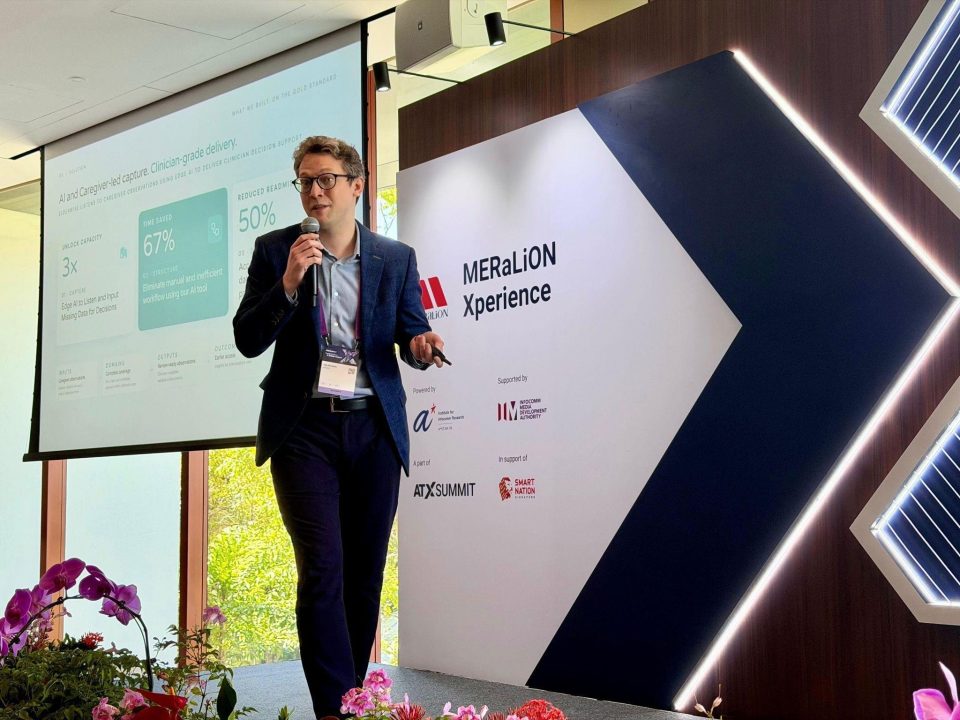
“If we force a busy clinician or an exhausted caregiver to learn a complicated new tool, we’ve failed,” Volodymyr says. “The goal is to lift their burden, not add to it.”
The approaches differ, but the lesson is similar: adoption depends less on persuading people to embrace AI than on asking as little as possible of them in return.
Efficiency Isn’t Impact. What Happens With the Time You Save Is.
Asked to imagine this conversation five years from now, none of the three founders reached for growth metrics first.
For AdminLess AI, business growth would show that it had built a successful company. Three other outcomes would show that it had changed something.
First, the systems would still be running five years later without AdminLess AI. A piece of software abandoned after a successful-looking pilot, the team argues, is still a failure.
Second, the hours saved would translate into more people being helped.
“Efficiency is not the outcome; it is the input.”
If a team gets 20 hours a month back, the question that matters is what it can do with that time.
Third, programmes would survive because organisations could better demonstrate their impact. AdminLess AI points to social-sector programmes whose evidence can remain scattered across inboxes and spreadsheets even as annual funding decisions determine whether their work continues. If better systems can show funders what is actually working, the company sees that as an impact capable of outlasting AdminLess AI itself.
“For the caregiver or the family at the end of it, success is that none of this is visible to them at all. They are simply seen sooner by someone who is no longer half-buried in paperwork.”
What If Success Means the AI Becomes Invisible?
Volodymyr imagines success as three broader shifts across the care sector.
The first is perception: AI in healthcare becomes a trusted, largely invisible bridge connecting hospitals, communities, and homes.
The second is collaboration. Healthcare clusters, community providers, and health-tech innovators would work through more open and connected ecosystems rather than isolated silos.
The third is ultimately human: clinicians would spend less time on paperwork and more time delivering compassionate care, while caregivers would no longer carry the same isolating mental load of coordinating care alone.
“When aging in place with dignity becomes the default reality for families,” Volodymyr says, “that’s when we’ll know we genuinely moved the needle for society.”
Ajinkya’s five-year measure is more directly tied to patient recovery.
According to an interim report from Seamless XR’s second clinical trial at NTFGH, cited by Ajinkya, one patient entered the trial with no sensation on her left side at baseline. After 10 sessions—three sessions a week across approximately three and a half weeks—she was able to feel sensation across 70% of her palm and the lower proximal parts of her fingers.
The result represents an early individual patient outcome from an ongoing trial, rather than evidence of broader clinical efficacy, but for Ajinkya, it illustrates what the work is ultimately trying to achieve.
“That result is what gets us up in the morning,” he says.
He sees a larger access challenge behind that individual outcome. Ajinkya argues that patient volumes are growing faster than the healthcare labour force and physical infrastructure can scale, pushing more rehabilitation from acute-care hospitals into community settings. Yet those settings may not have enough skilled clinicians to deliver rehabilitation at the frequency patients need.
For Seamless XR, the long-term ambition is to help close that gap without requiring the physical workforce to expand at the same rate.
Singapore’s AI Opportunity: Putting Human Needs at the Centre.
Taken together, these experiences sharpen raiSE’s broader perspective about applying AI around human needs rather than treating automation itself as the outcome.
A law firm can pay for AI and barely use it. A 92-year-old can engage with a sensory assessment when the interface asks almost nothing unfamiliar of them. An exhausted caregiver can provide information without downloading another app. And a social service organisation can use time recovered from administrative work to reach someone sooner.
The common denominator isn’t the sophistication or visibility of the AI. It’s whether the technology removes a meaningful constraint.
That may be the more consequential opportunity for Singapore’s AI ecosystem: not simply building more AI, but applying it where it can expand access, return scarce time to people and organisations, and support work that remains fundamentally human.
About the Founders
Ryan Sacatani, Co-founder and COO, AdminLess AI
LinkedIn: Ryan Sacatani | AdminLess AI
Volodymyr Iermolaiev, CEO and Co-founder, Ajentik AI
LinkedIn: Volodymyr I. | Ajentik AI
Ajinkya Bhat, Founder and CEO, Seamless XR
LinkedIn: Ajinkya Bhat | Seamless XR
Highlights
- What Happens When You Build the AI First?
- The Problem Has to Hurt Before the Technology Matters
- Trust Isn’t an AI Problem. It’s a Workflow Problem.
- If Users Have to Fight the Technology, You’ve Already Lost
- Efficiency Isn’t Impact. What Happens With the Time You Save Is.
- What If Success Means the AI Becomes Invisible?
- Singapore’s AI Opportunity: Putting Human Needs at the Centre.
Read the Chinese article here.