




Indonesia has spent years looking forward to the economic opportunity of its demographic dividend. But what if one version of that dividend is already behind us?
A recent discussion around Indonesia’s population pyramid offers an early glimpse of what demographic change can look like on the ground. Fewer children entering primary schools today could eventually mean fewer students in secondary schools and universities — and, later, smaller cohorts entering the workforce.
For businesses, that raises a bigger question than how many workers Indonesia will have.
What happens when Southeast Asia’s largest economy can no longer rely primarily on adding more workers, and instead has to generate substantially more value from each one?
Ahmad Ghifari Ammar A., Founder and Managing Director of Gandeng Foundation and a former product manager at Bukalapak and Amartha, challenges a familiar assumption, in his July 2026 essay, Generations of Sandwich Generations: An Indonesian Generational Ledger.
Indonesia may still appear to enjoy a demographic dividend by conventional population measures, while another way of measuring economic production suggests the advantage has already started to decline.
For businesses, the implication is straightforward: workforce strategy will increasingly need to focus not only on finding enough people, but on increasing the productive capacity of the people already available.
That puts technology, skills, workforce participation and longer productive careers into the same conversation — not simply as labor issues, but as ways of increasing how much economic value Indonesia’s workforce can create.
Highlights
- One Demographic Dividend, Two Ways of Looking at It
- When One Generation Gets Squeezed From Both Sides
- The Hidden Productive Capacity Indonesia Already Has
- Why AI Becomes a Demographic Question
- Preparing Before the Pressure Becomes Obvious
- What This Changes for Business Leaders
- Toward 2045, Indonesia’s Next Dividend Could Be Productivity
One Demographic Dividend, Two Ways of Looking at It
The demographic dividend is commonly understood through the dependency ratio: the number of children and older people relative to the working-age population.
Ahmad cites BPS data showing Indonesia’s dependency ratio bottomed at 44.33% in 2020 and is projected to rise to 49.91% by 2040, the final year it remains below 50.
By that measure, Indonesia still has time.
But Ahmad highlights another framework: National Transfer Accounts (NTA).
Rather than simply separating people into working-age and dependent groups, NTA examines how much people produce and consume throughout their lives. People consume at every age, but their capacity to generate labor income changes substantially.
Drawing on analysis from Bappenas, UNFPA and UNICEF, Ahmad notes that an Indonesian child aged 0–19 has an average annual lifecycle deficit of around Rp36 million. An adult aged 20–60 generates a surplus of around Rp17 million a year, while someone aged 61 or above has a deficit of approximately Rp22 million annually.
The important distinction is that being “working age” does not automatically make someone an effective economic producer.
According to the analysis Ahmad cites, Indonesia’s NTA-based support ratio began declining in 2024.
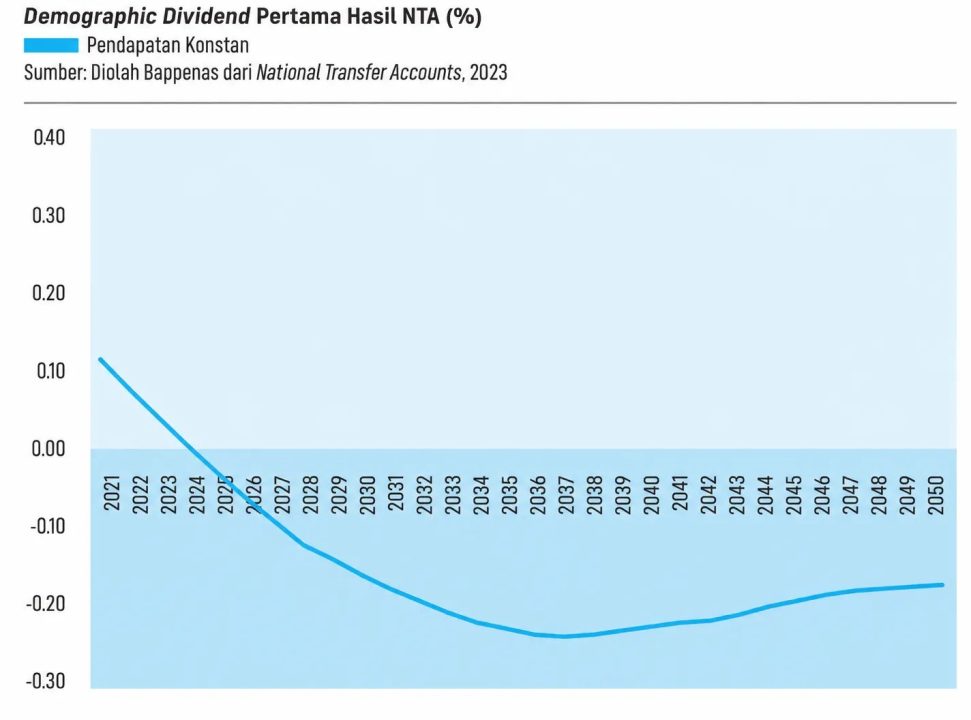
So while Indonesia can still have a favorable ratio of working-age people to dependents by headcount, the balance between effective producers and consumers may already be moving in the other direction.
When One Generation Gets Squeezed From Both Sides
If children and older people consume more than they produce, somebody has to finance the difference.
Ahmad identifies three broad sources: public transfers, private transfers between family members, and accumulated assets or savings. But those buffers remain limited.
He notes that only around one in eight elderly Indonesians has any pension, while approximately 86% lack adequate access to old-age savings. Among the people expected to support them, Ahmad cites figures showing 58% of workers are informal, while almost half of working-age women remain outside the labor force.
For many families, that leaves today’s workers in the middle.
A worker may simultaneously finance a child’s education, contribute to an aging parent’s healthcare and living costs, pay taxes, and attempt to save for their own retirement.
Ahmad describes the potential result as an “intergenerational financial trap.” Workers supporting both younger and older generations may struggle to accumulate enough assets for themselves. When they eventually retire, they can become financially dependent on their own children — restarting the cycle.
There is also an important difference between Indonesia’s past and future dependency burdens. Historically, a large proportion of dependents were children, who could eventually become workers and producers. As Indonesia ages, a larger share of the burden shifts toward older people.
The Hidden Productive Capacity Indonesia Already Has
Increasing productive capacity does not necessarily mean asking existing employees to work longer or harder. It also means looking at how much potential within the workforce is currently being used.
Ahmad notes that Indonesians only begin generating a lifecycle surplus at around age 25. Earnings peak at approximately 42, before people return to deficit at around 57.
The economically surplus-producing window can therefore be considerably narrower than the conventional working-age definition of 15–64.
One opportunity lies in participation.
Ahmad highlights women’s workforce participation in particular. He cites research estimating that greater investment in childcare — from 0.04% to 0.5% of GDP — could add approximately US$62 billion to GDP, or 3.2% above business-as-usual, by enabling more women to participate in the workforce at rates closer to neighboring countries.
For businesses, this gives childcare support, flexibility and workforce design a broader significance: they can affect how much skilled talent can participate in productive work in the first place.
At the other end of the age spectrum, Ahmad points to a potential “silver dividend.”
Older Indonesians can continue contributing through employment, entrepreneurship, mentoring, caregiving and other activities when their health allows them to do so. The opportunity is therefore not simply extending working years, but extending healthy, productive years.
For employers, both ends of the age spectrum point to the same opportunity: widening the pool of people able to participate productively.
Why AI Becomes a Demographic Question
Ahmad places increasing production per person among the central responses to Indonesia’s demographic transition.
That gives AI, automation and digitalization a different strategic relevance for business.
The question is not merely whether technology can reduce costs. It is whether companies can use technology to generate more value from each worker.
Ahmad’s manufacturing discussion illustrates the broader productivity challenge. He notes that manufacturing’s contribution to Indonesian GDP has fallen from around 32% in 2002 to around 19% today. He also cites an estimate that nickel downstreaming requires around US$262,000 of investment for every job created, using it as an example of how investment does not always translate proportionally into employment.
Technology is only one part of that equation, alongside skills, management practices and access to productive employment.
For CEOs and founders, that changes the lens through which AI adoption can be viewed. Rather than focusing only on automation or headcount reduction, the more useful question may be:
How can technology amplify human productivity rather than simply replace human labor?
Preparing Before the Pressure Becomes Obvious
Ahmad groups the broader response into three levers: increase production, lower lifecycle consumption pressures, and finance the remaining deficit more sustainably.
The first involves productivity, workforce participation and longer productive lives. The second includes measures such as preventive healthcare, while the third involves building enough savings and assets to support consumption later in life.
Those accumulated assets can also contribute to what Ahmad describes as a second demographic dividend, becoming investment capital for the wider economy even as the original population-based dividend fades.
These shifts take time. For businesses, that makes demographic change less about predicting exactly when workforce constraints will arrive and more about strengthening productive capacity before they become obvious.
What This Changes for Business Leaders
For CEOs and founders, the starting point is not a demographic forecast, but an examination of where productive capacity is being lost or left unused inside the business.
Is technology genuinely increasing output per employee? Are workplace structures unnecessarily narrowing the available talent pool? Are experienced employees leaving productive work earlier than they need to? And is training increasing what employees can actually accomplish — rather than simply adding credentials?
Together, these questions point to a more fundamental one:
Is the business model dependent on continually adding people, or can it create more value from the people it already has?
Toward 2045, Indonesia’s Next Dividend Could Be Productivity
The end of a demographic dividend does not automatically mean economic decline. Ahmad cites an estimate that if labor income grows by around 0.2% more per year, Indonesia’s NTA-based demographic dividend could potentially be extended through 2032.
Looking toward 2045, this shifts the question from the size of Indonesia’s workforce to what that workforce is capable of producing.
For business leaders, the question is increasingly: How much value can each worker create?
For companies preparing for Indonesia’s demographic transition, the next advantage may come not from having more workers, but from enabling each worker to do more.
Editor’s note:
This article draws extensively on Ahmad Ghifari Ammar A.’s July 2026 essay on LinkedIn and Substack, “Generations of Sandwich Generations: An Indonesian Generational Ledger.” Ahmad is Founder and Managing Director of Gandeng Foundation and previously held product roles at Bukalapak and Amartha.
Highlights
- One Demographic Dividend, Two Ways of Looking at It
- When One Generation Gets Squeezed From Both Sides
- The Hidden Productive Capacity Indonesia Already Has
- Why AI Becomes a Demographic Question
- Preparing Before the Pressure Becomes Obvious
- What This Changes for Business Leaders
- Toward 2045, Indonesia’s Next Dividend Could Be Productivity
Read the Chinese article here.
Related posts:
 Life After Hotels: 9 Career Moves That Prove Hospitality Builds Elite Talent
 Singapore’s Medical Costs Are Rising 17% — But SMEs Face a Bigger Risk Than Premiums
 Degree Holders Are Facing More Retrenchments. Is Singapore’s Career Contract Breaking Down?
 If AI Replaces the First Job, Who Will Teach the Next Generation to Think?

