AI promises HR teams faster recruitment, automated screening, better reporting and less repetitive work. But adding AI to an inconsistent process doesn’t necessarily improve it. Sometimes, it simply makes the underlying problems more visible.
That was a lesson Huong Nguyen learned while working on AI enablement for a global technology company with more than 500 employees.
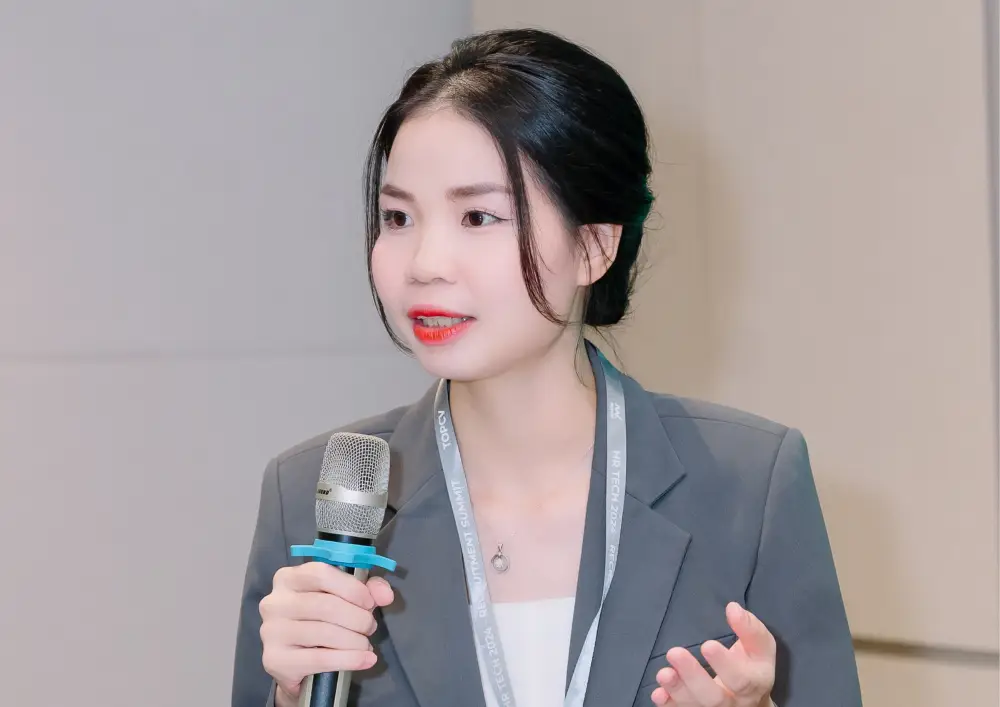
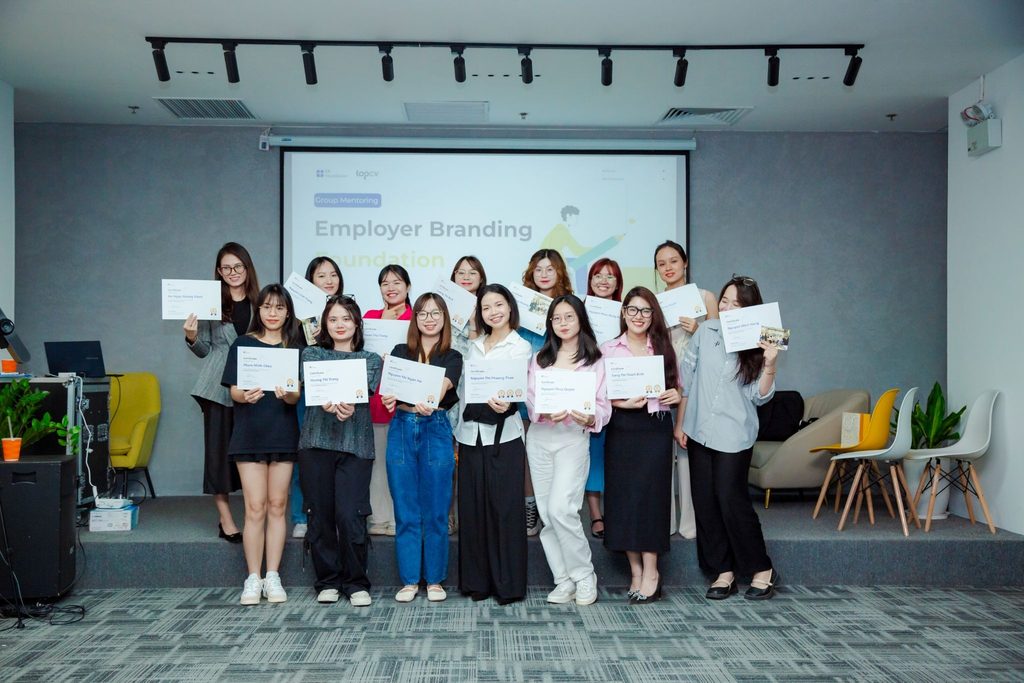
Huong has spent more than 11 years working in technology HR. Today, she is Country Talent Partner at DAPL IT Services and founder of EB Foundation, where she has trained more than 500 professionals across seven cohorts in employer branding. She is also pursuing an MBA in AI & Innovation at VinUniversity.
Having helped Creative Force triple its headcount and worked with Vietnamese CEOs exploring AI, Huong has become increasingly interested in what separates organisations that experiment with AI from those that turn it into a lasting capability.
Her experience suggests the answer has less to do with the number of tools a company adopts than with how well it understands its own work.
Highlights
- They Wanted Faster Recruitment. AI Exposed a Different Problem.
- They Fixed the Workflow. Then the Data Revealed Something Else.
- Vietnamese CEOs Are Eager to Experiment. But Is That Enough?
- The Feedback Was Polished. The Employee Still Felt Unheard.
- She Built Her First AI Assistant. Then Three or Four More Followed.
- Stop Asking Which AI Tool to Use. Find Where the Work Breaks.
- Final Thoughts: HR’s Next AI Skill May Have Little to Do With Prompting
They Wanted Faster Recruitment. AI Exposed a Different Problem.
The project began with a straightforward ambition: improve recruitment productivity.
Huong was working with the company’s Back Office team on AI enablement. The goal was to reduce the time spent screening CVs and evaluating candidates, automate parts of the recruitment journey, and make reporting faster and more efficient.
That meant exploring AI for content creation, attracting higher-quality candidates, screening, evaluation, and recruitment reporting.
Initially, the team assumed AI itself would deliver the productivity gains. The discussion focused on which tools could help generate more engaging content, improve candidate attraction, accelerate screening and produce better reports.
But as the project progressed, they discovered something more fundamental.
“The problem was not a lack of AI. The organisation was not working from a sufficiently consistent system in the first place.”
Different employees were performing similar tasks in different ways. Approvals were happening across Zalo, Messenger and Slack. Data was scattered across multiple locations and wasn’t clean enough to reliably support automation.
Even the company’s brand voice was less consistent than expected. External communication could vary depending on who was creating it.
The team realised that introducing more AI would not resolve those inconsistencies.
“At that point, we stopped trying to add more AI.”
Instead, they returned to the underlying processes: redesigning workflows, cleaning and structuring data, and standardising how the team worked.
Only after establishing that foundation did they begin incorporating AI into the workflow.
They Fixed the Workflow. Then the Data Revealed Something Else.
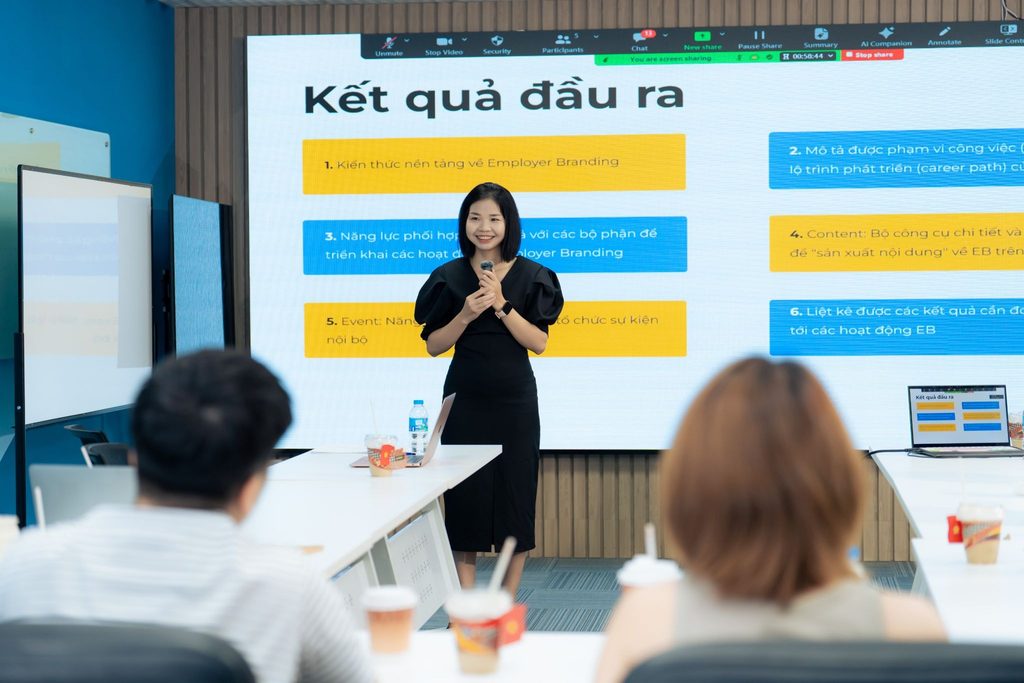
The results went beyond introducing new tools. Manual work decreased, productivity improved, and recruitment processes became more standardised. The team also became more capable of using AI in its daily work.
Improved recruitment and employee engagement dashboards began revealing insights that had previously been difficult to identify.
One outcome was particularly unexpected.
The project hadn’t originally been intended to redefine the company’s employer brand or brand voice. Yet the dashboards uncovered patterns in how employees experienced the organisation and what made it distinctive.
Those insights helped the company introduce new dimensions to its brand voice and develop a clearer, more differentiated identity.
For Huong, this was an important discovery: trying to automate an existing process can reveal problems and opportunities that weren’t visible before.
Her rule today is simple.
“Before you attach an engine, make sure the machine can run smoothly on its own.”
If every link in a workflow is unstable, she argues, AI will not magically fix it. It may simply make that instability faster and harder to manage.
Vietnamese CEOs Are Eager to Experiment. But Is That Enough?
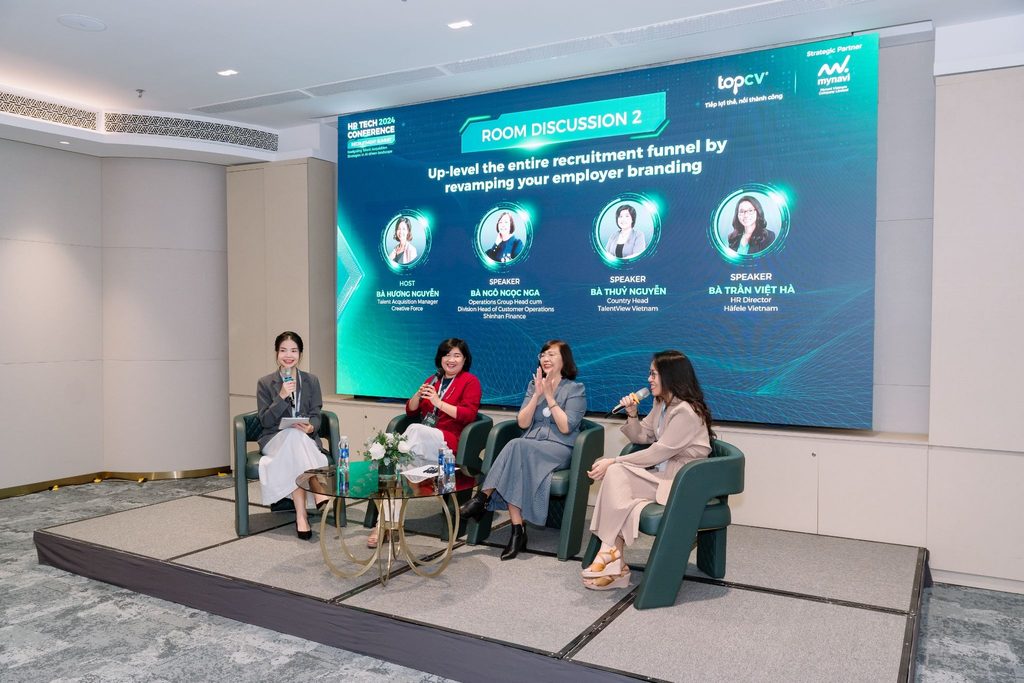
After more than 11 years in technology HR, Huong has become less interested in how many AI tools a company uses and more interested in how its leaders behave around the technology.
She sees this through her work as a Project Manager in a “Practical AI CEO” community, where she connects with CEOs who are actively exploring AI and sharing their challenges and solutions.
One thing she is particularly proud of is how willing many Vietnamese CEOs are to learn and experiment.
There is a strong appetite to move early rather than wait for others to figure everything out first.
But leadership enthusiasm needs to translate into opportunities for employees to develop their own capabilities.
Creative Force, where Huong previously worked, provides an example.
The CEO and leadership team actively led by example and encouraged employees to experiment with AI. The company also organised detailed workshops to help technical and non-technical employees understand how AI could be applied to their work.
This made a significant difference because AI wasn’t positioned as something belonging exclusively to the technology team.
It became something the whole organisation could learn and experiment with together.
The Feedback Was Polished. The Employee Still Felt Unheard.
Huong has also encountered a less effective approach: managers treating AI primarily as a productivity shortcut without fully understanding how it works, where it should be applied or where human judgement remains essential.
The consequences can be subtle.
For example, she has seen employees become frustrated when feedback from their managers felt as though it had simply been generated by AI.
The words might have been polished, but the feedback lacked clear reasoning, convincing guidance or a consistent direction.
Instead of making employees feel supported, the communication became more distant and transactional.
For Huong, this illustrates a risk that can be overlooked when companies focus on increasing AI adoption: technology can make communication faster without making it better.
She doesn’t believe the biggest risk for Vietnamese organisations is simply failing to adopt AI. A more subtle danger is adopting it superficially.
Vietnam has an advantage in its curiosity, speed and willingness to learn. While organisations may not always begin with the same level of process maturity or infrastructure as more established international companies, they can experiment and learn quickly.
The challenge is converting that experimentation into organisational capability.
Huong believes three conditions need to come together: leadership that demonstrates how AI should be used, employees who are given the skills and opportunities to experiment, and organisations willing to redesign how work gets done.
That combination is why she remains optimistic about Vietnam.
“The appetite is already there,” she says.
“The opportunity now is to move from ‘using AI’ to ‘working differently because of AI.’”
She Built Her First AI Assistant. Then Three or Four More Followed.
Huong’s own experience with AI challenged an assumption she had held about the boundaries between HR and technology.
“I used to think that to build something with AI, I needed to understand much more about technology.”
She had assumed there was a clear division of responsibilities: HR professionals understood people and processes, while technical teams built the technology.
That changed when she built her first AI assistant herself.
She subsequently created three or four additional AI agents, which she began treating almost like her own “digital employees.”
The experience was a turning point.
Huong discovered that building AI agents was not nearly as difficult as she had imagined. More importantly, she began to see that programming wasn’t necessarily the critical skill.
What mattered was understanding the work deeply enough to break it into tasks, identify what could be delegated, and translate those tasks into something an AI agent could execute.
“AI has lowered the distance between identifying a problem and building a solution.”
That realisation changed how she thought about the future of HR.
She no longer sees HR professionals simply as users of technology who must wait for IT or product teams to build tools for them.
Instead, she believes HR can increasingly become a builder of AI-enabled solutions.
This doesn’t mean every HR professional needs to become a programmer.
In fact, Huong believes the opposite.
The most valuable HR professionals may not be those who know the greatest number of AI tools. They may be those who understand organisational problems deeply enough to identify where technology can genuinely help.
That understanding comes from working closely with people, processes and the realities of organisational change.
AI offers a new way to translate that knowledge into working solutions.
Stop Asking Which AI Tool to Use. Find Where the Work Breaks.
Huong’s experience has also changed where she believes an AI project should begin.
Instead of asking, “Which AI tool should we use for recruitment?”, she would start with a more fundamental question:
“Where is the friction in the way we currently work?”
Her suggested process is practical: choose one painful workflow, map how the work actually happens, experiment with AI, build a small prototype and measure the outcome.
The sequence matters.
Without understanding how work currently happens, teams may automate unnecessary steps, overlook inconsistencies or introduce technology where the underlying problem has not been properly defined.
The recruitment project illustrated the importance of that foundation. Huong’s own experiments with AI agents demonstrated what becomes possible once someone understands a problem well enough to translate it into a solution.
Final Thoughts: HR’s Next AI Skill May Have Little to Do With Prompting
Together, those experiences have reshaped her view of AI enablement.
She believes it can become a natural new capability for HR because the profession already has experience in organisational behaviour, people management, change management and understanding how work gets done.
The opportunity isn’t simply to make existing HR tasks faster. It is to give HR professionals a more active role in identifying and developing solutions to organisational problems.
That also changes what AI literacy may mean for the profession.
Knowing how to operate tools will remain useful. But the ability to diagnose a workflow, identify friction, determine what should be delegated and recognise where human judgement remains essential may become just as important.
For Huong, the shift is captured in two questions.
“My mindset has shifted from ‘How can HR use AI?’ to ‘What can HR build with AI?’”
The first treats HR as a user of technology. The second opens the possibility of HR becoming a contributor to how technology is designed and applied.
And that is the opportunity she finds most exciting about the profession’s future.
Highlights
- They Wanted Faster Recruitment. AI Exposed a Different Problem.
- They Fixed the Workflow. Then the Data Revealed Something Else.
- Vietnamese CEOs Are Eager to Experiment. But Is That Enough?
- The Feedback Was Polished. The Employee Still Felt Unheard.
- She Built Her First AI Assistant. Then Three or Four More Followed.
- Stop Asking Which AI Tool to Use. Find Where the Work Breaks.
- Final Thoughts: HR’s Next AI Skill May Have Little to Do With Prompting
Read the Chinese article here.