



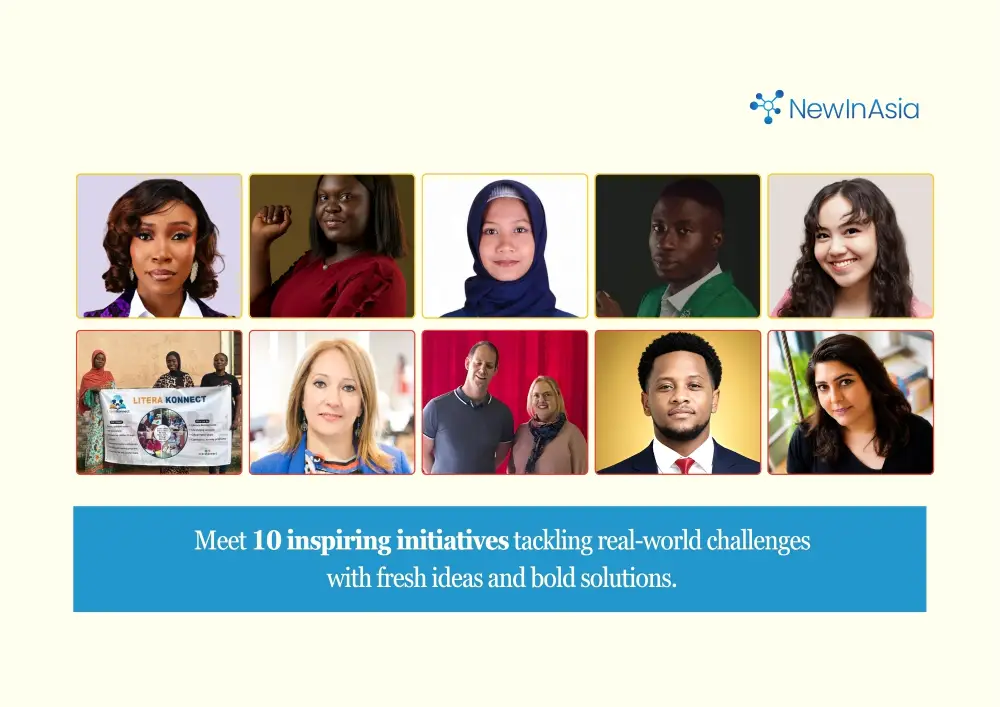
A student cannot afford research mentoring. A girl needs menstrual products every month. A displaced child has access to neither reliable electricity nor the internet.
These problems may seem unrelated, but they raise a similar question: what would it take to make existing support work better?
For 10 changemakers selected in Solve for Change Season 1 Round 2, the answer begins with understanding the people affected and developing solutions around their circumstances.
Highlights
- 10 Changemakers, 10 Different Approaches to Change
- Colors of My Heart: Teaching Emotions Through Creativity
- EcoFlow Girls Period: Tackling a Recurring Problem Differently
- Research Bridge Initiative: Students Building Their Own Alternative
- One to Learn, One to Give: Two Pairs, Two Different Benefits
- Kurio Rangers: Creating Space for Curiosity
- Literacy StoryLab: Reaching Children Through Their Teachers
- R-Fashion: Seeing Opportunity in Unwanted Materials
- The Unwritten Rules of Work: Making Invisible Knowledge Accessible
- STEMBridge for Youth: Designing for the Infrastructure That Exists
- MENTIO: Testing Better Communication With Three Families
- Before You Build a Solution, Ask These Three Questions
- Your Idea Could Be Next: Solve for Change Round 1.3
10 Changemakers, 10 Different Approaches to Change
Announced in September 2026, the winners received a combined US$3,600 in funding to support initiatives spanning education, health, entrepreneurship, digital inclusion and sustainability.
Some are building on established community programmes. Others are preparing small pilots to test their ideas.
Their approaches show how community challenges can inspire solutions of different sizes, from teaching practical skills to making existing knowledge more accessible.
Colors of My Heart: Teaching Emotions Through Creativity
Anita Nwokoji | Healing a Purple Heart Foundation | Nigeria
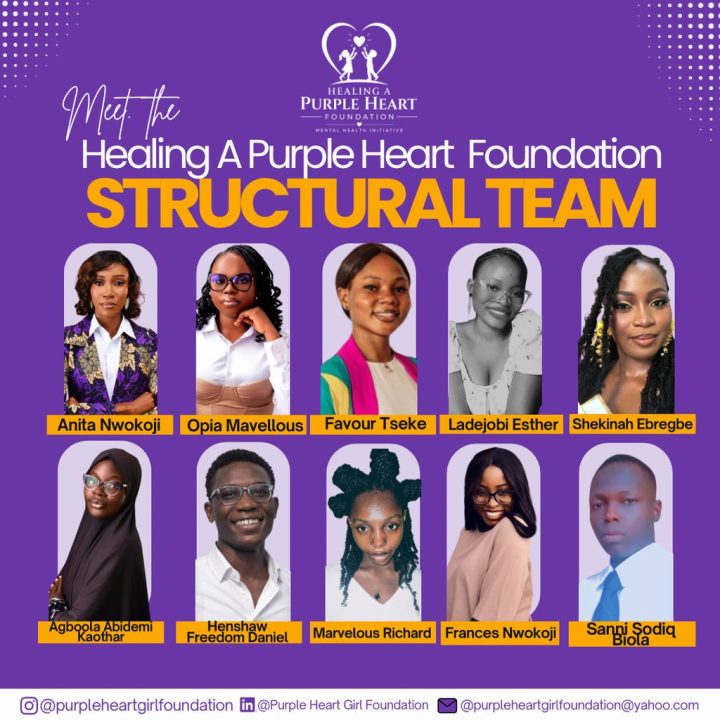
During a childhood marked by bullying and family difficulties, Anita Nwokoji found comfort in writing and poetry. Creative expression helped her process emotions she struggled to communicate.
Now, she wants to give children similar opportunities through Colors of My Heart, a programme that uses storytelling, music, drawing and guided reflection to develop emotional awareness.
The initiative is designed for 50 pupils aged five to 11 in Mushin, Lagos. Activities will help children recognise and express emotions, while learning materials and teacher involvement aim to reinforce those lessons.
Rather than asking young children to explain complex feelings directly, Nwokoji’s approach gives them creative ways to explore what they are experiencing.
EcoFlow Girls Period: Tackling a Recurring Problem Differently
Precious Adeleke | Precious BlossomGirls Advocacy Initiative | Nigeria
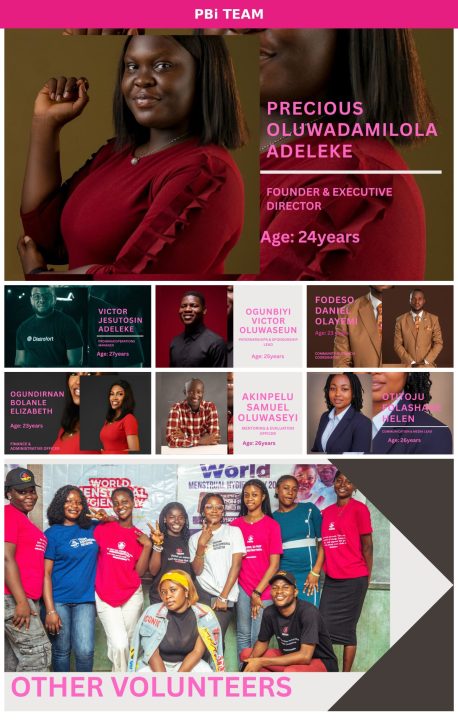
Sanitary pad donations can provide immediate relief. But what happens when the supplies run out?
Having experienced period poverty herself, Precious Adeleke understands why one-time distributions may not be enough.
Her initiative, EcoFlow Girls Period, proposes teaching 150 girls aged 10 to 18 in Agbara, Ogun State, how to make reusable menstrual pads while learning about menstrual health.
The programme also plans to train 20 peer educators who can share their knowledge with other girls.
Adeleke’s organisation reports previously reaching more than 3,000 girls through menstrual health initiatives.
EcoFlow Girls Period builds on that experience by combining access to menstrual products with skills that participants can continue using after the programme ends.
Research Bridge Initiative: Students Building Their Own Alternative
Queen, Deka and Assyifa | Research Bridge Initiative | Indonesia
Queen had paid for scientific writing training, yet still struggled to access the research guidance she needed.
Rather than accepting that barrier, she joined fellow high school students Deka and Assyifa to develop the Research Bridge Initiative.
Their proposed Research Camp will offer free workshops, individual mentoring and digital resources to help students aged 13 to 18 turn research ideas into proposals.
The first two batches will accommodate 40 students. A wider online Research Circle aims to connect 150 learners.
What began as frustration with limited access to mentoring has become an attempt to create the kind of support the founders themselves were looking for.
One to Learn, One to Give: Two Pairs, Two Different Benefits
Zee-dot Wears | Nigeria

Every student makes two pairs of sandals.
They keep one. They donate the other.
That is the idea behind One to Learn, One to Give, a proposed 10-day programme by Nigerian footwear enterprise Zee-dot Wears.
Sixty secondary school students in Osun State will learn sandal-making alongside basic entrepreneurship skills, including costing and pricing.
If the programme meets its target, participants will produce 120 pairs of footwear. Half will go to the students themselves, while the remaining 60 pairs will be donated to children who need shoes.
Zee-dot Wears reports previously producing more than 500 pairs and training over 20 students.
The model connects learning with a tangible outcome: participants practise a marketable skill while making something useful for another person.
Kurio Rangers: Creating Space for Curiosity
Olivina Maskan and team | Kurio Academy | Indonesia
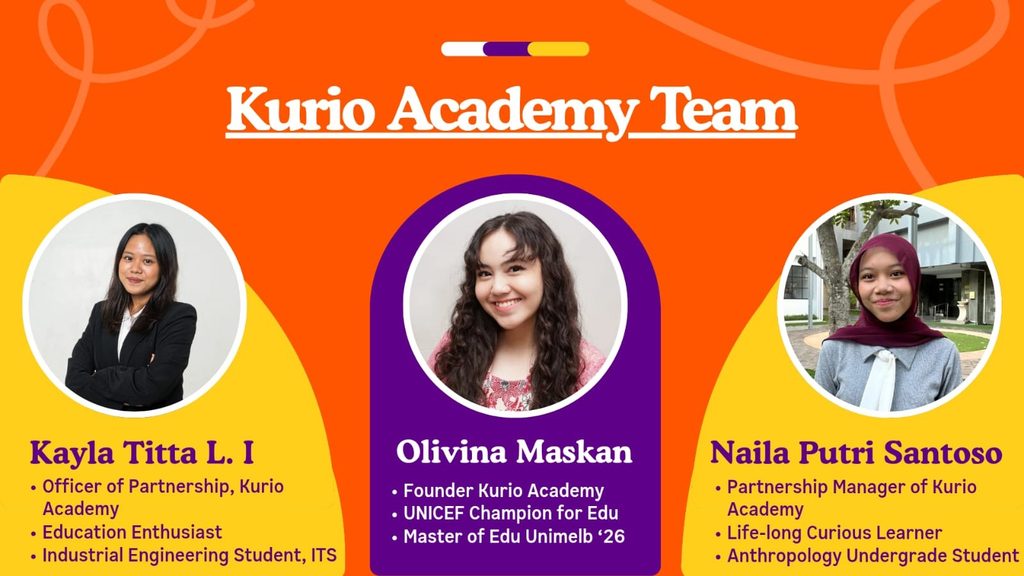
What happens to questions that fall outside the school curriculum?
For Kurio Rangers, those questions are worth exploring.
Developed by Indonesian learning community Kurio Academy, the programme encourages young people to pursue their interests through peer activities, workshops and independent learning.
Kurio Academy was established in 2022, while Kurio Rangers launched in 2025. The organisation reports having a community of more than 320 members.
Its proposed expansion includes expert-led sessions, digital learning resources and challenges designed to encourage exploration to welcome more than 500 additional learners.
Instead of organising learning around examinations, Kurio Rangers creates opportunities for young people to follow their curiosity and learn alongside others who share their interests.
Literacy StoryLab: Reaching Children Through Their Teachers
Rabiat Muhammad | LiteraKonnect | Nigeria
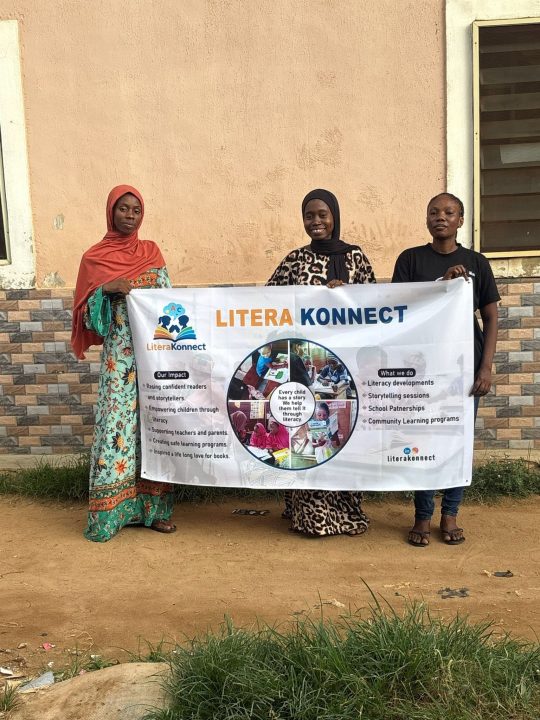
Rabiat Muhammad’s experience with her brother’s reading difficulties helped shape her interest in literacy education.
Through Literacy StoryLab, she is developing a way to support children who struggle with foundational reading skills.
Her Literacy Ladder framework combines assessment, phonics, comprehension, storytelling and expression.
An earlier pilot involving 43 girls reportedly found that 60% could read independently by the programme’s end.
For the next phase, Muhammad plans to train 20 teachers across 10 schools in Nyanya, Nigeria, rather than relying entirely on direct instruction.
The project aims to reach at least 200 children, with trained teachers encouraged to share their methods with colleagues.
The approach places educators at the centre of the expansion, allowing literacy support to continue through existing classrooms.
R-Fashion: Seeing Opportunity in Unwanted Materials
Ruba Rajab | R-Fashion
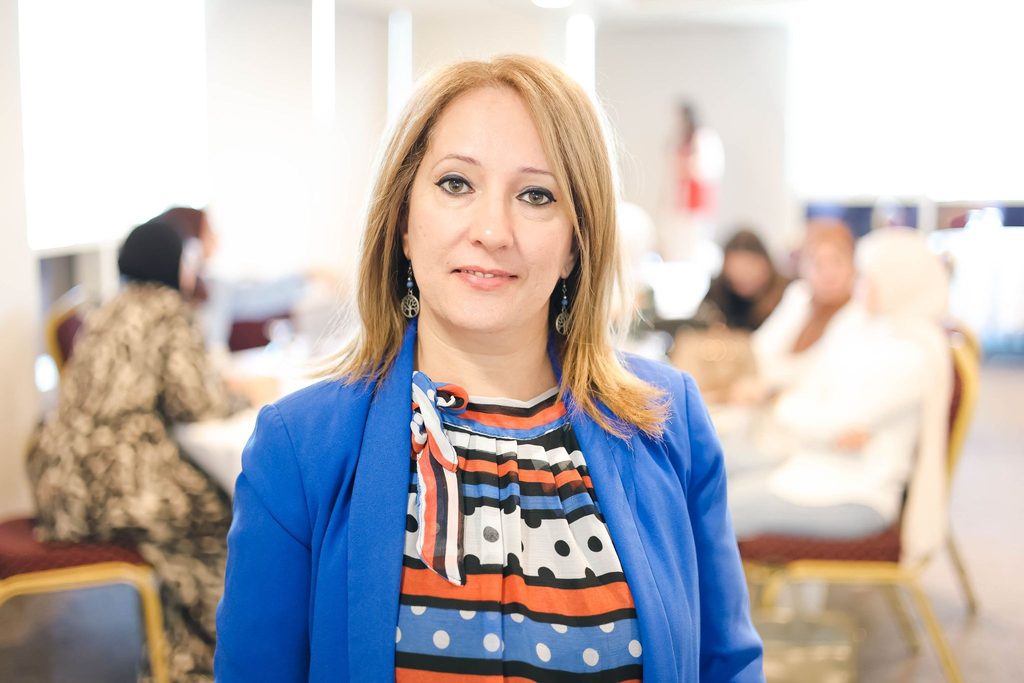
For Ruba Rajab, discarded materials represent more than waste. They could become a way for young people to learn practical and creative skills.
An engineer, fashion designer and entrepreneur, Rajab began developing R-Fashion after noticing limited affordable skills programmes for adolescents, including her daughter.
Her proposed training hub will introduce 50 underserved teenagers to sustainable fashion, upcycling and digital skills.
Participants will learn to turn reusable materials into products and explore ways to present their creations online.
The initiative also envisions a future digital marketplace where their work could reach potential customers.
By combining fashion, environmental awareness and digital learning, R-Fashion aims to help participants explore skills that could support future economic opportunities.
The Unwritten Rules of Work: Making Invisible Knowledge Accessible
Terri Allington and team | Zesummer Students | Europe
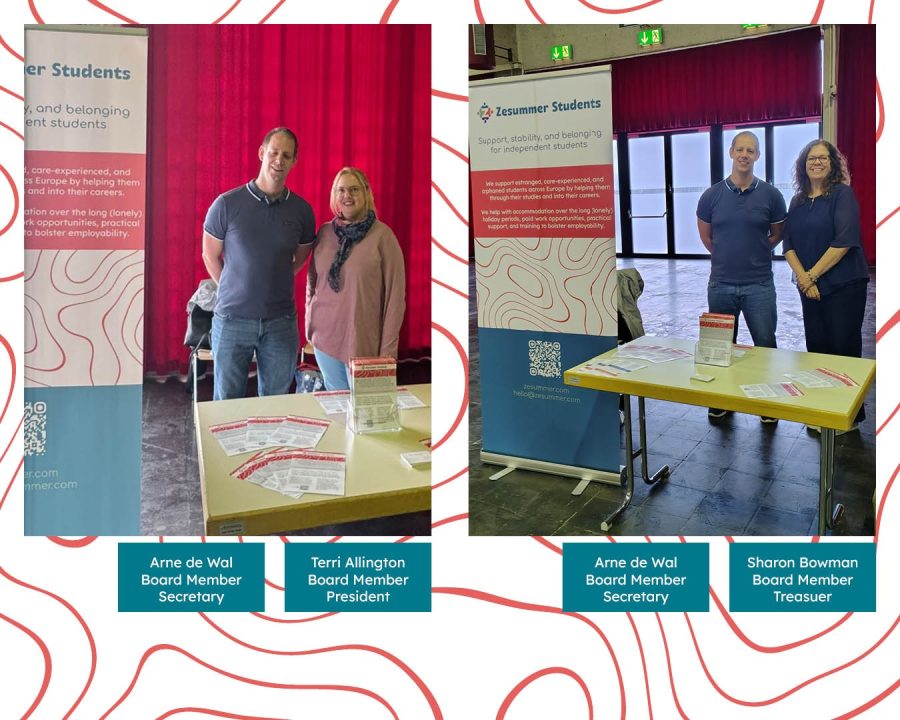
How should someone respond to workplace feedback? When is it appropriate to ask for help? What happens after making a mistake?
These expectations are rarely explained in job descriptions, yet they can shape a young person’s early employment experience.
Many people learn them through family members or professional networks. Care-experienced, estranged and independent students may have fewer opportunities to access that guidance.
The Unwritten Rules of Work, developed by Zesummer Students, proposes a digital learning course built around realistic workplace scenarios.
Young people with relevant experiences will help shape the content, ensuring the lessons reflect situations they recognise.
An initial pilot will involve at least 50 learners.
The initiative focuses on a form of workplace preparation that conventional career advice can overlook: understanding the informal expectations people are often assumed to know.
STEMBridge for Youth: Designing for the Infrastructure That Exists
Abongdoh Maluyane Titus and team | e-Mentor | Cameroon
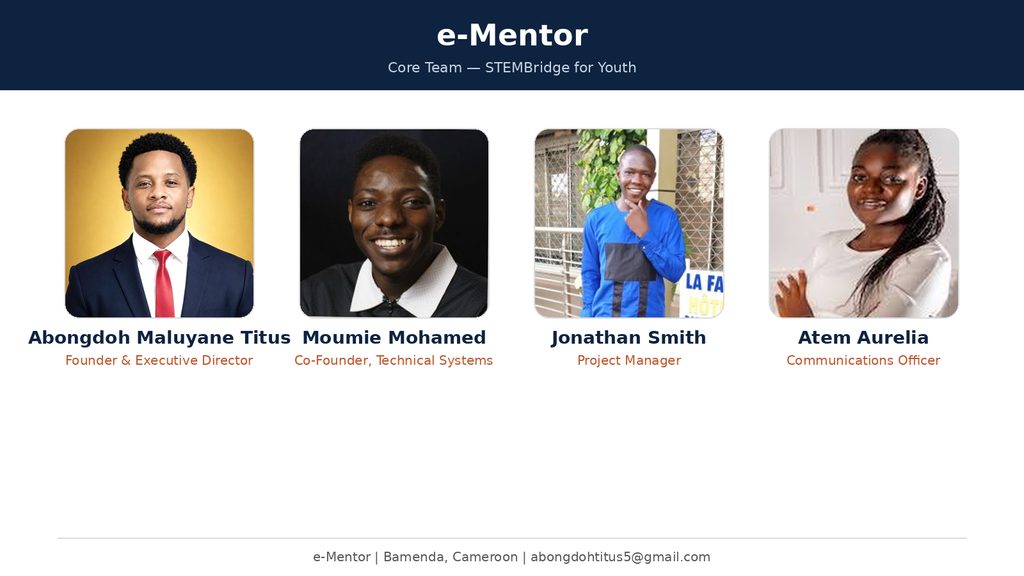
Digital education often depends on two things that displaced communities cannot always rely on: electricity and internet access.
STEMBridge for Youth is designed around those limitations.
Developed by e-Mentor in Cameroon, the programme combines offline, solar-powered learning technology with locally trained facilitators to deliver STEM education to displaced and refugee youth.
Founder Abongdoh Maluyane Titus experienced educational disruption during displacement, giving him personal insight into the challenges learners face.
According to its proposal, e-Mentor has reached more than 2,000 young people since 2021.
Its next phase aims to introduce AI-assisted English and digital literacy learning to another 300 participants.
Rather than waiting for better infrastructure, the programme adapts its technology and delivery methods to the conditions learners currently face.
MENTIO: Testing Better Communication With Three Families
Alev Özpolat | MENTIO | Türkiye
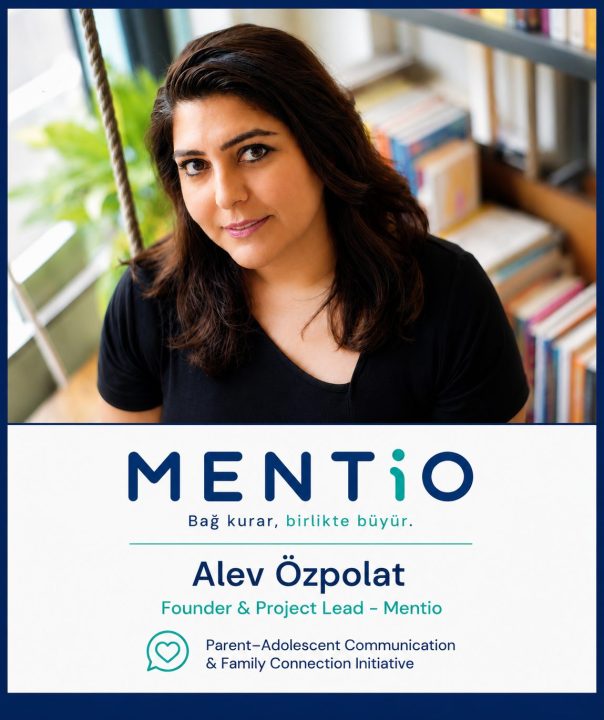
A parent may believe they are offering encouragement, while their teenager experiences pressure.
MENTIO explores how families might better understand those different perspectives.
Developed by Alev Özpolat, whose own educational journey was supported by her mother, the initiative focuses on communication, trust and expectations between parents and adolescents.
Its first pilot will involve just three families in Gaziantep, Türkiye.
Each family will receive an assessment and personalised guidance, followed by an evaluation of changes in communication and understanding.
The small starting point allows Özpolat to test the approach and gather feedback before considering a wider rollout.
Before You Build a Solution, Ask These Three Questions
The 10 initiatives show that turning a community problem into a practical solution starts with understanding what is needed and what can realistically be achieved.
For aspiring changemakers, three questions can help shape a stronger proposal:
- Who exactly are you trying to help? Identify the people affected, the challenges they face, and why existing support may fall short.
- What can you realistically achieve? Focus on a practical solution that fits your resources, budget, and timeline.
- How will you measure progress? Define what success could look like, whether through skills gained, improvements observed or feedback from participants.
A promising idea does not need to solve everything at once. It needs a clear purpose, a workable plan and a way to learn from the results.
For young changemakers ready to take that next step, Solve for Change Season 1 Round 3 offers an opportunity to seek support and put their ideas into action.
Your Idea Could Be Next: Solve for Change Round 1.3
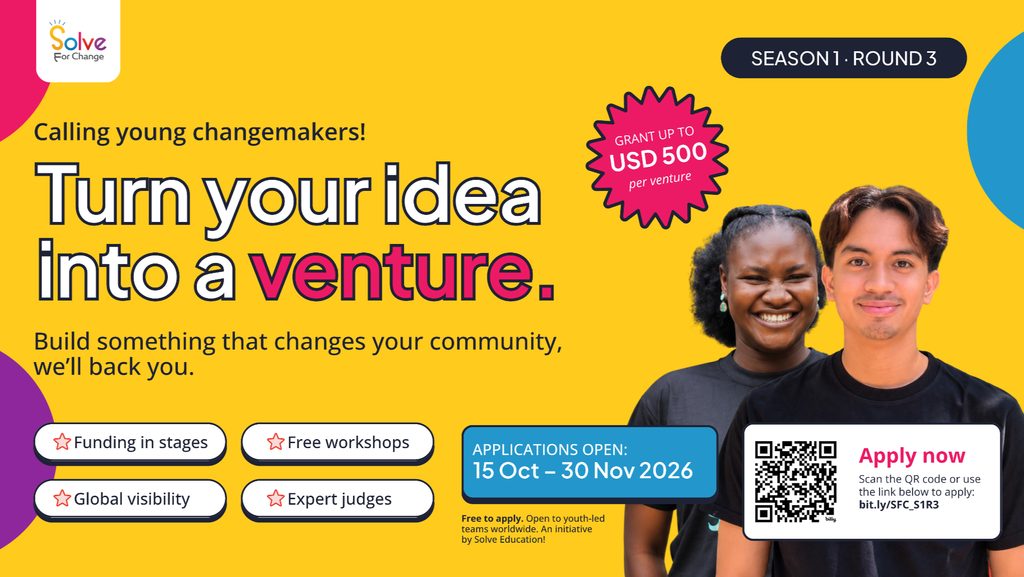
Solve for Change Season 1 Round 3, an initiative by Solve Education!, invites young changemakers worldwide to turn their ideas into community ventures.
Winning ventures can receive up to US$500 in funding, released in stages as project milestones are achieved.
Beyond financial support, the programme offers free workshops, global visibility and evaluation by expert judges.
Applications are free and open to youth-led initiatives worldwide. The programme welcomes ideas addressing challenges such as education, sustainability, health and community development.
Applications open on 15 October 2026, with two important deadlines:
- 31 October 2026: Early-bird application deadline.
- 30 November 2026: Final application deadline.
The initiatives featured here began with different challenges, from access to education to family communication. Some are expanding existing work, while others are preparing their first small pilots.
For the next group of changemakers, the opportunity begins with recognising a problem in their own community and developing a practical response.
Could your idea be among the next Solve for Change winners?
Apply for Solve for Change Season 1 Round 3 here, or visit the official website here, to explore its programmes and impact.
Highlights
- 10 Changemakers, 10 Different Approaches to Change
- Colors of My Heart: Teaching Emotions Through Creativity
- EcoFlow Girls Period: Tackling a Recurring Problem Differently
- Research Bridge Initiative: Students Building Their Own Alternative
- One to Learn, One to Give: Two Pairs, Two Different Benefits
- Kurio Rangers: Creating Space for Curiosity
- Literacy StoryLab: Reaching Children Through Their Teachers
- R-Fashion: Seeing Opportunity in Unwanted Materials
- The Unwritten Rules of Work: Making Invisible Knowledge Accessible
- STEMBridge for Youth: Designing for the Infrastructure That Exists
- MENTIO: Testing Better Communication With Three Families
- Before You Build a Solution, Ask These Three Questions
- Your Idea Could Be Next: Solve for Change Round 1.3
Read the Chinese article here.
Related posts:
 Myanmar’s Counsellors Reach 4,000 People a Month. Now They’re Building the Profession Behind That Support.
 From Learning to Livelihood: 55 Youth and Persons with Disabilities Turn Sustainable Ideas into Businesses in Lombok
 A School Project Grew Into a Refugee Youth-Led Organisation — And Won Top Honours Globally
 Can a Business Fight Climate Vulnerability & Still Survive Commercially? One Founder Says It Has To

