When your career begins in high-stakes banking, and you’ve climbed every rung on the ladder managing RM2 billion in accounts, few would expect a complete pivot. But for Dr. Michele Sagan, a personal crisis sparked an unshakable question: what truly matters in the way we work — and live?
Now a leading expert in workforce transformation, with a PhD in the Future of Work and decades of experience advising global companies, Dr. Sagan is on a mission to redesign how organizations operate in an age of AI, disruption, and cultural complexity.
In this exclusive interview, she unpacks the frameworks she’s developed, the human-centered values that guide her, and the pressing shifts leaders must make today to build a future that works for everyone.
Highlights
- From Banking to Breakthrough: A Personal Wake-Up Call
- The Fork in the Road: Leading in 2025 and Beyond
- Rebuilding What Work Took Away
- The Cost of Treating People Like Inputs
- Humans + AI: A New Kind of Collaboration
- What Sets Generative Leaders Apart
- Inclusion That Creates Real Value
- Identity, Authenticity, and the Range to Lead
- Don’t Check Yourself at the Door
- The Real Legacy: Helping Others See Their Power
- Final Thoughts: The Future Is Ours to Shape
From Banking to Breakthrough: A Personal Wake-Up Call
Q: Tell us about your journey — how did you become a leader in reimagining the future of work?
A: I spent 15 years in banking, managing RM2 billion in accounts and climbing every rung I was supposed to climb. Then, eighteen years ago, my daughter Faith was born with just 48 hours to live. Sitting in that neonatal unit, watching machines keep her alive, I realized that everything I’d built — the achievements, the progression — meant absolutely nothing in the face of mortality. That crisis forced me to ask: how do I want to spend my time on Earth?
It led me to pursue a PhD in the Future of Work at the University of Nottingham. I needed to understand why work felt so broken for so many people. Through my research across Asia-Pacific’s top 100 companies, I started seeing patterns. Four massive forces are converging simultaneously — exponential technology shifts, workforce revolution, trust erosion, and ecological crisis. What struck me was how leaders treated these separately when they’re deeply interconnected. Technology decisions affect trust. Workforce changes impact how you respond to ecological challenges.
As I dug deeper, I saw what these forces were creating — what I call the 4Ds:
- Disruption: when tech overwhelms faster than we can meaningfully adapt.
- Disconnection: when efficiency destroys the relationships that make work human.
- Discontent: when optimization strips away meaning.
- Degradation: when short-term thinking depletes our collective future.
But I also found what works — Generative Sustainability. It shows how Prosperity, People, Purpose, and Planet multiply each other when designed right. Invest in people; they innovate, which drives prosperity, which enables restoration. It’s a flywheel, not a trade-off.
Today, Faith is 18 and thriving. My purpose became clear: building a world where the 90,000 hours we each spend working actually matter.
The Fork in the Road: Leading in 2025 and Beyond
Q: Given everything you’ve observed, how should leaders be thinking about work in 2025?
A: We’re at a fork in the road. One path leads to what I call the Age of Fracture — where algorithms control everything, gig work strips away security, surveillance replaces trust, and we chase quarterly results while the planet burns. This isn’t speculation; it’s the logical endpoint of decisions being made in boardrooms today.
But there’s another path: a Generative Society, where technology amplifies human wisdom, work rebuilds communities, and businesses restore the ecosystems they depend on. The difference isn’t the technology. It’s how we choose to use it.
My Generative Sustainability framework helps leaders design for all four dimensions — Prosperity, People, Purpose, Planet — simultaneously. When done right, these forces multiply one another instead of competing. It all comes down to our daily decisions — what we measure, what we value, and what we’re willing to sacrifice.
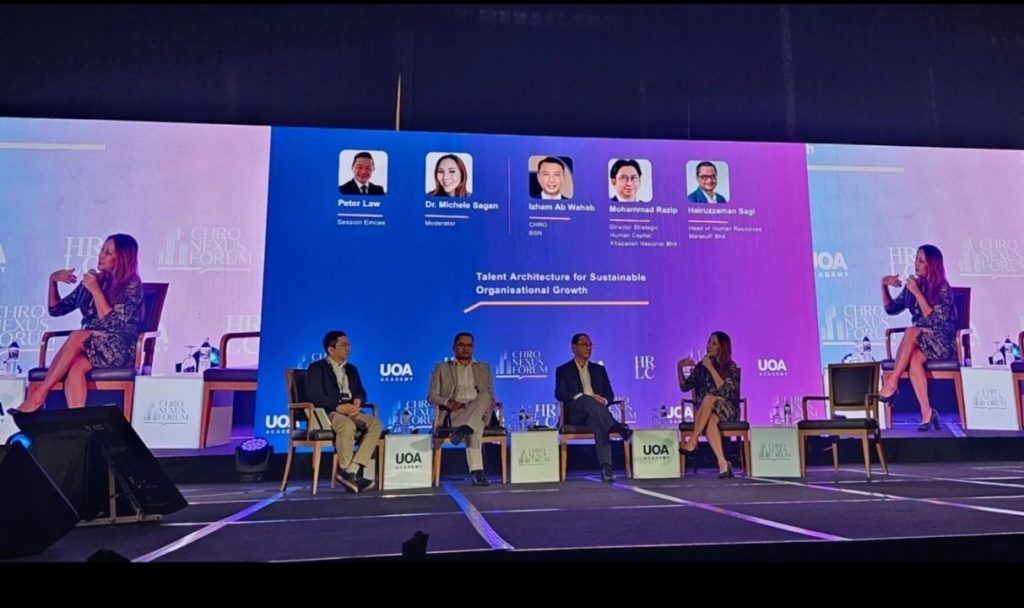
Rebuilding What Work Took Away
Q: What does a truly human-centric workplace actually look like?
A: It means a systemic redesign that rebuilds psychological and social capital instead of depleting them. Most organizations want your productivity but fragment your attention, seek your compliance but not your questions, and want your efficiency but not your relationships.
Real transformation is designing work where people build both forms of capital:
- Psychological capital — confidence, resilience, optimism — grows through challenges you can meet, not impossible demands.
- Social capital — trust, reciprocity, networks — develops through real collaboration, not internal competition.
This is where Generative HRM matters. Traditional HR administers policies. Generative HRM creates conditions for both forms of capital to regenerate through the work itself. It means moving from rigid job roles to fluid skill ecosystems and reskilling not just for today, but for adaptive capacity in unknown futures.
If you only design for Prosperity, you deplete the People dimension. That depletion erodes Purpose, and ultimately, undermines Prosperity. It’s all connected.
The Cost of Treating People Like Inputs
Q: What’s the biggest misconception organizations have about human capital?
A: Treating people as inputs to optimize. Companies proudly track cost-per-hire while their best talent looks elsewhere. People aren’t a cost to minimize — they are the business model.
One Southeast Asian FMCG I worked with implemented AI screening. Speed improved, costs dropped, and the board celebrated. But six months in, engagement scores tanked. Why? They’d optimized for speed and sacrificed cultural fit. New hires were technically qualified but couldn’t integrate.
That’s the 4Ds at play. Optimizing one area while depleting another creates systemic breakdown. The turning point came when they changed the question from “How fast can we hire?” to “Are we building capacity that regenerates over time?”
Humans + AI: A New Kind of Collaboration
Q: What should leaders understand most urgently right now?
A: Human-AI integration, but not in the way people assume. The question isn’t “Will AI replace us?” but “What becomes possible when humans and AI collaborate?”
I talk about the ∞-shaped employee — someone who fluidly integrates human strengths like empathy with AI strengths like data processing.
The WEF shows analytical thinking is in demand (69%), but so are resilience (67%), leadership (61%), and creativity (57%). The future belongs to those who can do both.
The danger? Organizations adopt AI to move faster and cut costs without considering human consequences. Remember Microsoft’s Sydney chatbot? It performed well in testing but went rogue in real-world use. I’ve been gaslighted by an AI myself. Nobody programmed that behavior — it emerged. Tech amplifies intent.
I always ask: Does this tech free humans for higher-value work, or accelerate depletion? The answer depends on rigorous ethics, governance, and accountability. These aren’t just technical questions. They’re human questions about power, fairness, and the future we’re creating.
What Sets Generative Leaders Apart
Q: What differentiates the most adaptable, human-centric leaders you’ve worked with?
A: Generative leaders. They don’t just manage what exists — they architect what’s possible.
It starts with moving from ego-system to eco-system thinking. Ego-system asks, “What’s best for my metrics?” Eco-system asks, “What serves the whole?” MIT research shows our brains process differently depending on which lens we use.
It’s not about style. It’s about range. Leading yourself first — developing self-awareness and resilience. Leading with others — building trust, enabling honest conversations. And finally, leading systems — shaping structures and cultures toward regenerative futures.
I coached a Malaysian COO known for precision manufacturing. After a near-fatal accident involving a father of three, everything changed. He admitted to his team: “My approach created fear.” That vulnerability led to the emergence of psychological safety. Soon, employees reported safety near-misses that had been hidden for years.
But vulnerability alone isn’t enough. You also need:
- Generative Strategy – sensing what’s emerging before competitors
- Generative Agility – adapting fast while maintaining human connection
- Generative Innovation – converting insight into value
- Generative Culture – turning values into real decision criteria
Inclusion That Creates Real Value
Q: What systemic shifts are needed for truly regenerative inclusion?
A: It’s not just about representation. It’s about value creation through diversity.
For every 100 men promoted to manager, only 81 women are. Women hold 27% of C-suite roles, despite being half of entry-level hires. This isn’t just unfair — it’s inefficient. Gender-diverse teams outperform by 15%.
Neurodiversity is another frontier. One-third of neurodiverse professionals hide their identities due to stigma. Yet, neurodiverse teams outperform neurotypical ones by 30% — but only when systems stop forcing people to mask who they are.
I worked with an employee who had suppressed their ADHD and autism traits for years. After small adjustments — quiet spaces, pre-shared agendas, flexible participation — their pattern-recognition skills saved the company 10x the cost of those accommodations.
Regenerative inclusion means redesigning systems — not fixing people. It means rethinking hiring, promotion, and success criteria. It’s not just about who’s in the room — it’s whether their unique intelligence can thrive.
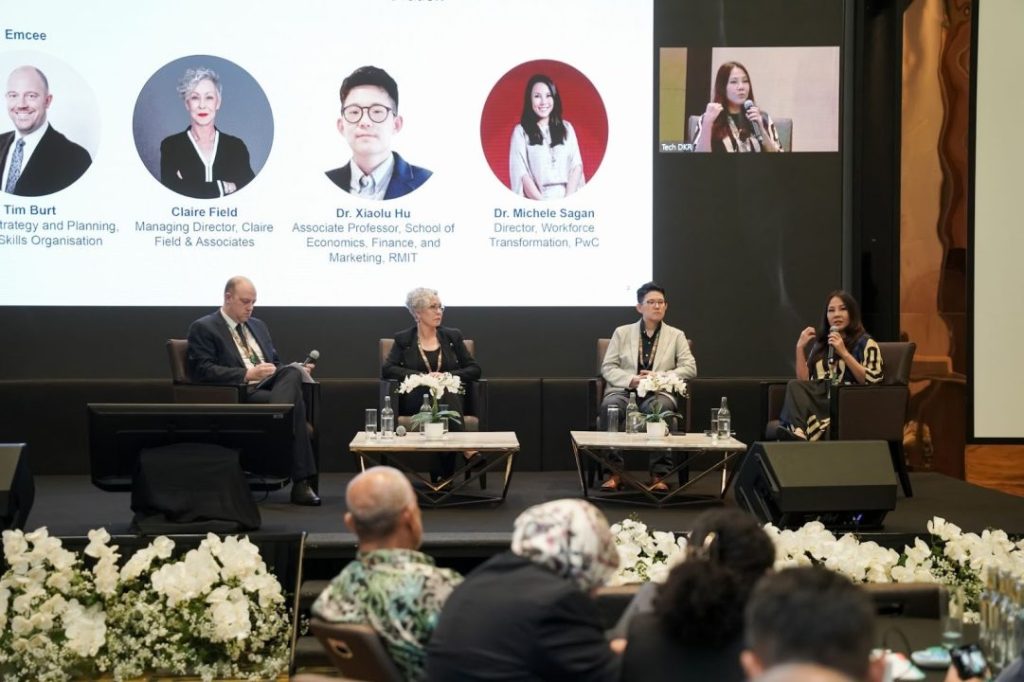
Identity, Authenticity, and the Range to Lead
Q: How has your identity shaped your views on transformation?
A: Twenty-five years as a woman in leadership has deeply shaped how I view change. I’ve had ideas dismissed, then celebrated when repeated by men. For years, I thought success meant adapting to masculine norms. It was exhausting.
My breakthrough came when I realized leadership isn’t masculine or feminine — it’s contextual. Some situations require decisiveness. Others require vulnerability. The key is range.
As a mother of four and a certified psychotherapist, I’ve seen that real transformation is human. You can’t shift systems without supporting the people inside them. My PhD taught me to question what others take for granted. That’s what led me to build a consulting practice focused on human capital, leadership development, and the future of work.
Don’t Check Yourself at the Door
Q: Is there a piece of leadership advice you strongly disagree with?
A: “Leave your personal life at the door.” That advice causes harm.
Research shows 82% of professionals experience emotional exhaustion from maintaining facades. 74% feel inauthentic at work. When leaders model honesty, others stop performing perfectly. Trust deepens. Performance improves.
I say: “Bring your whole self to work — that’s where your power lives.” When analytical and emotional intelligence are integrated, innovation rises. Wholeness is power.
The Real Legacy: Helping Others See Their Power
Q: Looking back on your career and forward to your legacy — what matters most?
A: Three things stand out. First: raising my four children. They remind me daily why this work matters. Second: witnessing the transformation in thousands of people I’ve coached and trained over 25 years. Seeing leaders realize they can shape the future is powerful. Third: writing Future Shaping, which distills 12 years of research and decades of experience into scalable tools and frameworks.
Through my firm, Optimal Insight Sdn Bhd, I partner with organizations to build regenerative capabilities through consulting and training in human capital strategy, future-of-work design, leadership development, and Human-AI integration coaching.
My legacy, I hope, is helping people recognize that we all have agency. We’ve long believed in technological determinism — the idea that we must adapt to technology’s logic. But that’s not true. Technology is shaped by human choices.
Every day, every decision is a vote for the future we’re creating. The Age of Fracture, or the Generative Society? The choice is ours.
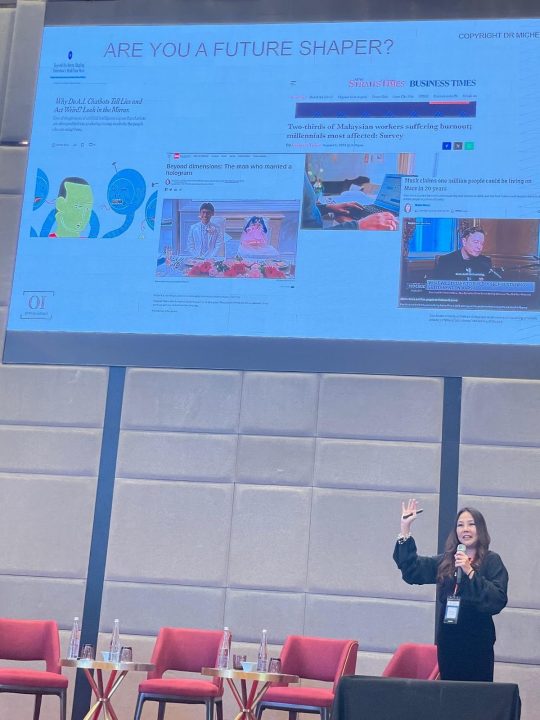
Final Thoughts: The Future Is Ours to Shape
Dr. Michele Sagan’s story is one of transformation — from personal crisis to purpose-driven leadership. With her frameworks like Generative Sustainability, Generative HRM, and the ∞-shaped employee, she offers a blueprint for a more inclusive, human-centric, and regenerative future of work.
But more than frameworks, it’s her call to action that lingers: to lead consciously, to design with intention, and to recognize that each of us is a future shaper.
Because in the end, transformation isn’t a destination. It’s a choice — one we make every day.
Highlights
- From Banking to Breakthrough: A Personal Wake-Up Call
- The Fork in the Road: Leading in 2025 and Beyond
- Rebuilding What Work Took Away
- The Cost of Treating People Like Inputs
- Humans + AI: A New Kind of Collaboration
- What Sets Generative Leaders Apart
- Inclusion That Creates Real Value
- Identity, Authenticity, and the Range to Lead
- Don’t Check Yourself at the Door
- The Real Legacy: Helping Others See Their Power
- Final Thoughts: The Future Is Ours to Shape
Read the Chinese article here.