




At the Digital Leadership Webinar Summit 2025, Kevin Shepherdson took the stage with a clear message for leaders navigating the AI revolution: data governance isn’t just a regulatory checkbox — it’s your competitive edge.
Kevin, CEO of Straits Interactive, is a globally recognized voice in data privacy and governance. He is the founder of the DPEX Network, author of 99 Privacy Breaches to Beware Of, a SkillsFuture Fellow, and a faculty affiliate at Singapore Management University. With over 30 professional certifications and 30+ courses developed for SMU and the industry, Kevin is shaping the future of responsible data leadership.
Highlights
The Real Risk Isn’t AI — It’s the Lack of Governance
Kevin opened with a call to action: if your organization is moving forward with generative AI without a governance framework in place, you’re not transforming — you’re gambling.
He illustrated the Data Life Cycle with a simple truth: every app, chatbot, or digital touchpoint has a collection point, followed by usage, storage, disclosure, and sometimes cross-border transfer. The risk? Breaches don’t usually stem from tech — they stem from failure in governance.
From consent mishandling to unsecured storage, Kevin laid out 40 risks every organization faces — many avoidable with the right accountability frameworks.

Why Data Protection Must Evolve into Data Governance
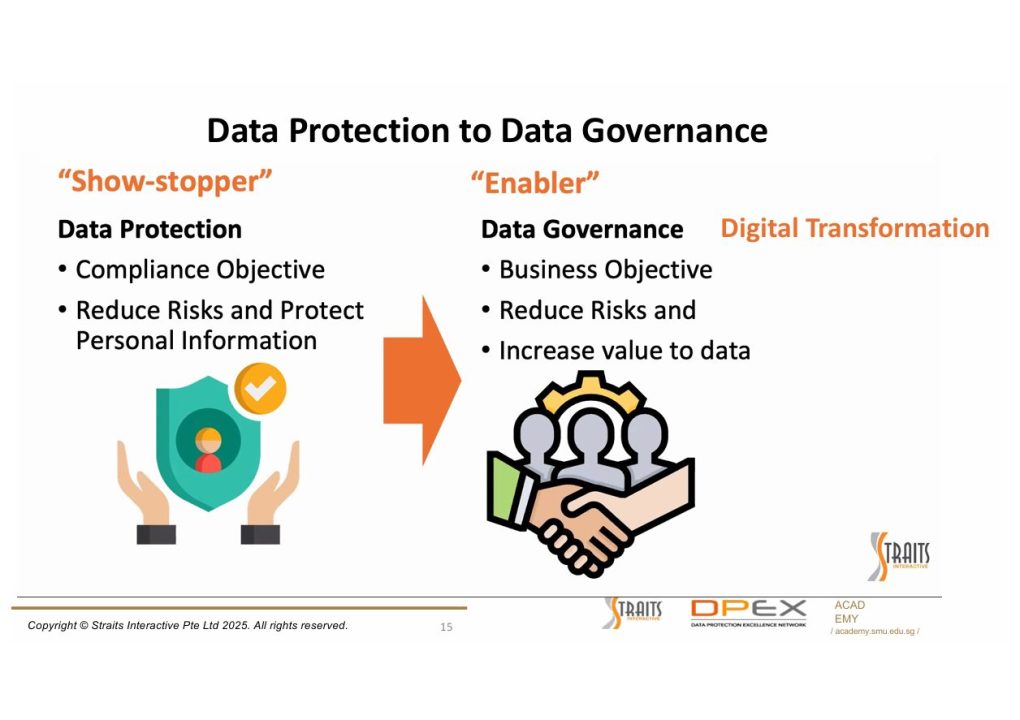
According to Kevin, data protection laws (like Singapore’s PDPA) define how data must be collected, used, stored, and transferred. But compliance alone isn’t enough.
“Governance expands the focus from risk reduction to value creation.”
Using ISO 38505, Kevin explained data governance as an accountability framework that both reduces risk and unlocks data value for business outcomes. It’s about moving from being perceived as a ‘compliance bottleneck’ to becoming an enabler of digital transformation.
Expanding the Life Cycle for AI: The 7-Stage Model
As AI becomes foundational to operations, Kevin proposed an expanded model for the data life cycle:
- Collect/Create
- Store
- Report
- Decide
- Distribute
- Dispose
- Govern
These new phases account for how generative AI systems process, infer, and act on personal data. The expanded model reflects the new digital realities leaders must address.
Kevin warned about real-world risks like hallucinated outputs, inaccurate decision-making, and data misuse in GenAI models. He cited cases like the Air Canada chatbot legal liability, where the courts held the company accountable — not the AI.
He also referenced widely publicized incidents of proprietary information being leaked through chatbots — including the Samsung case where employees unknowingly trained public models using confidential data. These examples reinforce the urgent need for internal governance before external adoption.
A Snapshot of Data Governance Maturity: Which Stage Are You In?
Kevin outlined five common scenarios that describe where organizations currently stand in their data maturity journeys:
- Non-compliance — No governance, no management, no operations
- DPO in Name Only — Appointed, but unsupported
- No Governance Committee — Ops without oversight
- Paper Compliance — Policies in place but not implemented
- Operational Compliance — Full integration, design-led
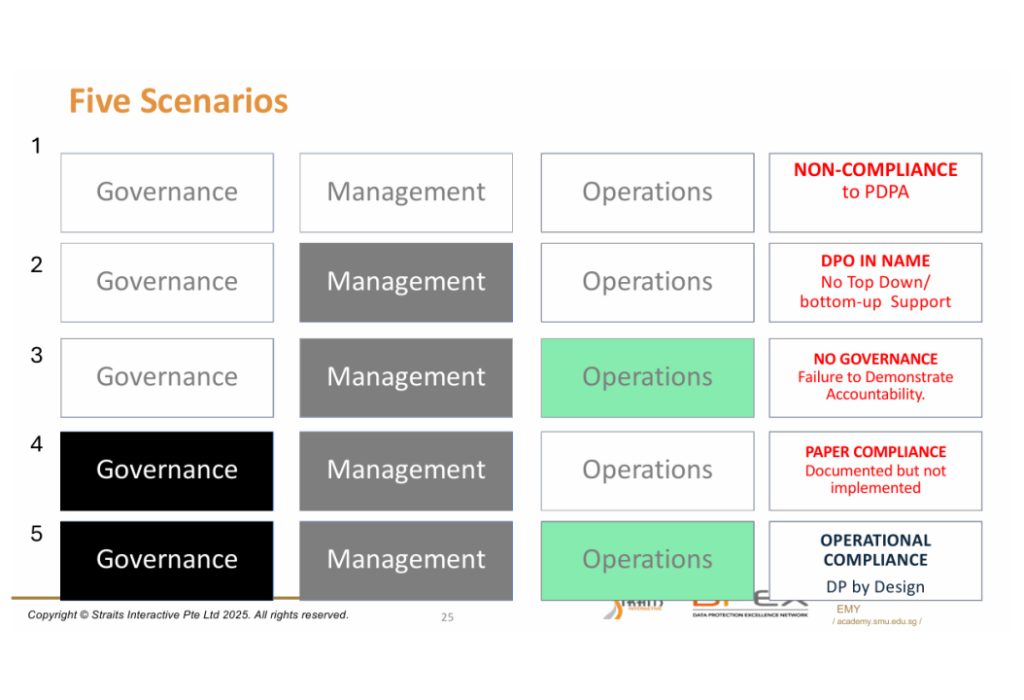
This framework helps leaders audit their current approach to privacy and governance. Scenario 5 — where policies are lived, not just documented — is where organizations begin turning compliance into a competitive differentiator.
“Governance isn’t about stopping innovation. It’s about scaling it responsibly.”
Future-Ready Governance: Build It Before You Need It
Kevin’s closing remarks weren’t just a summary — they were a call for proactive leadership. As more organizations integrate GenAI into customer service, HR, marketing, and R&D, the volume and velocity of sensitive data flow will only intensify.
Kevin emphasized the need for operational compliance — embedding data protection principles into day-to-day practices across departments. He advocated for data protection by design: a mindset where privacy is not an afterthought, but a foundational element in every project.
“If you’re feeding AI without knowing where your data goes or how it’s used, you’re not innovating — you’re exposing your business.”
He left leaders with a roadmap that spans legal readiness, operational clarity, and strategic alignment. Those who adopt it early will not only stay out of regulatory trouble — they’ll build trust and sustainable advantage in an AI-driven economy.
📌 Editor’s Note:
This feature highlights Kevin Shepherdson, CEO of Straits Interactive and author of 99 Privacy Breaches to Beware Of, who delivered the keynote “Privacy and Data Governance in the Age of AI” at the Digital Leadership Webinar Summit 2025, organized by NewInAsia to spotlight future-ready leadership and innovation in the digital economy.
Highlights
Read the Chinese article here.