Singapore, 18 March 2026 — Artificial intelligence adoption in Singapore is nearly universal — but the infrastructure required to support it may not be keeping pace.
According to Hitachi Vantara’s State of Data Infrastructure 2025 report, 96 per cent of Singapore organisations are already using AI in some form, yet only 23 per cent say their infrastructure is industry-leading in delivering a return on that investment.
That tension — ambitious adoption but uncertain foundations — formed the quiet centrepiece of a media lunch convened by Hitachi Vantara on Tuesday at Artemis Grill & Sky Bar, high above Singapore’s financial district.
The event, held amid the policy momentum of Budget 2026 and Singapore’s National AI Strategy, marked the launch of two new enterprise storage platforms: VSP One Block High End, an all-flash NVMe array designed for mission-critical AI workloads, and VSP One Object, a petabyte-scale platform built to manage the exploding volume of unstructured data.
Yet the product launches ultimately pointed to a broader message: the AI era is advancing faster than the infrastructure built to sustain it.
“Singapore is all in on AI right now,” said Joe Ong, Vice President and General Manager for ASEAN. “But is the foundation ready? Ninety-six per cent are using AI. Only 23 per cent are achieving ROI. That gap is the problem we’re here to address.”
Highlights
The Infrastructure Gap
Hitachi Vantara’s State of Data Infrastructure 2025 report — based on a survey of more than 1,200 C-level and senior IT leaders across 15 markets, including 51 respondents from Singapore — provides statistical context to the infrastructure challenge many organisations are now confronting.
While 66 per cent of Singapore respondents report some success with AI initiatives, confidence drops when infrastructure resilience and data security are examined more closely.
- 57 per cent cite data loss as a critical risk
- 52 per cent say growing data complexity makes security breaches harder to detect
- 64 per cent believe their leadership would be deeply concerned if they fully understood the fragility of their organisation’s data infrastructure
The supply-side pressures are equally significant. 94 per cent of respondents say they require third-party support to manage their data infrastructure, while 86 per cent report that more than half of their organisation’s data stores are now unstructured.
“Data is our life,” Ong told the room. “Without data, a lot of things will not work.”
A Hummingbird’s Wingbeat
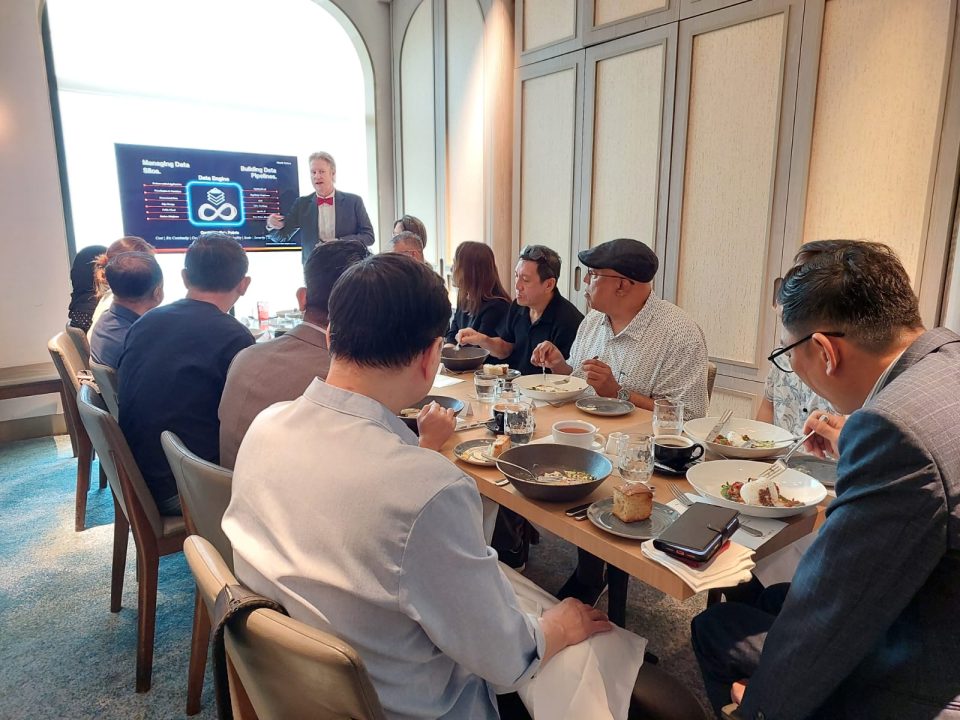
The product keynote was delivered by Matthew Hardman, Chief Technology Officer for Asia Pacific, who used a simple illustration to explain the concept of extreme reliability.
To demonstrate the difference between six-nines and eight-nines availability, Hardman compared the amount of downtime each standard allows. Six nines of uptime, a common industry benchmark, allows for roughly 31 seconds of downtime per year. Eight nines reduces that margin dramatically — to just 314 milliseconds annually.
“314 milliseconds,” Hardman explained. “That’s the time of a hummingbird’s wingbeat. That’s the size of the downtime window at eight-nines availability.”
The newly launched VSP One Block High End platform is designed to operate within that threshold while delivering up to 15 million IOPS performance for demanding enterprise workloads.
The system is available both as an on-premise appliance and as provisionable services across Azure, AWS, and Google Cloud, with Hitachi claiming potential cost savings of up to 40 per cent compared to cloud storage through compression and deduplication technologies.
Hardman emphasised that the company’s 100 per cent data availability commitment is backed by financial guarantees.
“We’ve got to stand behind everything we commit,” he said. “We will take financial penalties if we don’t deliver. It’s about integrity.”
The Explosion of Unstructured Data
While the first product addressed performance and uptime, the second launch targeted a different challenge: the rapid growth of unstructured data.
VSP One Object is designed for petabyte-scale storage of assets such as logs, images, scans, and geospatial datasets — information organisations increasingly retain even when its future value is uncertain.
“Eighty-six per cent of leaders say more than half their data stores are now unstructured,” Hardman noted. “Customers are storing it because they don’t want to lose it, even if they don’t yet know how to use it.”
Among the platform’s headline capabilities are native support for Amazon S3 Tables and Apache Iceberg integration, allowing organisations to run SQL queries directly on object storage and accelerate AI model training without moving data between systems.
Other features include embedded PII detection, storage immutability for ransomware protection, and a microservices-based architecture designed for scalability.
Both products sit within Hitachi Vantara’s broader VSP One platform strategy, which the company describes as a “data singularity” architecture — a unified environment spanning block, file, object, and mainframe storage under a single management framework.
The goal is to reduce the fragmentation that currently forces many organisations to manage multiple storage systems with separate operational tools.
Cloud, Quantum, and the Bigger Questions
While the formal presentations concluded on schedule, the most substantive discussion emerged during the extended Q&A session that followed.
One topic was cloud repatriation — the idea that rising storage costs and growing AI workloads are pushing organisations to bring data back on-premise.
Hardman suggested the reality is more nuanced.
Citing Dropbox’s well-known migration away from public cloud infrastructure, he described that move as an extreme example rather than a widespread trend. Most organisations, he said, are instead pursuing cloud optimisation — separating application layers from storage and keeping high-volume or sensitive data on-premise while continuing to use cloud for scalable compute.
“No one’s really going fully back,” Hardman said. “What we’re getting to is cloud optimisation. Infrastructure optimisation. That’s really where it’s at.”
Quantum computing also surfaced as a concern among enterprise customers, particularly within the banking sector.
Ong noted that some organisations are already asking whether storage systems are quantum-safe. Hardman confirmed that Hitachi Vantara has implemented AES-256 encryption, which the US National Institute of Standards and Technology (NIST) currently considers resistant to quantum threats — though he acknowledged the complexity of planning for a future where standards are still evolving.
“How do you protect something when the standards for protecting it aren’t even fully agreed yet?” he said.
The conversation also turned to whether such enterprise-grade infrastructure is relevant only to large government agencies and financial institutions.
Ong responded with examples that surprised some in the room: a bread manufacturer and a church in Singapore currently operate Hitachi Vantara systems.
The same resilience architecture used by large institutions, he explained, can also be delivered in smaller configurations.
“Essential services should be available to all,” Hardman added. “We shouldn’t hide them behind a paywall and say you have to buy the highest-end product to get them.”
The Bigger Picture: One Hitachi
One of the more memorable moments of the afternoon came not from a product slide but from a passing anecdote.
Hardman described visiting Italy during Christmas and noticing Hitachi trains at nearly every station — prompting curiosity from his son about the repeated sightings.
The explanation, he said, lies in how the company operates across infrastructure sectors. Those trains, in effect, function like data centres on wheels, supported by reliability-as-a-service models.
Ong expanded on the theme: Hitachi elevators in residential towers, travelators at Changi Airport, and a regional distribution centre near Singapore’s free trade zone that has operated for more than two decades, capable of shipping replacement hardware into Vietnam within days after Typhoon Yagi cleared customs.
At one point in the company’s history, he added, 40 per cent of hard disk components produced globally carried the Hitachi name.
The broader narrative — spanning energy, rail, healthcare, construction, and data infrastructure — is a depth few technology companies can claim.
In a market increasingly dominated by AI conversations, Hardman suggested the real story may lie beneath the algorithms.
“Everyone wants to talk about AI,” he said earlier in the session. “I want to talk about what runs AI. Speeds and feeds still matter — when something slows down, people get very upset.”
Highlights
Read the Chinese article here.