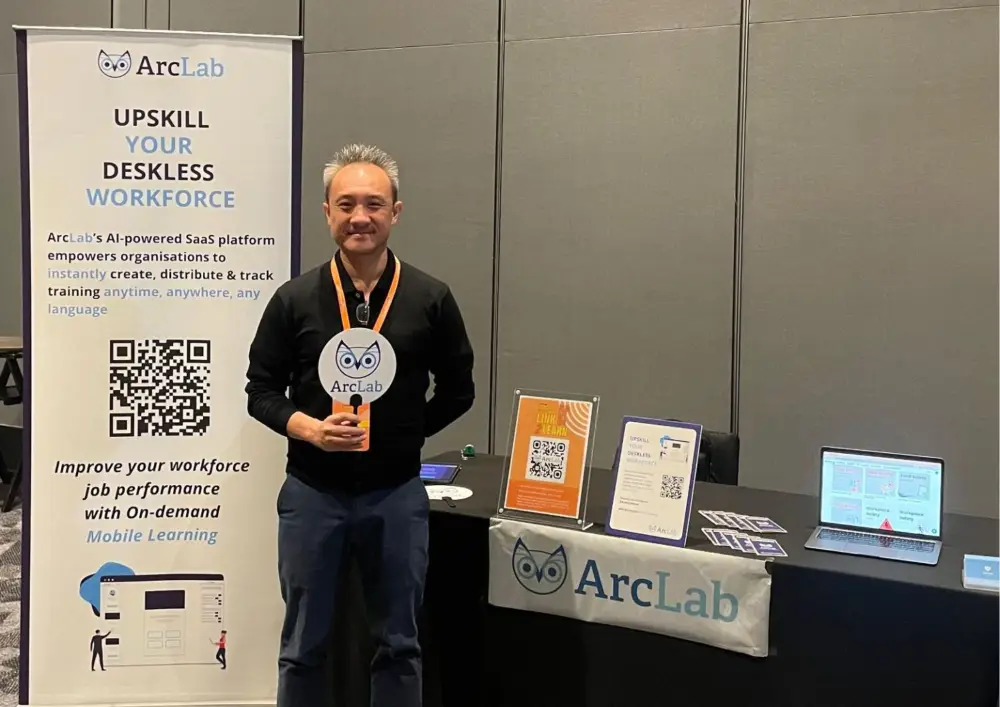
For companies employing deskless workers, providing effective training remains a significant challenge. Traditional learning systems often fail to meet the needs of this workforce, leaving many employees without the tools they need to succeed. James Chia, Co-founder and CEO of ArcLab has taken on this challenge, designing solutions that cater to deskless workers.
James Chia has redefined what accessible training can look like, ensuring that learning opportunities reach those who need them most. With a vision to empower this often-overlooked workforce, James Chia continues to lead ArcLab’s mission, driving progress with user-centric tools and technologies that adapt to the specific needs of companies and their employees.
Key Takeaways:
- James Chia and ArcLab simplify learning systems to help companies train deskless workers, addressing language and access challenges.
- Innovations like Smart Translate and Smart Transform cut training creation time, boosting efficiency for businesses.
- ArcLab’s iterative development keeps the platform user-focused, inclusive, and accessible for diverse workforces.
Highlights
Understanding the Unique Needs of Deskless Workers
Q: How did you come up with the idea, and what’s happening when you develop your product? Are there any technical hurdles or limitations that you face in developing your product?
James Chia: Let me first give a short introduction of what ArcLab is. ArcLab is a mobile learning software as a service platform. Basically, we’re like a mobile LMS. We empower companies to very easily create, distribute and track training. So this is sent digitally to a workforce that we call deskless workforce. Our customers are companies, but our users are workers in the field, typically our frontline employees, our blue-collar. The common characteristics about these workers are, number one, they are generally lower educated and not so proficient in English. Number two, they have no workstation, no computer. And number three, they have no corporate email addresses.
If you think about it, the traditional learning management system; Coursera and Udemy, are very hard to serve this segment of workers. So for us, when we were building it from the ground up, we wanted to do it differently. We empower our L&D and our HR managers to use our SAS tool.
Immediately, we needed to include non-English because we don’t take it for granted that everyone can read English. Most apps, at least in Singapore, are built for English speakers. So the right-handing apps, for example, our non-English readers, in fact, cannot use Grab or Gojek. I mean, Indonesian, no problem, but in Singapore, when they are used to Chinese, for example, I can’t even type in an address in Chinese. So it’s very unfortunate, right? Hence, from the ground up, we needed to build local language. Secondly, we also needed to not assume that everybody needed to know how to download an app. So our product was built from the very beginning to be a web app so that the modules are opened in mobile phone directly.
Lastly, we had to make sure of the accessibility. Not everybody had a computer or a corporate email address. So we are built to be delivered without corporate email training and sent directly to the learner’s phone via WhatsApp or email. If you can notice, I didn’t talk about implementation, coding problems. It’s more about understanding the user. And because it’s so constrained, workforce technology typically is built for office workers.
We really needed to strip down into the very basics. We do not over-engineer, but by understanding the user very, very well, that they are very limited. To build a product that had very few features but fit what exactly they wanted is what we need. So if you think about the workforce, our tech workforce is typically younger, good, highly educated, and speak English. It’s the opposite of the people we are serving.
There was a lot of work needed to make sure that our team understood the user demographics and characteristics, if that makes sense. From a very early on, when it’s just my CTO and I, it’s very simple–just the two of us. But as the team grew a bit, then we needed to make sure they understand it. I think that the challenge was more in the design part. The tech is not the major problem. Once you understand it, then building the right level of tech, I think that is what we were aiming to go for.
Q: Can you elaborate more about the limitations you have when developing this product?
James Chia: I think limitations are something we are very used to. I mean, in Singapore, at least. We are very used to doing a lot with very little. I always joke that when I used to work in London, so I helped to manage the reserves of MAS, our central bank. And among all the rep offices there, we had the largest reserves, but we had the smallest team. So we are always expected to do multiple jobs, double-head, triple-head. So it’s almost like the DNA of our country. And so even today, ArcLab, the receipt stage firm, pre-A, we still have a very small team, including part-timers and associates.
In fact, when we first started out, it was just our CTO, Stephen, and I. So we had to make sure that we understood the user need very well, which is what I explained just now. Most importantly, you needed to build something that people want. You cannot build something people don’t want. This is the traditional startup. Paul Graham always says this, but you will be surprised how many people don’t do this.
Secondly, we needed to make sure that you needed to balance long-term vision, but at the same time, there are short-term goals. So the short-term, many, many short-terms make up the long-term. You cannot give up the short-term, but you cannot give up the long-term when you are building the short-term.
It’s a bit strange but importantly as well, we are a software platform, we are not a system integrator. We don’t build for specific targets, so we build platform. We want to serve the entire customer, the user base. Whatever we build isn’t just for a single company, everything we build must have scalability. It must be reusable. I think in terms of the way that we think about the product, we build a lot with very little; that’s the philosophy. In terms of the team and HR, we have been very blessed to have very good team members, most of whom we recruit out of school. While they come to us with no experience, they have a great attitude, willing to learn. They have no baggage from elsewhere. So it’s a blank canvas, so to speak.
It’s a trade-off. We don’t have experience, but we bring in good, smart people that are hungry, eager, good attitude, humble, and we’re very glad to work with them. I’ll give you an example of our software engineer, Icarus. We hired him from school, from university. He’s not a computer science graduate. I think he is a minor, but his degree is in physics, which is very cool, right? I mean, you know that he’s smart, he’s rational. But even though he’s not a computer science major, we could use his skills and the ability that he could think logically, which is very important for a software engineer. He doesn’t talk very much–most programmers don’t talk very much, but he’s very great with our customers on the chat. We take turns to man our customer success chat. People can ping us if we have questions, and they tell you what we learn.
The other thing that is very good is that in Singapore, wages are very high, relatively. We augment with interns from Singapore Polytechnic, which is a very good institute of higher learning, from their school of computing, from their school of business. These students come in, they work for us, with us, six months, one year. They help us with marketing, we provide a great place for them to work on interesting projects, and they bring it to life. If you work for a larger company, you work on a small piece, but if you work with us, you can bring it from front to back. So for talented people, you want to leave an impact, I think this is quite cool. In fact, one of the interns became my full-time staff.
Last but not least, I think I don’t want to take up too much time, but being a smaller and younger company, you talk about limitations, but being a small company, it’s in fact one of our greatest strengths, because it also means that our club is very agile. We can iterate very quickly; we see what users want, we see what customers want, we talk to them, and open to ideas. We analyze how they can use us. Customers, companies that are very large, they will take too long because they have too many committees. Then Steven and I, we have a quick chat, discuss with the team, and immediately we can move. This has helped us to shape our development road map to be very nimble and very quick.
Q: Is there any particular moment when you feel like it’s hard to run this business with only very, very few people?
James Chia: Yeah, of course, there are always times where you feel that you need more people, which is why I think it was also great to work with Solve Education team. Because one of the things that I run is sales, and obviously there’s a lot of follow-ups that I need to do, which I don’t do enough for, because obviously I need to prioritize my time. I work on product as well. I need to run a firm. Working with some of these who are not on payroll, but actually are good partners that we like and know what we want, I think this is good to be able to have short-term resource or non-payroll resource that can help us to also do the work that’s necessary.
I think in development, sometimes we do very well on the first try, sometimes we take a bit longer–it’s plus and minus. At the end of the day, I think it’s just important to understand that no matter what happens, our core vision doesn’t change. Our vision is to scale the world’s technical workforce, so we’re a little laser focused on that, which means that we don’t try to be everything to everyone. There are some firms that, oh, anything you ask me to do, I can do. And there are these firms that everything they can promise, they say yes. But I think that’s not right. We should not try to boil the ocean. We must solve the core problem that we set out to do because ultimately, we need to make sure that the customer needs that we meet. If not, then you’ll end up being nobody to no one. And nobody will use you and you end up doing lousy job for everything. So I’d rather do less, but make sure that we keep solving the problems of our customers.
So it’s HR, it’s L&D, it’s Ops. Our club will always stay useful and relevant. Then even if things take a bit longer, I think working together with our team with our customers, we understand what they want, and then we eventually will get there.
Q: Do you have some tips to maybe entrepreneurs out there who also running a business with very limited people?
James Chia: I think team members, ultimately. It’s a win-win. Symbiotic, I call it a relationship. I need you, you need me. I know now there’s this whole thing about employer-employee thing. Then, employees are like, “Now it’s not so bad because job market has come down a bit!” but one year ago, it was, “If you don’t offer remote, you don’t offer work from home, I don’t work for you”. These are not a war. It’s not two teams fighting each other. It’s not us versus them. As long as we can understand that it is a team, symbiotic, I need you because I need you to do the work for me. If I’m the employer and you are the worker, I actually need you as the employer because, without you, I have no job. Together, we all need the customer because without the customer paying us, nobody has a job. I think this is a very important philosophy that, unfortunately, many people forget.
The customer is, in fact, the most important because without the customer, without the need, without the pain, there’s no work for us to do. This is very important for us, which is why we are very cooperative. Ultimately at a team level, there are product meetings weekly where we discuss what we’re doing. We discuss what are the problems that we face and then suggestions to make things better because the team is small. We use it to our strength; we can make decisions very fast. So, for fellow entrepreneurs who are running small teams, you use it as your advantage because you are very fast. You’re like the little mouse, you can run very fast. The big elephant takes a long time to turn. So, move faster than the elephant!
Secondly, I think we don’t try to be everything to everyone. So, just make sure you fit that need. Once you have done that very well and you have done that at scale, then you think about extending further. But before you are ready, don’t try to build the next thing.
The last thing I would say is that, again, customers are very important. We make sure that we work the ground by constant communication with customers and their staff. Sometimes we arrange for on-site with the key customers at their outlets, at their workplaces, so that we can see how the staff uses our web. We interview them so we don’t take for granted what we know. Obviously, we track the usage, but the best tech companies in the world will spend countless hours refining that user experience; as few steps as possible to start, sign up, use. As a B2B company, because we sell to companies, we adopt a similar approach and we make sure the interface is as B2C as possible. The C in this case is the worker. The worker may not be used to technology, so all our work must be built to must be done to help him or her succeed. And customers know the best; they give us suggestions of what they want to see.
We glean insight from the platform usage issues they tell us through the customer chats, and then we chip away at the problem that most, if not all of their customers will face. We then implement it. Because we are not a system integrator, we are a platform, we build for everyone in our user base, we don’t charge any customer development fees. All of their costs are borne by our club, so companies will just pay a simple subscription. And best of all, they don’t need to maintain any software. They benefit from all the ongoing improvements in the platform.
And because it’s our baby, we will take good care of it.
Q: Can you share some milestones and breakthroughs that you’re really proud of and that you want to celebrate with us in your product or maybe your experience so far?
James Chia: A bit hard for us to do because I always tell my team that we’re in day one. We are always in day one, but obviously, we need to celebrate small wins, which I think the first thing is that we have come a long way from when we first built our POC. I built my POC with an intern in six weeks, it’s a very small, basic one, but it validated that people use it. And then from there, when we launched commercially, the MDP with my CTO coming on board, we just make sure we keep working hard. The platform today must always be better than the platform yesterday. Just that little bit better, guided by how we can help customers to solve their training needs.
If you ask about milestones, I guess the first key one is ArcLab Smart Translate. I mentioned that we empower our customers to create training in just one language and then with a click of a button, it can be translated into as many languages as they want. Learners can consume training in the languages that they are most comfortable in. The machine generates the translation, but it is not a hundred percent. There’s context and local nuance to it. Our users still need a native speaker to review, but to think about it, we have saved 80% of training creation time.
I don’t need to create 10 different modules. I create one, then I press the button nine times. Hopefully, one time I’m working on this, then I just have a native speaker just review and I cut down the work so much. This is a great thing and it’s much more accessible, much more inclusive. This is something that we were very glad to introduce.
The second one is ArcLab Smart Transform, where now customers can upload a PowerPoint slide. It can contain their training material and in an instant is converted into ArcLab interactive learning module. So again, it saves time. We can convert it, and I don’t need to spend time quote-unquote data entry. I can upload it very fast and again, saves up to 80% to 90% of training creation time.
The third one is we’re going to launch soon. When we first started, we were serving smaller companies. But, as we started to serve larger companies, we are being re-architected into a multi-user team product. Different builders can collaborate more effectively to deliver training at scale to larger organizations. Think about it like a Figma or a Canva or a Google Doc where we can collaborate together. This is the new environment that we are architecting.
Last but not least, we’re probably going to work on a little bit more AI, put it into the platform. One big challenge that hasn’t been solved is how to assess skill. So, on the job training, we typically need a person, a senior person or a mentor to guide a younger one. Can we use technology to do that? We are working on some prototypes. If everything works out, we should launch it hopefully next year.
This is the exciting part, skills assessment, skills training, skills accreditation. This is something that we’re quite excited about. But I cannot celebrate it yet.
Building Tools That Matter for the World’s Workforce
James Chia’s unwavering commitment to deskless workers highlights a key challenge: bridging the gap between technology and accessibility. As Co-founder and CEO of ArcLab, James Chia leads efforts to build a platform tailored to overlooked workers. These include workers with limited digital literacy or no access to corporate infrastructure, often neglected by traditional systems.
Through innovation, James Chia shows how user-focused design and scalable solutions can create impactful tools for businesses. By turning challenges into opportunities, James Chia inspires us to envision a future where all workers have access to essential training.
Highlights
Read this article in Chinese here.