Startups pitch. Leaders present. Teams meet. But how many truly make their message stick? Attention is the new currency—but most leaders are still paying in bullet points. This is a pain point many leaders face today. They know their content, but something’s missing—authenticity, energy, presence. And that’s the real problem. Being heard isn’t the same as being remembered.
Hazriq Idrus learned this early—not in a boardroom, but on stage. He started his journey in theatre, where connection is everything. Later, he entered corporate training and saw a similar challenge—great professionals but stiff communication. That’s when he decided to bring the world of improv to the business world. He believed theatre and leadership had more in common than people realized.
Today, Hazriq helps leaders communicate with soul, spontaneity, and story. Because when professionals show up with creativity and presence, people listen—and remember.
Highlights
Why Leadership Today Needs a Stage Mindset
Q: It’s been 13 years since you founded The Speaking Factory. Take us back to the beginning—what inspired you to start this company?
A: I think it must be this particular brochure I stumbled upon while in Vancouver, Canada in 2009. It kind of seeded in my mind for some time.
You see, my background, and first love, has always been in the performing arts – particularly theatre. I started doing stage acting in 1997 and after national service, I got the opportunity to work full-time as an actor.
In 2002, I was offered to be in the pioneer team at library@esplanade, Singapore’s first and only performing arts library. My manager then also encouraged us to continue to be involved in the performing arts so that we can use our arts experiences to serve the customers. So I was balancing library work during the day, stage acting (sometimes TV acting) at night or weekdays, or off days.
In the library staff system, there’s also a scheme where you could work 10% of your time (about 20-25 days per year) with another department, as part of personal and professional development. I was attached to library HQ – to help conduct corporate training workshops.
Over there, I started to fall in love with corporate training – conducting creativity and innovation workshops for internal staff and for other agencies. This is the start of my corporate training journey. After five years at library@esplanade, HQ offered me to join them full-time. And I still continue doing my acting and theatre stuff.
To keep up with my learning especially in the areas of acting and theatre, I went to Vancouver in 2009. It was a vacation plus attending an improv workshop. Improv was huge in the UK, US and Canada. For me, I wanted to learn from the best.
When I was there, I stumbled upon a ‘Corporate Training with Improv’ brochure, at the workshop. Then I began to research more on corporate improv and theatre-based training. That was something not widely familiar in Singapore but interesting. I had a thought – what if these programmes were brought to Singapore? What if I conducted such programmes?
But at that time, I was still working with the library, so I just shelved that idea aside.
Around 2010/2011, however, a major reorganisation happened. A change in direction in the library management saw the closure of the corporate training arm that I was running. To me, I was at a crossroads. I could choose to stay – and probably doing something that I might not be good at – or going for greener pastures.
And that point of time coincidently, our clients were asking if I could still run corporate training for their companies. When I told them we couldn’t, they asked me, “How about running it on your own?”
That question was the turning point. What if I run my own training firm? Then the ‘corporate improv training’ appeared in my head again. Not long later, I bumped into my ex-lecturer, who by then had resigned and started his own training firm. He shared with me what he did.
So it’s like everything came at one time. It’s like a revelation. Hahaha. Perhaps, it’s more of a calling.
So I put all these together, and The Speaking Factory was born in Nov 2011. Our specialty: Helping leaders & professionals to connect, speak, and innovate effectively using creativity & theatre improv principles.
Q: What has been your most memorable experience on the job, and how has it shaped your career?
A: I think there are two that go hand-in-hand.
First, I had to have a switch of mindset – from just a corporate trainer (which obviously I like to do) into an entrepreneur. Which means, I had to attend business networking sessions, among other things. Ironically, I’m kind of shy. I am an introvert by nature. And meeting with CEOs and other seasoned business owners, I felt “small”. I had this thought like, as to why these CEOs would want to even talk to me.
Then some of my friends jokingly uttered to me “You are a business owner, and the founder of your company. What’s the big deal meeting with these CEOs!” They were right. I need to change my perspectives. Interestingly, when I met up with these CEOs, they were so humble, and their willingness to share with newbies like us was a gem! I enjoyed their company and along the way, I realised that while I am an introvert, I am a people person. I like to meet with new people and learn from them.
The second experience came in 2014, when I got a chance to partner with one of the training events companies. This company opened up doors for me to train in Malaysia. This was in line with what I wanted to do, to serve clients beyond Singapore, in particular, the ASEAN region. That was a wonderful experience.
Following that session, one of the participants contacted me again a few years later, wanting me to conduct the programme that he attended in 2014, this time for his organisation. That led me to having a good 3-year project conducting training in Malaysia for this oil and gas company.
These two experiences showed me the importance of networking with people. After all, there’s a saying, ‘our network is our net worth’.
Q: How do you handle challenges or difficult situations at work, and have your strategies changed over time?
A: One of the challenges I face at work is very much on the admin side of it. Some of the clients delayed their payments – which definitely affected my business cashflow.
What I used to do then, after sending invoices, I would just wait – for the money to come in. After the deadline, when the funds didn’t come in, I would follow up. It was only then I found out that there were errors on the invoicing, which they did not notify me about. Or they were just simply sitting on the invoice without any action, and then tried to give reasons for the delay after I checked-in. No wonder my money didn’t come in. Hahaha.
So now, I’ve implemented a simple system that we will follow up with clients 3 days after my admin manager had sent out the invoices. This was just to do a quick check with the client and if there are any challenges, we could mitigate them sooner than later.
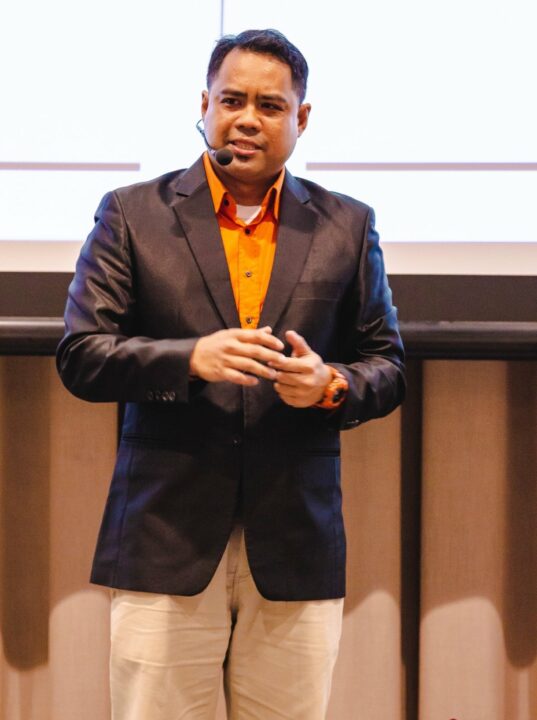
Q: The Speaking Factory has worked with clients like BMW, Petronas, and Starhub. What’s a common communication challenge these organizations face?
A: I think the most common challenge I noticed was the clients’ level of ability to connect with their audience. Generally, these corporate staff can do presentations. The room for improvements for them is how they can effectively interact and engage with the people they are speaking with.
So over the years, I fine-tuned my training programmes to include the mindset bit on the importance of connecting with people and how to make connections with people during speaking and presentation.
Q: How has your experience in theatre shaped your approach to leadership communication and creative thinking?
A: One of the core skills in acting that we need to learn especially during my early days doing theatre is improv. Improv is more than just being spontaneous or being comedic.
For example, one of the training games, “Yes, And” will have two actors having a conversation with each person saying 1 sentence each during their turn. And both must start with the words, “Yes, And’ before completing their sentences.
(Example: The Yes And Game – Hazriq Idrus’s YouTube)
This training helps actors to develop the skills in spontaneity, active listening, adaptability, and collaboration so that they can put up a short scene spontaneously.
And these are very same principles that are also needed in communication and creative thinking in the corporate setting!
So what I do, I use these same principles and same activities and make them relevant during my training and prepare them for the world beyond performing arts.
Q: Can you walk us through the theatre-based Speaking System and why it is so effective?
A: For public speaking training, I put together a framework called ‘The Public Speaking Trifecta’. It is a 3-ACT system – that mimics a theatre production where there are usually three Acts in a play.
For my case, ACT 1 focuses on the Messenger – the speaker/presenter. The speaker undergoes all the principles of actors’ training needed to build his capacity and capability as a presenter/ speaker, e.g. confidence-building, breathing techniques, voice projection, space or stage movement. ACT 2 focuses on the Message – how to design and craft the script itself. One of the methods I used is Storyboarding. ACT 3 will be Masterpiece. This is the culmination of ACT 1 and ACT 2 together, stitching and peppered them with other core principles from theatre like Improv to make the presentation unique.
The beauty of this framework is that participants attending my workshops will be busy doing hands-on work. People learn better by doing. And for those having upcoming speeches, by the end of the workshops, they will have the basics of their speeches, plus on-site feedback. At one glance, people thought it was an actor’s training session, but it has been designed in a way that it is suitable for corporate people.
My participants always ‘complained’ that they had no time to be idle or checking their phones while attending my workshops. Hahaha. They were immersed into the programme.
Currently, I’m also working on the revised edition of ‘The Stage Fright Antidote’ – a book to help master public speaking using acting and theatre techniques. Originally it was launched in 2013. In this edition, it’s going to be more structured, easier to follow, yet beefy in its content.
Q: How do you stay motivated and engaged in your work after so many years?
A: I must say that motivation is a feeling in us that can come and go. So I had to find that trigger. For me, my two main triggers would be: (1) the love for acting and theatre; and (2) family.
For (1), my first love will always be stage acting. So I fuse those principles in all my workshops and speeches, so even on non-acting days, I would still be involved in some sort of ‘theatre work’. That makes me happy.
(2) It is really about putting the food on the table for the family, bringing them for holidays, and enjoying our time together. And I need to keep working to get the funds so I can do those things.
Q: How have you balanced your work with your personal life over the years, and has your approach changed?
A: When I first started out, it was fun. I mean, new company, new life. A breath of fresh air. I set aside time doing my morning walks, then work. On non-training days, I’ll be doing my admin stuff in the office. Over the years, things started to get overwhelmed… I would do a bit of here and a bit of there… and sometimes, counter-productive…
Until I met Mr Shafie. He was the CEO of Carrefour (APAC) then and was based in Indonesia. He was back in Singapore for Hari Raya and he invited me over to his house for Hari Raya Open House.
Over there, we chatted. He asked me a simple but interesting question, “Hazriq, what is entrepreneurship to you?” I gave him my ‘textbook’ answer of being an entrepreneur and running my own business. He smiled.
Then, I asked him the same question. His reply was mind-blowing. “Entrepreneurship is a lifestyle”, he said.
He went on to explain that he planned his day around his work; so he can have meetings with staff, have lunch with his family and even run a social enterprise wing to help single mothers in Indonesia to get jobs and businesses. That wing was managed by his wife.
That Hari Raya visit turned out to be a “business class – learning from the best!’. I emulated Mr Shafie’s version of what entrepreneurship was. I’ll no longer face, ‘Guys, I’ll meet you guys up for soccer after I finish work’ kind of thing.
Now, I schedule my time around me running my business. If my son is having his school’s Sports Day, I would arrange meetings with clients after attending the school event.
I enjoy giving back to the community. So my way of giving back is scheduling on certain days as ‘Corporate Social Responsibility (CSR). Last year, we started partnering with one of the local madrasahs to conduct leadership training programmes for their student leaders and staff as part of CSR.
When my friends invited me to form a futsal team to play in a league, I set aside time on certain days to play futsal, as part of my ‘corporate wellness day’. Not only that, I set aside some funds to sponsor the jerseys for the futsal team I was playing in. So I had a vested interest in keeping fit as well. Hahaha.
This term “Entrepreneurship is a Lifestyle” is now my motto.
Building a Business That Speaks—and Moves—People
Hazriq’s story is more than a career pivot—it’s a powerful lesson for every founder and leader. He built a new way of thinking about leadership. Where communication isn’t a skillset—it’s a stage. Where entrepreneurship isn’t a job—it’s a lifestyle. And where creativity isn’t a nice-to-have—it’s a daily tool.
Your idea matters, but your delivery decides whether it lands or gets ignored. That’s where creativity steps in. Not the artsy kind, but practical, purposeful creativity. The kind that helps you think on your feet. Listen deeply. Speak clearly. Hazriq built The Speaking Factory to help others do just that. He teaches that leadership is a performance—and your audience deserves your best.
From startup founders pitching VCs to managers leading teams, the need is the same. Clarity. Confidence. Connection. And perhaps that’s what we need more of—not just better slides, but better storytellers. Because, in the end, the best leaders don’t just talk. They move people.
Highlights
Read the article in Chinese here.