For decades, Southeast Asia’s growth story has been defined by familiar themes: rapid urbanization, a growing middle class, expanding digital economies, and shifting global supply chains.
Yet beneath those headline trends, a quieter transformation may be taking place.
Governments across the region are increasingly focused on strengthening the institutions that support long-term economic development, particularly their capital markets.
The observation was recently highlighted by Christopher B. Beselin, CIO and Founding Partner of Endurance Capital. Drawing on more than 15 years of operating and investing across Southeast Asia, Beselin noted that five countries — Vietnam, Malaysia, Indonesia, Singapore, and Thailand — are simultaneously pursuing significant capital market reforms, something he says he has never previously seen during his time in the region.
The observation is noteworthy not simply because reforms are taking place, but because they are happening at roughly the same time.
It raises a larger question: Why are so many Southeast Asian countries focused on improving their capital markets now, and what does that reveal about the region’s evolving economic priorities?
Highlights
- Capital Markets Matter Far Beyond Finance
- The New Competition for Capital Is No Longer Just About Growth
- Five Economies, Five Strategies, One Shared Challenge
- Trust Is Becoming a Competitive Advantage
- What Public Market Reforms Mean for Companies That Aren’t Public Yet
- Better Rules Do Not Automatically Create Better Markets
- What These Reforms Reveal About Southeast Asia’s Next Chapter
Capital Markets Matter Far Beyond Finance
Capital markets are often viewed as a niche topic relevant only to investors, regulators, and publicly listed companies.
In reality, they sit much closer to the heart of economic development.
Healthy capital markets help determine how efficiently savings are transformed into productive investment. They influence how businesses access growth capital, how companies are governed, how investors evaluate risk, and how economic value is distributed across an economy.
They also play an important signaling role.
When investors evaluate a country, they are not only assessing growth potential. They are also assessing the quality of institutions that support business activity. Market accessibility, regulatory consistency, disclosure standards, and shareholder protections all contribute to perceptions of trust and credibility.
In that sense, capital markets function as more than financial infrastructure. They are a reflection of how an economy organizes accountability, transparency, and long-term value creation.
As countries move beyond the early stages of development, these foundations often become increasingly important.
The New Competition for Capital Is No Longer Just About Growth
For many years, attracting investment was largely associated with economic growth rates, favorable demographics, and expanding consumer markets.
Those factors still matter.
However, global capital today operates in a vastly different environment than it did a decade ago.
Investors have more options, more data, and greater expectations regarding governance and transparency. Large institutions can compare opportunities across dozens of markets almost instantly. As a result, countries are increasingly competing on factors that extend beyond growth alone.
The ability to provide predictable rules, credible oversight, efficient market access, and transparent corporate behavior has become part of a country’s competitive positioning.
This helps explain why several Southeast Asian governments are pursuing reforms despite having different political systems, economic structures, and market characteristics.
Each country faces unique challenges, but many are responding to the same global reality: capital increasingly rewards trust as much as opportunity.
Five Economies, Five Strategies, One Shared Challenge
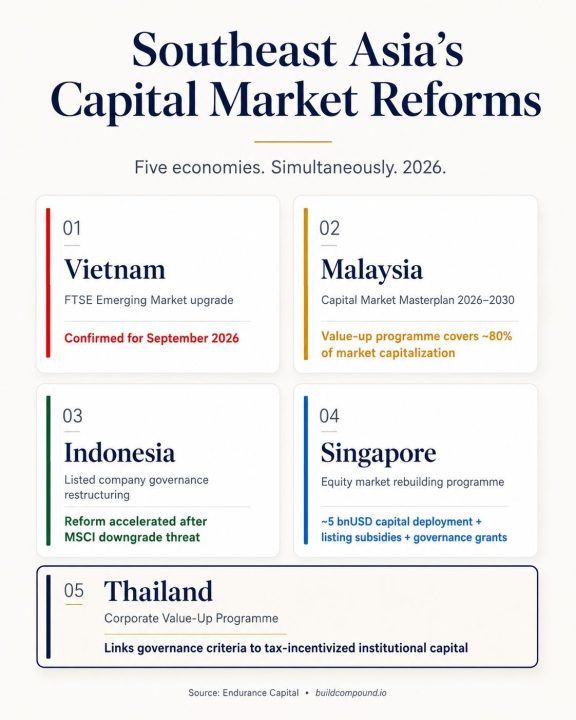
One of the most interesting aspects of the current reform wave is that there is no single regional blueprint.
Instead, each country is pursuing its own path.
Vietnam has spent years working toward greater integration with global financial markets through improvements in market accessibility, trading infrastructure, and governance standards. Its reform journey reflects a desire to reduce barriers that have historically limited participation from larger pools of international capital.
Malaysia’s approach has focused more heavily on corporate value creation, governance enhancement, and strengthening confidence in listed companies. Rather than fundamentally rebuilding its market, Malaysia is seeking to improve how existing companies engage with investors and create long-term value.
Indonesia’s reforms have accelerated following external scrutiny regarding governance and market oversight. The response illustrates how pressure from international institutions can sometimes become a catalyst for domestic change, particularly when market credibility is at stake.
Singapore, meanwhile, faces a different challenge. As one of Asia’s leading financial centers, its focus is less about basic market development and more about ensuring continued relevance in an increasingly competitive global landscape. Recent initiatives reflect efforts to strengthen market vibrancy, attract listings, and deepen institutional participation.
Thailand has concentrated on improving company-level governance and encouraging listed firms to adopt higher standards of transparency and long-term planning.
Viewed individually, these reforms appear distinct.
Viewed collectively, they suggest that policymakers across the region increasingly recognize that capital market quality is becoming a strategic economic issue rather than merely a financial one.
Trust Is Becoming a Competitive Advantage
A common thread running through many of these initiatives is the growing importance of trust.
Historically, governance was often discussed as a compliance requirement. Companies followed rules because regulations demanded it.
Today, the conversation is changing.
Transparency, accountability, and governance standards are increasingly influencing how businesses, investors, and institutions assess opportunities.
For governments, stronger governance frameworks can improve market credibility.
Meanwhile, businesses gain better access to capital and stronger relationships with stakeholders through improved governance.
Finally, these standards provide investors with the confidence that disclosures are reliable and minority interests are protected.
In other words, trust is no longer simply an ethical consideration. It has become an economic asset.
Countries that can establish a reputation for credible institutions and transparent markets may find themselves better positioned to compete for long-term capital, talent, and business activity.
Whether every reform succeeds remains uncertain, but the direction of travel itself is revealing.
What Public Market Reforms Mean for Companies That Aren’t Public Yet
Many founders and entrepreneurs may assume that stock market reforms have little relevance to their businesses.
The reality is more interconnected.
Public markets often influence the broader business ecosystem in ways that are not immediately visible.
Stronger capital markets can create additional pathways for companies seeking to scale. They help establish valuation benchmarks, support acquisition activity, attract institutional capital, and provide potential exit routes for investors and founders.
They can also influence expectations around professionalism and corporate behavior.
As governance standards improve among listed companies, similar expectations frequently spread throughout supply chains, investment networks, and private businesses. Investors become more demanding. Customers seek greater transparency. Boards become more sophisticated.
Over time, the effects extend beyond public companies and begin shaping the broader business environment.
For entrepreneurs building long-term businesses, these changes can be highly relevant even if an IPO is nowhere on the horizon.
Better Rules Do Not Automatically Create Better Markets
While the reform momentum is significant, it is important to distinguish between policy announcements and outcomes.
Reforms often take years to demonstrate measurable impact.
New governance standards may be introduced, but unevenly enforced. Regulatory ambitions can collide with practical realities. Political transitions can alter priorities. Market participants themselves may require time to adapt.
There is also no guarantee that stronger governance alone will transform investor perceptions.
Global capital remains heavily concentrated in a handful of major markets. The United States, China, India, Japan, and other large economies continue to attract enormous amounts of attention and capital.
Even well-designed reforms may struggle to shift those dynamics quickly.
Moreover, capital markets ultimately reflect broader economic conditions. Governance improvements can strengthen foundations, but they cannot substitute for corporate performance, innovation, economic growth, or business confidence.
The journey from reform to tangible results is rarely linear.
Recognizing that uncertainty is essential to understanding the significance of what is happening today.
What These Reforms Reveal About Southeast Asia’s Next Chapter
The most important takeaway may not be any individual reform program.
It may be what the collective effort reveals.
For years, Southeast Asia’s economic narrative has been dominated by discussions around demographics, manufacturing, digital transformation, and consumption growth. Those themes remain important, but maturing economies eventually face a different set of questions.
How do they strengthen institutions?
How do they strengthen institutions?
In what ways can they improve governance?
Finally, what will it take to build confidence among businesses, investors, and stakeholders?
The current reform efforts suggest that policymakers across the region are increasingly focused on those questions.
Vietnam, Malaysia, Indonesia, Singapore, and Thailand are pursuing different strategies because their circumstances differ. Yet all appear to be responding to a similar reality: the quality of institutions is becoming a more important determinant of economic competitiveness.
Whether these reforms ultimately achieve their intended objectives remains uncertain. Some may take longer than expected. Others may deliver more modest outcomes than policymakers hope. Global investors may continue prioritizing larger markets elsewhere.
Yet the fact that several Southeast Asian countries are pursuing these efforts simultaneously is significant in itself.
It suggests that governance, transparency, and capital market quality are increasingly being viewed not as technical regulatory matters, but as strategic assets in a more competitive global economy.
That may prove to be the most important story of all.
Editor’s note: This article was inspired by a LinkedIn post and essay by Christopher B. Beselin, CIO and Founding Partner of Endurance Capital. Building on his observation that several Southeast Asian countries are simultaneously pursuing major capital market reforms, this feature explores the broader implications for governance, competitiveness, and long-term economic development across the region.
Highlights
- Capital Markets Matter Far Beyond Finance
- The New Competition for Capital Is No Longer Just About Growth
- Five Economies, Five Strategies, One Shared Challenge
- Trust Is Becoming a Competitive Advantage
- What Public Market Reforms Mean for Companies That Aren’t Public Yet
- Better Rules Do Not Automatically Create Better Markets
- What These Reforms Reveal About Southeast Asia’s Next Chapter
Read the Chinese article here.