As Aichi-Nagoya 2026 crowns its first MLBB champion, esports has the audience, the medals, and growing institutional recognition. But its place at future Asian Games remains a more complicated question.
Mobile Legends: Bang Bang has awarded its first official Asian Games gold medal, with Myanmar defeating Indonesia 4–0 in the final on 1 October.
But the audience was already there months before the medal event.
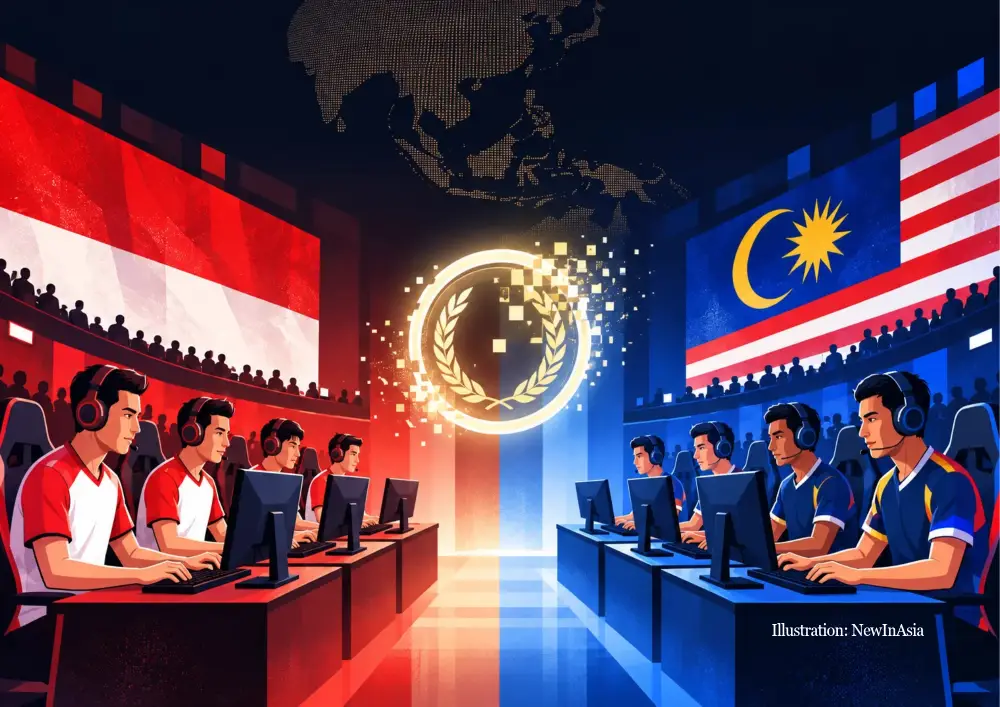
In June, the Asian Games MLBB qualifiers peaked at 1.278 million concurrent viewers during Malaysia versus Indonesia, according to Esports Charts. That is a very large audience for a qualifier.
It also shows how far competitive gaming has come inside one of Asia’s biggest sporting institutions. In eight years, esports went from a demonstration event to 11 medal events at Aichi-Nagoya 2026.
Yet this week also raised an awkward question. On 28 September, the Olympic Council of Asia (OCA) denied reports that esports would leave the Asian Games after this edition. Those reports were based on the OCA’s own 2024 board decision. Esports has made it onto the programme. Whether it stays there is less clear.
Highlights
From Sideshow to Medal Table in Eight Years
At Jakarta-Palembang 2018, esports was a demonstration sport. Medals were awarded but did not count towards the official standings.
Five years later, that distinction disappeared. At the Hangzhou Asian Games, held in 2023, esports became an official medal sport for the first time. Seven titles were contested by 473 athletes representing 30 National Olympic Committees, according to the OCA. China topped the esports medal table with four golds and a bronze, ahead of South Korea.
Aichi-Nagoya 2026 expanded the programme again, to 11 medal events covering 13 titles. The gap comes from one Competitive Martial Arts team event that combines Street Fighter 6, Tekken 8 and The King of Fighters XV. Each country fields three players, and one medal is awarded.
| Edition | Esports status | Programme |
| Jakarta-Palembang 2018 | Demonstration, medals not counted | 6 titles |
| Hangzhou 2022 (held 2023) | Official medal sport | 7 titles |
| Aichi-Nagoya 2026 | Official, expanded | 11 events, 13 titles |
This is also the first time MLBB is an official Asian Games medal event.
The Medal Events: Decided and Still to Come
Four of the final esports medal events began between 28 and 29 September. PUBG Mobile, Identity V and Mobile Legends: Bang Bang have now been decided, leaving League of Legends to close the esports programme on 2 October.
Already Decided
Mobile Legends: Bang Bang (29 September to 1 October)
Myanmar became the first Asian Games MLBB champion, defeating Indonesia 4–0 in the gold-medal match.
The Malaysia-Indonesia rivalry that drew 1.278 million peak viewers in qualifying returned in Nagoya, with Malaysia winning their group-stage meeting 2–0. But Indonesia went further, reaching the final before losing 4–0 to eventual champion Myanmar.
Myanmar completed a dominant knockout run, beating Cambodia 2–1 in the quarterfinals and Malaysia 2–0 in the semifinals before sweeping Indonesia in the final.
Myanmar won gold, Indonesia took silver, while Malaysia and Mongolia earned bronze.
PUBG Mobile (28 to 29 September)
Twelve nations competed across 12 matches over two days: Japan, China, South Korea, Chinese Taipei, Vietnam, Thailand, Malaysia, Indonesia, Myanmar, Uzbekistan, Jordan and Pakistan.
Thailand won gold with 128 points, ahead of China with 114 points for silver and Pakistan with 100 points for bronze.
Identity V (28 to 30 September)
Ten teams competed in the seven-player mobile title: China, Chinese Taipei, Hong Kong, Indonesia, Japan, Malaysia, the Philippines, South Korea, Thailand and Vietnam.
China won gold after defeating Japan in the final. Japan took silver, while Malaysia and Chinese Taipei earned bronze.
Still in Play
League of Legends (29 September to 2 October)
Eight teams compete: South Korea, Chinese Taipei, Hong Kong, India, Malaysia, Saudi Arabia, the United Arab Emirates and Vietnam. South Korea are the defending champions from Hangzhou, where Chinese Taipei took silver. China, the 2023 bronze medallists, are not competing. The grand final is a best-of-five.
The Medal Table So Far
With 10 of 11 esports medal events now decided, China leads with three gold medals, followed by Japan with two. Malaysia has the joint-highest overall medal count with five: gold in Gran Turismo 7, silvers in eFootball and Honor of Kings, and bronzes in Identity V and Mobile Legends: Bang Bang. Myanmar has also joined the gold-medal winners after becoming the first Asian Games MLBB champion.
| Event | Gold | Silver | Bronze |
| Honor of Kings | China | Malaysia | Hong Kong, Philippines |
| Pokémon Unite | Japan | Indonesia | South Korea, Philippines |
| Puyo Puyo Champions | Japan (Yuki Kurihara) | South Korea | Chinese Taipei, Thailand |
| Competitive Martial Arts | South Korea | Japan | Hong Kong, Saudi Arabia |
| Naraka: Bladepoint | China | Thailand | Chinese Taipei, Vietnam |
| eFootball | Iran | Malaysia | Japan, Uzbekistan |
| Gran Turismo 7 | Malaysia (Taj Izrin Aiman Taj Madira) | Saudi Arabia | South Korea |
| PUBG Mobile | Thailand | China | Pakistan |
| Identity V | China | Japan | Malaysia, Chinese Taipei |
| Mobile Legends: Bang Bang | Myanmar | Indonesia | Malaysia, Mongolia |
Six Southeast Asian nations have now reached the esports podium: Malaysia, Indonesia, Thailand, the Philippines, Vietnam and Myanmar. With League of Legends still to be decided on 2 October, the region could add more before the programme ends.
The Audience Arrived Before the Medals
Formal recognition is one thing. Audience demand is another, and esports brought its own.
When esports made its medal debut at Hangzhou in 2023, the OCA reported that esports tickets were the most sought-after of the Games’ 61 disciplines. The road to Aichi-Nagoya showed similar demand online:
| Asian Games qualifier (June 2026) | Peak concurrent viewers |
| Mobile Legends: Bang Bang | 1.278 million |
| PUBG Mobile | More than 658,000 |
| Honor of Kings | More than 207,000 |
The MLBB qualifiers also generated about 8.91 million hours watched, according to Esports Charts. Outside the Asian Games, MLBB’s M7 World Championship grand final in January 2026 passed 5.68 million peak viewers, becoming the most-watched mobile esports tournament in history, according to Esports Charts.
Online peaks are not directly comparable with broadcast audiences for traditional sports. But the direction is clear. The Asian Games are hosting a competition that arrives with its own audience, and that audience is strongest in Southeast Asia.
A Running Track Doesn’t Need a Software Update
Putting esports inside a multi-sport event takes more than setting up computers. Competitive gaming adds hardware, software, network stability, and game versions to the usual work of officiating.
A running track does not receive a software update. A football match does not depend on a game engine. Esports does.
For Aichi-Nagoya 2026, Tencent Esports’ Competition Solution is providing technical support across all 11 esports events, covering equipment inspections, real-time technical monitoring and post-match reviews.
Some titles are even played in special editions. PUBG Mobile and Identity V are contested in “Asian Games Versions”. At Hangzhou, the Asian Games version of Arena of Valor reduced the game’s “amount of socialization, commercialization, and non-battle systems”. No one builds a special edition of the 100 metres.
Who Owns the Sport?
Nobody owns the 100 metres. In esports, every medal title belongs to a company, and that company controls the rules, the updates, and whether the game continues to exist.
On this year’s programme, Honor of Kings and PUBG Mobile are Tencent titles. League of Legends is made by Riot Games, which Tencent owns. Tencent Esports is also the technical provider for all 11 events.
MLBB’s publisher, Moonton, co-organises the MLBB tournament with the OCA and the Asian Electronic Sports Federation. ByteDance acquired Moonton in 2021 in a deal that valued the studio at around US$4 billion, according to Reuters.
In March 2026, Savvy Games Group agreed to buy Moonton from ByteDance in a deal valuing the studio at US$6 billion, according to Bloomberg. Savvy Games Group is owned by Saudi Arabia’s Public Investment Fund. Saudi Arabia is also among the nations competing in MLBB at Aichi-Nagoya, according to Moonton.
None of this suggests wrongdoing. Publishers are what make competition at this level possible, and they invest heavily in it. “What began as a game enjoyed by millions of players is now a competitive platform where elite athletes represent their regions on one of Asia’s biggest medal stages,” said Ray Ng, Head of Esports Ecosystem at Moonton.
It does, however, create a governance question that traditional sport never faced. Decisions about game versions, patches and a title’s future are commercial decisions, made outside the sporting bodies that award the medals.
The Demand Is Physical Too
Esports is digital, but its biggest events move people. Players, teams, organisers, sponsors, media and fans all need somewhere to stay, eat and meet.
“What is particularly interesting from a hospitality perspective is that a digital-native industry is increasingly creating very physical demand. Major esports events bring players, teams, organisers, sponsors, media and spectators into a destination, and the Asian Games gives that demand an additional level of visibility and legitimacy.
For hotel owners and operators, the opportunity goes beyond simply filling rooms during an event. Esports audiences are digitally engaged, international and often younger than the traditional customer segments many hotels have historically targeted. Understanding how they travel, how long they stay, what they spend on, and how they book could open up new opportunities across accommodation, F&B, events, partnerships and destination experiences.
We have seen hospitality continually adapt as new sources of demand emerge. Esports is another example of why owners need to look beyond traditional segmentation and pay attention to where the next generation of travel demand is being created.”
Pierre Marechal, Vice President, Asset Management Asia Pacific, JLL Hotels & Hospitality Group
Will Esports Stay?
The OCA’s official record and its latest public statement don’t agree.
According to the OCA’s official decisions document from its 90th Executive Board meeting, on 26 November 2024, the board unanimously approved a proposal to remove esports from the Asian Games programme after Aichi-Nagoya 2026 and hold a separate Asian Esports and Mind Games.
On 19 September 2026, the OCA confirmed that Kuwait will host the first Asian Esports and Mind Sports Games in 2027.
But on 28 September 2026, the OCA said esports would continue as a medal sport at the Asian Games, stating that it had not made or issued any announcement regarding esports withdrawing from the Asian Games.
The OCA has not publicly clarified whether the 2024 decision was later withdrawn, amended or superseded. The next Asian Games will be held in Doha in 2030.
So this week’s finals may be the start of something permanent, or the high point of a short run. Either way, this week’s competition has shown that esports can fill an Asian Games medal programme and bring a substantial existing audience with it.
The harder question is who should decide its future. If a sport’s rules, versions and very existence belong to companies, who should decide whether it earns a place at the Asian Games: the OCA, the publishers or the audience?
Tell us where you stand.
Sources
- Asian Games 2026 esports medal table and results, Sheep Esports (as of 28 September)
- OCA denies esports exit from Asian Games, contradicting its 2024 decision, Sheep Esports
- OCA 90th Executive Board decisions (PDF)
- MLBB Asian Games Main Stage Group Draw, Moonton
- Esports at the 2026 Asian Games, Wikipedia
- League of Legends at Asian Games 2026, Dot Esports
- PUBG Mobile Asian Games Version finals, press release
- Savvy to buy ByteDance studio Moonton for $6 billion, Bloomberg
- Esports at the 2022 Asian Games: Arena of Valor and League of Legends, Wikipedia
- MLBB M7 World Championship viewership, Esports Charts
Read the Chinese article here.