For too long, health-tech innovation in Asia was dominated by buzzwords — AI-powered telemedicine, data dashboards, wearable diagnostics. But beneath the surface, the real barriers remained: fragmented infrastructure, cultural stigma, and gaps in affordability and access.
That’s finally changing.
A new generation of founders and health-tech leaders is focused on one thing: access. They’re building solutions for cancer, chronic diseases, and mental health — not to impress at demo day, but to deliver lasting impact. Not with hype, but with frugal design, scalable platforms, and cultural empathy.
As Lao Tzu said, “To lead people, walk behind them.” Asia’s health-tech leaders are finally walking with their communities.
Highlights
- Policy and Infrastructure: Still a Bottleneck, But Hope Is Rising
- Cancer Care: Asia’s Most Pressing — and Unequal — Health Crisis
- Chronic Disease: Tackling NCDs with Digital Infrastructure
- Mental Health: Taboos, Shortages, and Digital Breakthroughs
- Culture and Trust: Technology Can’t Solve It All
- ESG in Health Tech: Purpose, People, and Proof
- What Investors Should Look For
- What Works in Asia’s Health Tech: Lessons from the Field
- Access Over Hype: Asia’s Health Tech Matures
Policy and Infrastructure: Still a Bottleneck, But Hope Is Rising
Asia is home to over half the world’s population, but it accounts for only 22% of global health spending among the top 60% of income earners. Health expenditure as a share of GDP in 2014 stood at just 4.37% in South Asia and 4.72% in Southeast Asia, compared to 12.36% in OECD countries.
Alex Loh, also known as The Growth Connector, believes the supply of meaningful innovation has always existed, but demand has shifted post-2020. “Scarcity of funds may actually be helping solutions become more hyper-focused,” he said. “Startups are now forced to prove measurable access outcomes — like diagnostic turnaround or cost per patient — instead of chasing buzz.”
Dr. Timothy Low, author of The Triangulation of Success, sees this shift as critical: “Innovation that aligns with purpose, people, and proof is what earns trust — the ultimate currency in healthcare.”
Dae Wook Lee, Chief Strategy, Marketing, Commercial Operations Officer (CSMO) from GE Healthcare Korea, adds that the winners will be those who embed digital tools into logistics, procurement, and clinician workflows. “That’s when innovation becomes infrastructure,” he said.
Cancer Care: Asia’s Most Pressing — and Unequal — Health Crisis
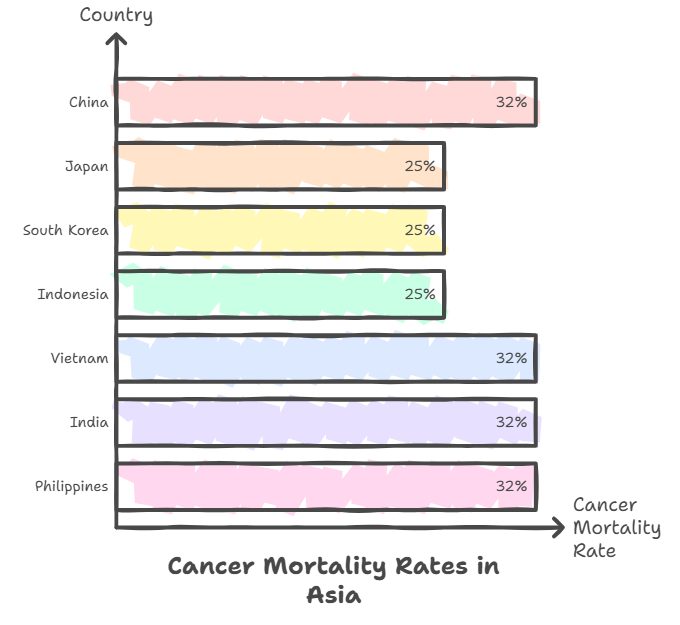
Cancer is now responsible for 25–32% of deaths across nations like China, Japan, South Korea, and Indonesia. But outcomes vary drastically. While Japan and Australia offer near-Western survival rates, countries like India, Vietnam, and the Philippines suffer from late diagnoses and limited treatment options.
Startups are stepping up with scalable and cost-effective innovation. Taiwanese biotech Acepodia is reshaping cancer treatment through off-the-shelf γδ2 T-cell therapies. By using antibody-cell conjugation (ACC™) instead of genetic engineering, Acepodia reduces production time and costs — opening access, particularly for solid tumors, which are most common in Asia.
FathomX and X-ZELL are bringing AI-powered diagnostics into public clinics, and mClinica is expanding pathology access across Southeast Asia.
Le Uyen Thao, founder of YEAST ERA, cautioned against surface-level innovation. “Many startups digitize processes but skip the science,” she said. “Biotech can create real change — like producing proteins from microorganisms or advancing imaging AI. These shift system outcomes, not just UX.”
Chronic Disease: Tackling NCDs with Digital Infrastructure
Noncommunicable diseases (NCDs) — including cardiovascular disease, diabetes, respiratory illness, and hypertension — are Asia’s biggest killers. In China, NCDs accounted for 91% of deaths in 2021, up from 80% in 2002.
Singapore-based Albatroz Therapeutics is targeting the problem at the molecular level. Their monoclonal antibodies — built on glycosylation pathway research from A*STAR — inhibit extracellular matrix degradation, reducing fibrosis and slowing cancer progression.
Consumer-facing apps are also seeing real traction. Ping An Good Doctor and MedLinker in China, along with Halodoc and Alodokter in Indonesia, provide hybrid services that blend insurance, teleconsultation, and home-based testing. These cloud-based, AI-enabled platforms handle everything from early diagnosis to behavior nudges based on healthy habits.
Yap Vi Vian, a digital health strategist, highlighted the importance of emotional design. “People managing diabetes or hypertension aren’t chasing novelty. They need consistency, encouragement, and human connection,” she said. “Design should support small wins, routine-friendly UX, and a blend of tech and human support.”
Mental Health: Taboos, Shortages, and Digital Breakthroughs
Mental health disorders affect between 4% and 20% of Asia’s population, with the greatest burden falling on young people. In China alone, it’s estimated that 170 million people live with mental disorders — yet over one-third of mental health workers admit to personal biases and discriminatory attitudes.
Dr. Timothy Low explained, “Stigma persists because mental health is seen as weakness. Reframing the story from ‘something is wrong with you’ to ‘something is happening to you’ is key. When trusted figures speak openly, we normalize the conversation and create psychological safety.”
He added, “Technology should amplify empathy, not replace it. AI can democratize access, but healing still depends on human connection.”
Platforms like Intellect (which supports over 120 languages), Ooca (connecting rural users to licensed therapists), Riliv, and ThoughtFull are making mental health services more accessible and stigma-sensitive. Public campaigns — like Singapore’s Mind Matters, China’s pilot programs, and the Philippines’ Mental Health Act — are slowly shifting perceptions.
Culture and Trust: Technology Can’t Solve It All
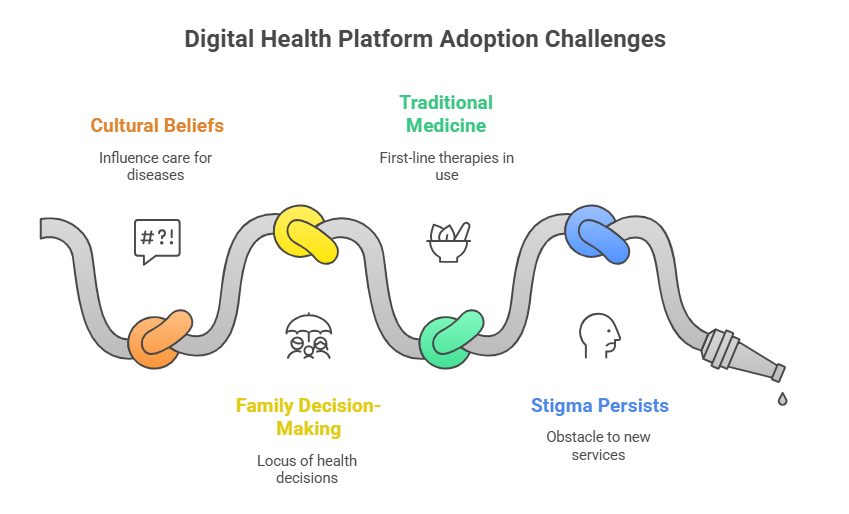
Even the best-designed digital platforms can fail without trust and cultural alignment. Health beliefs, family dynamics, and traditional medicine practices heavily influence care decisions across Asia. In countries like Malaysia, Vietnam, and the Philippines, families often make health decisions, and traditional remedies remain common.
Alex Loh emphasized that digital tools must complement — not replace — existing trust structures. “Adoption must move from offline to online. If a solution plugs a gap, it must align with the people and systems around it,” he said. “Accessibility is reach. When language is expressed both literally and emotionally, it hits home — and could be the starting point for someone’s mental health elevation.”
Yap Vi Vian agreed, adding that trust is human-driven. “In low-literacy communities, the approach must shift from ‘digital first’ to ‘digital with guidance.’ Co-create with local stakeholders, simplify design, and show visible local impact.”
Dr. Fatih Mehmet Gul, CEO of The View Hospital in Doha, highlighted the need for integration: “Technology must be embedded into daily life. Patient and caregiver engagement is key to adoption and better outcomes.”
From a systems perspective, Dae Wook Lee noted that scalable startups are those proving reproducible adoption across both urban hospitals and rural clinics. “Product messaging should use culturally acceptable language and screening pathways that translate somatic complaints into mental health flags,” he said.
ESG in Health Tech: Purpose, People, and Proof
Dr. Timothy Low and Yap Vi Vian both advocate for ESG principles — environmental, social, and governance — as essential filters for health-tech investments. These go beyond financial returns.
Yap Vi Vian emphasized that good health-tech needs to serve genuine unmet needs, reflect inclusive leadership, and demonstrate measurable outcomes. She also stressed environmental responsibility — from reducing medical waste and app overload to minimizing data center energy use.
What Investors Should Look For
According to Le Uyen Thao, evaluating a startup goes far beyond pitch decks and prototypes. She suggests looking for signs like biosafety compliance, meaningful partnerships with hospitals and universities, and truly localized monetization strategies. Sustainable R&D, pragmatic product design, and regulatory alignment are all part of her informal “founder scorecard.”
What Works in Asia’s Health Tech: Lessons from the Field
Asia’s most effective health-tech companies share several traits:
- They design for constraints — low bandwidth, low literacy, and basic devices.
- They integrate offline care — combining digital tools with community clinics, NGOs, and traditional providers.
- They measure what matters — such as time-to-diagnosis, cost per patient, and sustained adoption.
- They build trust early — by working closely with local health workers and cultural gatekeepers.
- They prioritize ESG — not as a slogan, but as a framework for relevance and resilience.
- And they reframe the message — using metaphors and language that resonate across local norms and mindsets.
As Peter Drucker said, “Culture eats strategy for breakfast.” In health tech, it also eats technology. Build for people first.
Access Over Hype: Asia’s Health Tech Matures
Asia’s massive health challenges — from cancer and chronic illness to mental health — demand more than buzzwords and demo-day solutions. They demand science, partnerships, and respect for local realities.
The future of health tech in Asia isn’t about headlines — it’s about access, equity, and trust.
Or as Seneca put it: “Luck is what happens when preparation meets opportunity.” For Asia, that preparation means policy fluency, scientific rigor, and community-based design.
Editor’s Note:
This article was contributed by NewInAsia editorial fellow Dr. Muhammad Faisal, a clinical writer and Pharm-D graduate specializing in digital health, regulation, and patient engagement. His work explores how innovation, policy, and trust intersect to shape the future of healthcare in Asia.
To pitch your story or share insights on health-tech and medical innovation, reach out to the NewInAsia editorial team.
References:
- Rahman MM, Khanam R, Rahman M. Health care expenditure and health outcome nexus: new evidence from the SAARC-ASEAN region. Global Health. 2018 Nov 22;14:113.
- Kristina SA, Krisnadewi KIK, Trung VQ, Ramadhani A, Verdiana AS, Aryasatya MD. Cancer Burden Across The South East Asia Nation (ASEAN) in 2022. Asian Pacific Journal of Cancer Prevention.
- Min Y, Jiang LX, Yan LJL, Wang LH, Basu S, Wu YF, et al. Tackling China’s noncommunicable diseases: shared origins, costly consequences and the need for action. Chin Med J (Engl). 2015 Mar 20;128(6):839–43.
- OECD. Health at a Glance: Asia/Pacific 2024.
- Wu J, Wang Y, Wang L, et al. Trends and burden in mental disorder death in China (2009–2019): a nationwide study. Front Psychiatry. 2023 May 12;14:1169502.
- Yin H, Wardenaar KJ, Xu G, et al. Mental health stigma and mental health knowledge in the Chinese population: a cross-sectional study. BMC Psychiatry. 2020 Jun 22;20:323.
- Influence of Chinese cultural health beliefs among Malaysian Chinese in a suburban population: a survey. ResearchGate.
Highlights
- Policy and Infrastructure: Still a Bottleneck, But Hope Is Rising
- Cancer Care: Asia’s Most Pressing — and Unequal — Health Crisis
- Chronic Disease: Tackling NCDs with Digital Infrastructure
- Mental Health: Taboos, Shortages, and Digital Breakthroughs
- Culture and Trust: Technology Can’t Solve It All
- ESG in Health Tech: Purpose, People, and Proof
- What Investors Should Look For
- What Works in Asia’s Health Tech: Lessons from the Field
- Access Over Hype: Asia’s Health Tech Matures
Read the Chinese article here.