
Singapore has been steadily integrating AI into its healthcare system, from tuberculosis screening and diabetic eye disease detection to clinical documentation.
The technology itself, however, may not be the most important part of the story.
What distinguishes Singapore is what surrounds it: a national electronic health record, regulatory pathways for health technologies, governance frameworks and healthcare institutions increasingly prepared to integrate AI into clinical workflows.
That distinction points to a bigger question for Southeast Asia.
As healthcare AI becomes more accessible, will competitive advantage come from developing better algorithms — or from building healthcare systems capable of deploying them safely and at scale?
Increasingly, the answer may lie in what could be called trust infrastructure: the data systems, regulatory clarity, governance, and clinician readiness that allow AI to move beyond isolated pilots and become part of everyday healthcare.
For ASEAN governments, healthcare providers, and investors, that infrastructure could prove just as important as the technology itself.
Highlights
- Singapore’s Advantage Is What Sits Behind the AI
- Malaysia Is Building the Foundation While Deploying AI
- Thailand’s AI Push Is Driven by Demographic Pressure
- Where the Infrastructure Still Breaks Down
- What Investors Should Look at Beyond the Model
- Beyond the Algorithm: The Advantage Won’t Be AI — It Will Be Trust
Singapore’s Advantage Is What Sits Behind the AI
Singapore’s National Electronic Health Record (NEHR) provides a national repository for patients’ health information, with public healthcare institutions contributing data to the system since 2011 and private providers progressively coming on board.
The Health Information Bill, introduced in Parliament in November 2025 and passed in January 2026, will further expand this framework by requiring licensed healthcare providers to contribute specified health information to the NEHR.
For AI systems, that kind of connected health-data environment matters.
“The NEHR isn’t just a database. It’s the foundation that makes every AI tool in the system trustworthy,” says Andy Ta, Chief Data Officer at Synapxe, Singapore’s HealthTech Agency. “Without it, you’re deploying isolated algorithms in fragmented systems.”
But data integration alone does not explain Singapore’s execution advantage.
The NUHS–Singtel–Ericsson partnership offers another example. Rather than deploying 5G-enabled healthcare technologies first and addressing governance later, the initiative involved multiple organisations across health IT governance, telecommunications regulation, and cybersecurity as technologies were developed and tested.
“Singapore’s playbook isn’t really a 5G story; it’s a trust-architecture story that happens to run on 5G,” says Alex Szomora, a Singapore-based venture investor with experience across health tech, AI and telecommunications. “Governance and security can’t be retrofitted. They have to be built in from day one.”
This infrastructure is already supporting a range of healthcare applications.
Note Buddy, developed by SingHealth, uses generative AI to assist with clinical documentation by transcribing doctor-patient conversations across English, Mandarin, Malay, and Tamil. More than 2,100 healthcare professionals have used the system, with over 16,000 clinical notes generated.
SELENA+, meanwhile, uses AI to screen retinal images for diabetic eye disease, supporting Singapore’s wider diabetic retinopathy screening programme.
These examples point to the same underlying advantage: AI becomes more useful when it can operate within an established healthcare ecosystem rather than as a standalone technology.
Malaysia Is Building the Foundation While Deploying AI
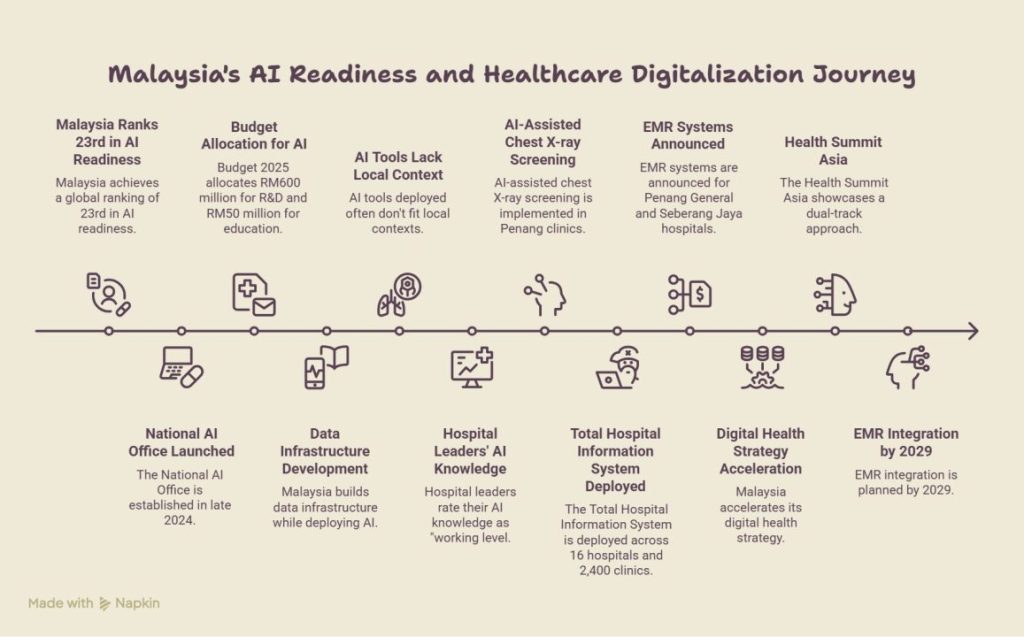
Malaysia faces a different challenge: it is deploying healthcare AI while continuing to build the digital infrastructure needed to support it.
The country’s Total Hospital Information System and other digitalisation initiatives are expanding across hospitals and clinics, while AI applications, including chest X-ray screening, are already being tested and deployed.
But health-record integration remains uneven across the healthcare system. Health Minister Dr. Dzulkefly Ahmad has also linked further electronic medical record (EMR) expansion to funding availability, highlighting the practical challenge of connecting healthcare facilities while digitalisation is still underway.
That creates a more difficult environment for scaling AI. A tool may perform effectively within one hospital or network but encounter different data systems, workflows, or implementation conditions elsewhere.
There is also the question of localisation.
“Local model-building is what turns a pilot into something a workforce actually trusts at the bedside,” says Szomora.
AI trained in one healthcare environment may not automatically translate into another. Disease patterns, languages, patient populations, and clinical workflows can differ, making local validation and implementation capability important alongside model performance.
Malaysia, therefore, illustrates a central challenge facing healthcare AI across ASEAN: how do countries scale digital health tools while the infrastructure underneath them is still being connected?
Thailand’s AI Push Is Driven by Demographic Pressure
Thailand’s healthcare AI story is shaped by another pressure: demographics and healthcare capacity.
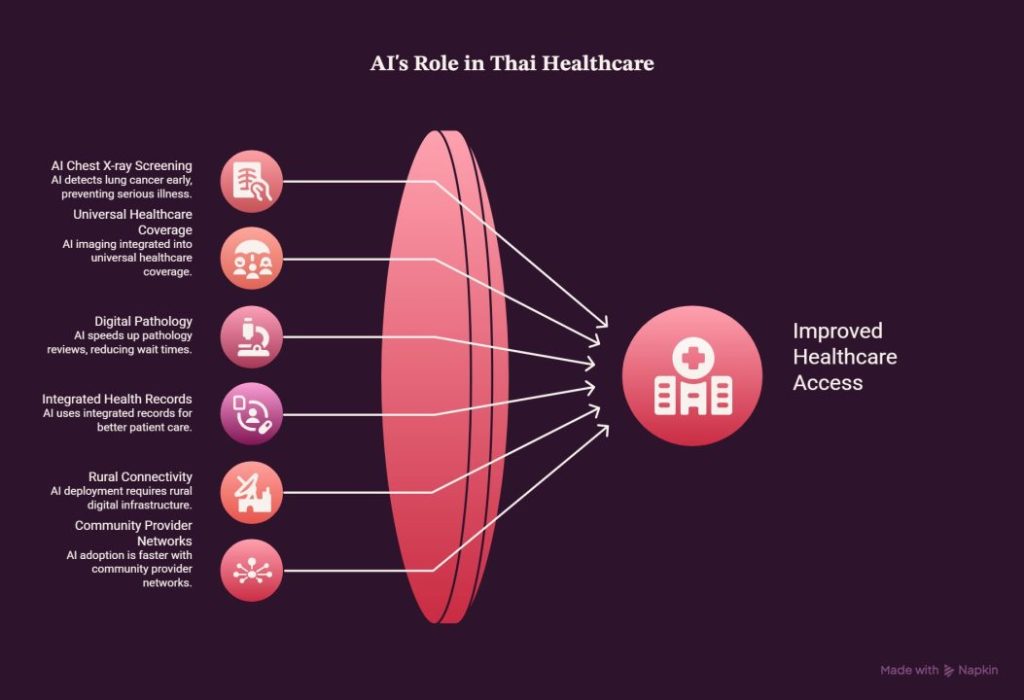
An ageing population and uneven distribution of medical professionals are increasing demand on the healthcare system. AI is therefore being explored not simply as a productivity tool, but as one way of extending screening and diagnostic capacity.
Thailand’s universal healthcare system has begun incorporating AI-assisted imaging, while initiatives including lung-screening programmes demonstrate how AI could support larger patient populations.
But deployment is not uniform.
Major teaching hospitals in Bangkok benefit from specialist networks, connected laboratories, and stronger digital infrastructure. Rural and secondary healthcare facilities may operate under very different conditions.
That matters because an AI tool cannot create the infrastructure it depends on.
Reliable connectivity, compatible health records, specialist oversight, procurement systems, and trained clinicians all influence whether a successful pilot can become part of routine care.
Malaysia and Thailand are therefore not simply “behind” Singapore. They demonstrate how different healthcare systems encounter different bottlenecks on the path from experimentation to scale.
Where the Infrastructure Still Breaks Down
Singapore’s progress does not mean infrastructure automatically produces equitable or frictionless AI adoption.
Across the region, several challenges remain.
Data privacy and governance become more consequential as health information moves across increasingly connected systems. Expanding access to data for clinical care and AI development must be balanced against patient privacy, cybersecurity, and transparency.
Procurement can also slow deployment. Scaling an AI application across hundreds of healthcare facilities is fundamentally different from demonstrating it successfully in a leading hospital.
Clinician adoption remains another critical variable. Technology that adds friction to existing workflows, produces results clinicians do not trust, or arrives without adequate training can struggle regardless of model performance.
Rural infrastructure creates an additional divide. Singapore’s highly connected urban health system cannot be directly replicated across geographically dispersed ASEAN markets, where clinics may have different levels of connectivity, equipment, and specialist support.
And finally, there is funding sustainability. Governments and healthcare systems need to determine not only how AI pilots are funded, but who pays when those technologies become part of routine healthcare.
These challenges do not negate the promise of healthcare AI. They show why successful deployment is ultimately a systems problem.
What Investors Should Look at Beyond the Model
This distinction also changes how healthcare AI opportunities in Southeast Asia should be evaluated.
A technically impressive model operating inside a fragmented health infrastructure may have a more difficult path to scale than a less novel technology integrated into a connected healthcare network.
For investors, that means evaluating more than accuracy rates or technical sophistication.
Can the technology access reliable and interoperable health data? Is there a clear regulatory pathway? Can hospitals procure it? Does it fit existing clinical workflows? Are clinicians trained to use it? Is there a sustainable reimbursement or funding model once a pilot ends?
These questions reveal whether a healthcare AI company has access to an ecosystem capable of turning technology into adoption.
They also help explain why Singapore has become an important regional testbed. Its advantage is not simply that it can develop or attract healthcare AI technologies, but that much of the surrounding institutional infrastructure already exists.
For larger ASEAN markets, closing that gap could create significant opportunities.
Malaysia brings a larger healthcare market while continuing to strengthen digital integration. Thailand has demographic pressure, creating a clear need for healthcare productivity and reach. Indonesia and Vietnam represent major future markets as their digital health and AI ecosystems develop.
The commercial opportunity, therefore, may not belong exclusively to companies building AI models. It could also extend to businesses solving the less visible infrastructure problems around them: interoperability, cybersecurity, clinical workflow integration, data platforms, training, and implementation.
Beyond the Algorithm: The Advantage Won’t Be AI — It Will Be Trust
As AI models become increasingly accessible, technological capability alone will become harder to defend as a long-term advantage.
Healthcare systems, however, are much harder to replicate.
The countries that can connect health data responsibly, establish credible regulatory pathways, prepare clinicians, strengthen cybersecurity, and create sustainable mechanisms for adoption will be better positioned to turn AI experimentation into healthcare infrastructure.
That is why Szomora’s assessment captures the larger regional opportunity:
“Whoever builds the trust infrastructure — interoperability standards, cross-border data frameworks, clinician training — wins the decade, not whoever has the best model.”
Singapore currently offers one view of what that foundation can look like. Malaysia and Thailand show how different markets are assembling their own versions while responding to different healthcare needs and constraints.
For the rest of ASEAN, the question is not simply who can adopt AI fastest.
It is who can build the conditions that allow AI to earn trust, move beyond pilots, and scale.
And for investors, healthcare leaders, and policymakers, that may become a far more useful measure of regional competitiveness than the sophistication of any single algorithm.
Editor’s Note:
This article was contributed by NewInAsia editorial fellow Dr. Muhammad Faisal, a clinical writer and Pharm-D graduate specializing in digital health, regulation, and patient engagement.
His work explores how trust, governance, and policy design shape the adoption of emerging health technologies — particularly in complex, multi-stakeholder systems across Asia.
To pitch your story or share insights on digital health, healthcare innovation, or the future of health systems in Asia, reach out to the NewInAsia editorial team.
Highlights
- Singapore’s Advantage Is What Sits Behind the AI
- Malaysia Is Building the Foundation While Deploying AI
- Thailand’s AI Push Is Driven by Demographic Pressure
- Where the Infrastructure Still Breaks Down
- What Investors Should Look at Beyond the Model
- Beyond the Algorithm: The Advantage Won’t Be AI — It Will Be Trust
Read the Chinese article here.