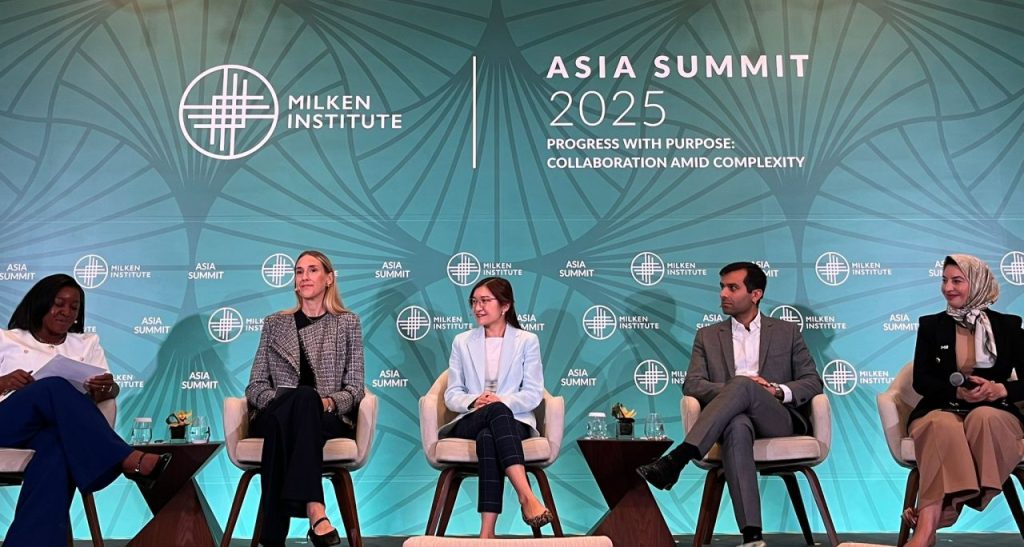
Adapted from insights by Lindsay Davis, Founder of FemTech Association Asia and one of NewInAsia’s Top Women’s Voices in Singapore, originally shared as part of the Milken Institute’s Power of Ideas series at the Asia Summit.
Femtech in Southeast Asia is growing fast — but not yet deep enough.
Since the term was coined in 2016, more than 100 femtech startups have emerged across Indonesia, Malaysia, the Philippines, Singapore, Thailand, and Vietnam — with 77% launched after 2019.
The momentum is clear.
What’s less obvious is the constraint holding the industry back:
Not funding. Not innovation. But understanding.
Highlights
- A Market Expanding Faster Than Awareness
- The Adoption Gap: When Products Outpace Understanding
- Trust Still Sits with Healthcare Institutions
- Social Media: Opportunity and Constraint
- Cultural Barriers Still Shape Demand
- Pricing and Accessibility Will Define Scale
- The Growth Opportunity — If Education Catches Up
- The Real Lever: From Awareness to Adoption
A Market Expanding Faster Than Awareness
Despite rising investment and product development, women’s health education in Southeast Asia remains limited in scope.
For most women in the region, early education focuses narrowly on:
- Menstrual health
- Puberty
- Sexually transmitted infections
With 69% of women receiving health education primarily through school systems, exposure to broader topics — such as hormonal health, fertility planning, menopause, and long-term wellness — remains insufficient.
In many markets across Southeast Asia, particularly in Indonesia and the Philippines, these topics are still considered sensitive or private, often discussed only within close circles rather than in formal education or public discourse.
This creates a fundamental mismatch.
While femtech companies are building solutions across the full lifecycle of women’s health, consumer awareness has not kept pace.
The Adoption Gap: When Products Outpace Understanding
The result is a clear barrier to growth.
42% of consumers cite a lack of understanding as the primary reason for not adopting femtech solutions.
This is not a product problem.
It is an education problem.
For founders, this means the responsibility goes beyond explaining what the product does.
They must also communicate:
- Why it matters
- How it works
- Where it fits into a woman’s broader health journey
Many early-stage founders in the region find themselves not just building products, but effectively introducing entirely new categories of health awareness — often needing to educate users before they can even begin to sell to them.
Without that clarity, even the most innovative solutions risk remaining underutilised.
Trust Still Sits with Healthcare Institutions
In Southeast Asia, trust in healthcare remains highly institutional.
More than 50% of women rely on healthcare professionals and institutions as their primary source of information.
This presents both a constraint and an opportunity.
Femtech companies that operate independently of the healthcare ecosystem may struggle to build credibility — particularly in markets where medical authority is deeply respected and rarely questioned.
Those that collaborate with doctors, clinics, and medical institutions can accelerate adoption significantly.
This is not new.
Pharmaceutical companies have long understood that medical endorsement drives trust.
Femtech companies must adopt a similar approach — integrating into existing healthcare pathways rather than attempting to replace them.
Social Media: Opportunity and Constraint
Social media is emerging as a critical channel for femtech growth — but it comes with complexity.
On the one hand, it enables:
- Open conversations
- Peer-to-peer education
- Community-driven product discovery
On the other hand, it remains constrained by:
- Content moderation
- Algorithmic suppression of women’s health topics
- Misinformation risks
In practice, many founders are navigating a delicate balance — using platforms like Instagram and TikTok to spark conversations, while working around restrictions that still limit how openly women’s health can be discussed.
Despite these challenges, founders are finding ways to build engaged communities through authentic storytelling and user-led conversations.
Today, many users rely on community reviews and shared experiences when deciding which femtech products to trust.
In this environment, credibility is built collectively, not just institutionally.
Cultural Barriers Still Shape Demand
Beyond awareness, cultural norms continue to limit open discussion.
Across Southeast Asia, 52% of women feel it is culturally unacceptable to discuss women’s health issues in public, often due to fear of judgment or stigma.
In more conservative communities, this stigma can be even more pronounced — shaping not just conversations, but whether women seek help at all.
This creates a hidden demand for:
- Private, safe digital spaces
- Anonymous engagement
- Discreet access to information and services
Femtech platforms are uniquely positioned to meet this need — not just as service providers, but as trusted environments for conversation.
Pricing and Accessibility Will Define Scale
While demand is growing, accessibility remains a key constraint.
Consumers consistently prioritise:
- Convenience
- Cost-effectiveness
Yet many femtech solutions still target premium segments — often reflecting early adopters in urban centres like Singapore or Jakarta, rather than the broader population.
To scale across Southeast Asia’s diverse markets, companies must rethink:
- Pricing strategies
- Product design
- Distribution models
Because in this region, affordability is not a feature — it is a requirement for adoption.
The Growth Opportunity — If Education Catches Up
The upside remains significant.
Projections suggest femtech in Southeast Asia could grow by an additional US$1.2 billion — a 20% increase — driven by both new users and increased spending from existing ones.
- 54% of non-users are expected to adopt femtech
- 80% of current users plan to increase spending
But this growth is not guaranteed.
It depends on one critical factor: Education.
The Real Lever: From Awareness to Adoption
Femtech in Southeast Asia is not constrained by demand.
It is constrained by understanding, trust, and accessibility.
The companies that win will not be those that build the most advanced products.
They will be the ones that:
- Educate consistently
- Partner strategically
- Build trust across both institutions and communities
Because in this market, innovation alone does not scale.
Adoption does. And adoption is not driven by features — it is driven by confidence.
Trust that the product works. Assurance that it is safe. A sense that it belongs in a woman’s everyday life.
That confidence is built over time — through education, credibility, and relevance.
In Southeast Asia’s femtech landscape, the real competitive advantage will not be technology.
It will be who earns trust at scale — and turns awareness into action.
Highlights
- A Market Expanding Faster Than Awareness
- The Adoption Gap: When Products Outpace Understanding
- Trust Still Sits with Healthcare Institutions
- Social Media: Opportunity and Constraint
- Cultural Barriers Still Shape Demand
- Pricing and Accessibility Will Define Scale
- The Growth Opportunity — If Education Catches Up
- The Real Lever: From Awareness to Adoption
Read the Chinese article here.
Related posts:
 From 41 to 111 Startups — She’s Asking Why Southeast Asia’s Femtech Boom Still Isn’t Enough
 How Rural Destinations Became Hospitality’s New High-Value Asset Class
 Singapore’s Science + China’s Scale: Why APAC Biotech Winners Must Think Cross-border Early
 This One Overlooked Decision Could Make or Break a Food Company’s Expansion