
For years, good managers have been judged by how well they coordinate teams, oversee execution, and keep operations running smoothly. But as AI agents become increasingly capable of handling everything from scheduling and documentation to drafting reports and managing workflows, the very nature of management is beginning to change.
For Geargina Tan, that shift isn’t something leaders should fear — it’s something they should prepare for.
After spending more than 15 years leading operations across organizations, including Universal Studios Singapore, Amazon, and Jewel Changi Airport, while scaling businesses across Southeast Asia, Tan is now Co-Founder and COO of WTFox.ai. Her company is challenging the traditional CRM model with AI agents designed to eliminate administrative work rather than create more of it.
Having spent much of her career building high-performing operations before AI became mainstream, Tan believes the leaders who thrive in the next decade won’t simply be those who know the latest tools. They’ll be the ones who understand what human leadership should look like when execution is increasingly automated.
Highlights
When AI Takes the Work, Managers Must Raise Their Game
One of Tan’s favorite analogies is surprisingly simple.
She treats AI like “an extremely smart intern.”
It’s fast. It’s tireless. And if it’s given poor instructions, it can still produce the wrong answer with remarkable confidence.
That, she argues, changes the manager’s role rather than eliminating it.
Instead of personally coordinating every task, leaders must become better at defining objectives, setting guardrails, documenting processes, and reviewing outcomes.
“Managing one agent well looks remarkably like onboarding a bright junior hire,” she explains. “Managing many of them looks like running a team, with the same dynamics of briefing, handoffs, and accountability — minus the emotional layer.”
It’s one reason she believes experienced operators may be better prepared for the AI era than they realize.
Nearly everything she learned while managing large operational teams still applies today.
The structure.
The discipline.
The documentation.
The ability to communicate clearly enough that someone else can execute without constant supervision.
“If you can run a team of people,” she says, “you can run a team of agents.”
The skill was never mastering a particular tool.
It was always clear.
Judgment Is Becoming More Valuable Than Execution
As AI becomes capable of handling more operational work, Tan believes many organizations are focusing on the wrong competitive advantage.
Average managers assign work.
Exceptional managers decide whether the work should exist in the first place.
Routine task delegation is becoming increasingly automatable. What becomes more valuable is judgment — understanding which problems deserve attention, recognizing weak assumptions, and knowing when a confident answer isn’t necessarily the right one.
That distinction, she argues, is becoming one of leadership’s most important skills.
“AI is always sure of itself,” she says. “Judgment is knowing that sure isn’t the same as right.”
She points to Singapore’s Minister for Defence, Chan Chun Sing, who has described the future advantage as one of “discernment.”
As access to powerful AI becomes increasingly universal, Tan believes every business will be able to generate similar outputs.
The real differentiator won’t be intelligence.
It will be discernment.
Stop Chasing AI Tools. Fix the Workflow Instead.
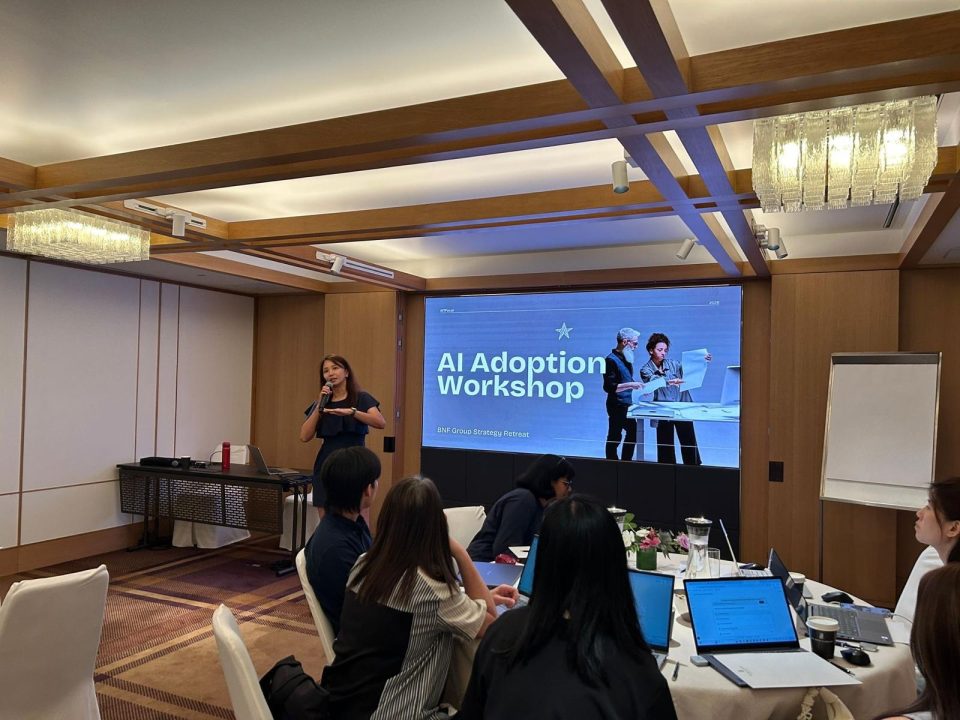
Ask Tan what she believes is the most overhyped trend in AI today, and her answer comes quickly.
Tool chasing.
Too many organizations, she says, confuse activity with progress.
Every new model release, every viral AI application, and every certification creates pressure to keep up. Yet many businesses end up collecting subscriptions rather than solving meaningful problems.
She understands the anxiety.
A new model launches.
Social media declares that everything has changed overnight.
Suddenly, everyone feels behind.
But inside businesses that are creating measurable value with AI, she sees something very different.
“They’re not the companies with the longest list of subscriptions,” she says. “They’re the ones that got one thing working properly and let it compound.”
More importantly, they build cultures where employees are encouraged to experiment, innovate, and accept reasonable failures along the way.
For leaders wondering where to begin, Tan’s advice is refreshingly practical:
Choose one workflow that genuinely hurts.
Then redesign it completely.
That distinction matters.
Too many companies try to make inefficient processes faster.
Very few ask whether those processes should exist in their current form at all.
Drawing from years spent managing crowd flow at large venues, Tan compares AI transformation to queue management.
“You don’t fix a queue by making people shuffle forward more efficiently,” she says. “You fix it by redesigning the flow.”
The principle, she argues, is exactly the same for AI.
Asia Doesn’t Need Silicon Valley’s AI Playbook

While much of the global AI conversation is shaped by Silicon Valley, Tan believes Asia has an opportunity to build differently.
Silicon Valley often builds for scale first.
Asia, she says, has traditionally built for survival.
That difference creates a surprisingly practical advantage.
Markets across Asia skipped many legacy technology stages by moving directly to mobile-first experiences. Tan believes many organizations now have the opportunity to make another leap — bypassing complex legacy software and adopting AI-native ways of working instead.
She also sees an opportunity that many outsiders overlook.
Across much of Asia, business still happens inside conversations.
Chat threads.
Voice notes.
Paperwork.
Relationships.
For years, those habits were often viewed as signs of digital immaturity.
Tan sees them differently.
Rather than forcing businesses to abandon how they naturally operate, AI can quietly structure information in the background while allowing people to keep working through familiar channels.
It’s one of the reasons WTFox.ai chose the Philippines as its first market.
Paper-heavy industries.
Strong appetite for AI.
Relatively few incumbents are protecting outdated systems.
At the same time, she believes one challenge still deserves far more attention.
Education.
“The appetite is ahead of the understanding,” she says.
Organizations are buying AI tools faster than they’re learning how to redesign work around them.
Closing that gap, she believes, matters far more than launching another product.
Final Thoughts: The Future Belongs to Leaders People Still Want to Follow
Despite building AI for a living, Tan doesn’t believe technology will replace the qualities that define exceptional leadership.
AI won’t mentor a struggling employee.
It won’t notice when a high performer suddenly becomes unusually quiet in meetings.
It won’t rebuild trust after a difficult quarter.
Those moments remain deeply human.
As organizations become increasingly AI-enabled, Tan believes the leaders who thrive will be the ones who combine technical fluency with empathy, trust, and sound judgment.
“They’ll be fluent at directing AI,” she says, “and irreplaceable at what it can’t fake.”
For her, that’s the future of management.
Not overseeing more tasks.
Not mastering more software.
But helping people do better work in a world where intelligence is abundant — and humanity becomes the true competitive advantage.
Highlights
Read the Chinese article here.