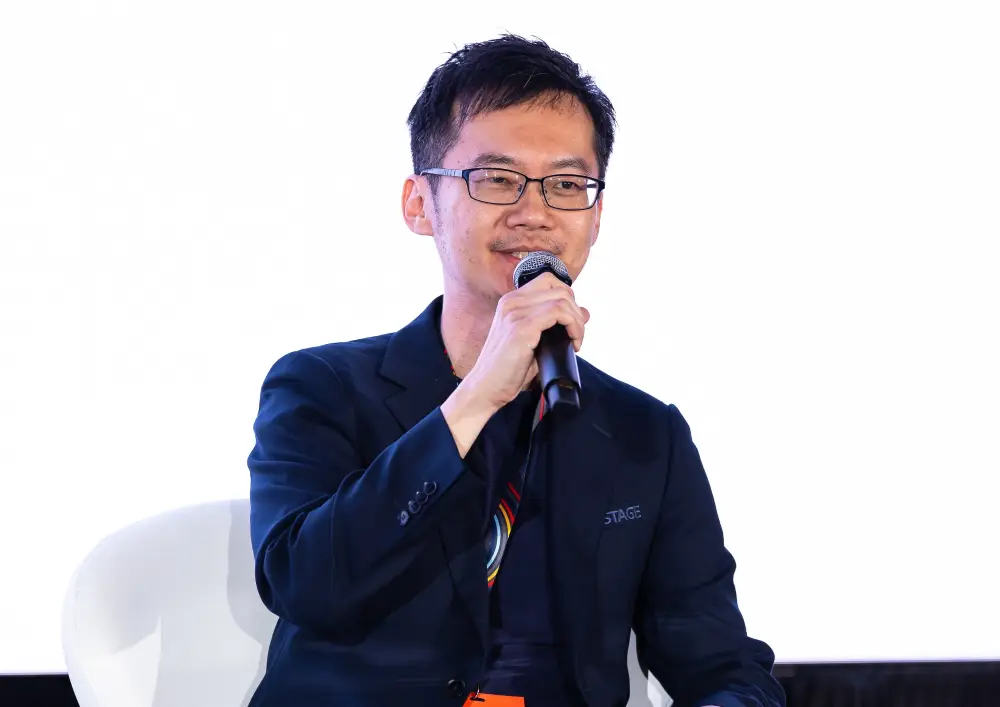
AI is making it easier than ever for employees to turn ideas into working prototypes. A concept that once required a larger development team, months of work, and significant budget can increasingly be tested in days.
But for established companies, faster experimentation creates another challenge. Building something is one thing. Getting an organization to adopt it, fund it, govern it, and give someone enough authority to take it forward is another.
Yeong Harng Saim has experienced that tension from both sides. With more than 20 years of experience spanning digital transformation, venture building, and corporate innovation, Saim previously built and scaled CardsPal from an internal venture to acquisition. Today, he is Co-Founder and CEO of Synvo AI, an NTU deep-tech spinout developing enterprise AI infrastructure for persistent, multimodal memory. He also works with emerging ventures and intrapreneurs through his roles in business coaching, advisory, and venture building.
NewInAsia spoke with Saim about what it really takes for employees to “think like founders,” how AI is changing the economics of experimentation, and why companies that want innovation need to examine what happens after a promising idea appears.
Highlights
You Can’t Ask Employees to Think Like Founders While Rewarding Them Like Employees
Q: Companies increasingly tell employees to “think like founders.” But can someone genuinely behave like a founder when they are still measured, promoted, and rewarded like an employee?
A: You can encourage a founder mindset, but you can’t expect founder behaviour if the environment still rewards employee behaviour.
I experienced this first-hand. When I first became an intrapreneur, I was still doing my full-time job and was given 20% of my working time to pursue the idea that eventually became CardsPal. In reality, a lot of the work happened after hours and on weekends. I was effectively trying to build something new while still delivering what was expected of me in my existing role.
That experience taught me that an entrepreneurial mindset is only one part of the equation. The system around the intrapreneur matters just as much.
What changed the trajectory for me was that the organization progressively created more space around the idea. I had access to mentors and coaches, senior leaders and subject-matter experts to validate the business model, followed by funding to build the proof of concept. Eventually, after securing pre-seed funding, I was able to leave my existing role and focus on building the venture full-time.
That’s an important distinction. Companies cannot simply tell people to “think like founders” and expect innovation to happen alongside business as usual. If an idea demonstrates potential, there needs to be a mechanism to give the intrapreneur increasing levels of ownership, resources, and decision-making authority.
At the same time, I don’t think companies should try to turn every employee into a founder or remove governance entirely. Founders make decisions under uncertainty, move with imperfect information, and change direction when evidence changes. Established organizations still need predictability, accountability, and appropriate controls.
The challenge is creating enough room for both. Most critically, leaders need to distinguish execution failure from intelligent failure. If someone runs a disciplined experiment, discovers that an assumption is wrong, and stops early, that isn’t necessarily failure. They may have just saved the company significant time and money.
So yes, employees can think like founders. But if companies genuinely want them to act like founders, they need to create an environment that allows founder-like behaviour when it matters. Otherwise, “think like a founder” is just another slogan.
AI Made Prototypes Cheaper. It Didn’t Make Companies Easier to Change.
Q: AI has made it dramatically easier for employees to prototype ideas without large teams or budgets. Does that give intrapreneurs more power — or simply create more ideas for organizations to kill?
A: Probably both.
AI has collapsed the cost of turning an idea into something tangible. What once required developers, designers, and months of budget can increasingly become a working prototype in days. That’s real power for intrapreneurs because they no longer need to sell an idea purely through slides. They can show people something that actually works.
When I started building CardsPal, getting from an idea to a working product still required assembling product designers, developers, and data capabilities. We followed a lean startup approach — design, validate with users, build, test, deploy, learn, and iterate.
AI is compressing that cycle dramatically, though not uniformly. I see this now building Synvo AI. The deep technology itself — our memory layer — still takes real scientists and engineering time to build properly. That part hasn’t gotten faster just because AI tools exist.
But building the agentic systems and applications on top of that memory layer is a different story. With AI tools, we’ve been able to do with two engineers what would have previously needed a team of ten.
Building the product, however, is only one part of building a business. Turning that kind of capability into something an enterprise will actually run in production is a different problem entirely. It means navigating data sovereignty, security, integration, compliance, and finding someone internally willing to own the outcome.
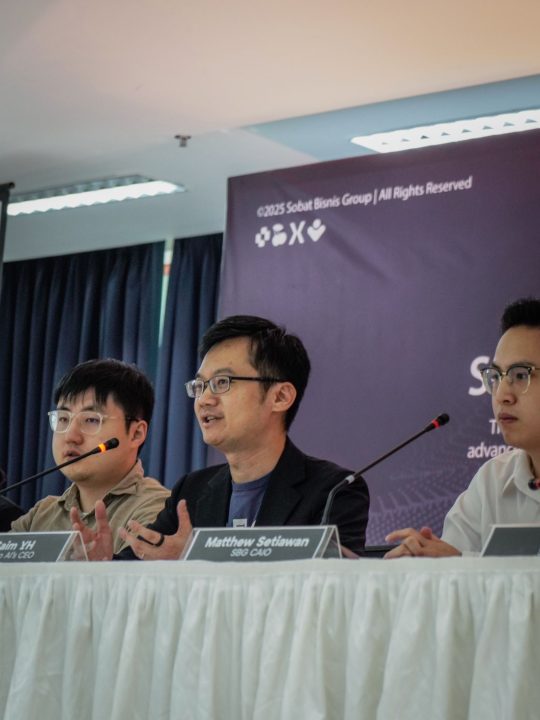
That’s exactly why we’ve partnered with organizations like Sobat Bisnis Group in Indonesia. Technology alone doesn’t get you into the enterprise — you also need a path that solves for trust and long-term deployment.
AI is therefore reducing the cost of building much faster than organizations are reducing the cost of adopting. A team may be able to build an impressive AI prototype very quickly, but putting it into a real enterprise workflow still means dealing with data access, cybersecurity, compliance, integration, governance, and, importantly, finding someone willing to own the outcome in production.
So the bottleneck is shifting. The question used to be: “Can we build this?” Increasingly, it is: “Can the organization absorb it?”
And because AI enables far more people to experiment, this problem becomes bigger, not smaller. Ten times more employees building prototypes doesn’t automatically create ten times more innovation. It may simply create ten times more ideas competing for the same organizational capacity to evaluate and scale them.
Companies therefore need a clear pathway from prototype to validation, ownership, funding, and scale — and equally, a disciplined way to stop ideas that don’t demonstrate value. Killing an idea isn’t necessarily a failure. Letting hundreds of experiments remain permanently in “pilot mode” may be a problem.
The companies that benefit most from AI won’t necessarily be those running the most experiments. They will be the ones that learn fastest, decide which experiments matter, and build the organizational muscle to turn the best ones into real businesses.
When a Good Idea Dies, Was the Idea Really the Problem?
Q: You now see innovation from several sides — AI venture builder, CEO coach, board director, and advisor to emerging ventures. When a promising innovation dies, how often is the idea actually the problem versus the organization surrounding it?
A: Sometimes the idea simply isn’t good enough. There may not be a real customer problem, the economics may not work, or the timing may be wrong. Good innovation requires the discipline to recognize that and stop.
But I’ve also learned that an idea doesn’t succeed in isolation. The environment around it matters enormously.
I saw this myself building CardsPal. The idea still had to prove itself, but having the right environment around it — such as mentors, staged funding, and organizational sponsorship — gave it the opportunity to do so.
That’s why I don’t think the most useful question is whether an organization is “innovative.” I would ask: what happens after someone has a good idea?
Who helps them validate it? Who can fund the next experiment? How quickly can a decision be made? And when an idea crosses several functions, who is ultimately accountable for moving it forward?
I’ve seen plenty of enthusiasm for innovation where everyone supports an idea in principle, but nobody really owns what happens next. That’s usually where promising ideas quietly disappear.
But intrapreneurs carry responsibility too. One lesson I learned through venture building is that entrepreneurial spirit cannot just be about protecting your original idea. You have to validate it with real users, challenge your assumptions, learn quickly, and be willing to iterate or pivot when the evidence changes.
So when an innovation dies, I wouldn’t immediately ask, “Who killed it?” I’d ask: did it get a fair opportunity to prove or disprove itself?
If it was properly tested and the evidence was weak, stopping it is a good outcome. If the evidence was strong but the idea died because nobody could navigate the organization around it, then the organization has something to learn and improve.
Final Thoughts: The AI Innovation Race May Be Won After the Prototype
AI is lowering one of the traditional barriers to corporate innovation: the cost and effort required to turn an idea into something people can see and test. But as that barrier falls, another becomes more visible.
The constraint may no longer be whether employees can build. It may be whether the organization around them can make decisions quickly enough to validate, fund, own, and eventually scale what they create.
Saim’s experience also suggests that companies should be careful about equating innovation with the number of pilots they launch. An experiment that produces evidence to stop can be valuable. A promising prototype left indefinitely without ownership or a path to production is another matter.
For leaders asking employees to behave more like founders, the harder question may therefore be whether the company itself is prepared to behave differently when those employees actually do.
Highlights
Read the Chinese article here.