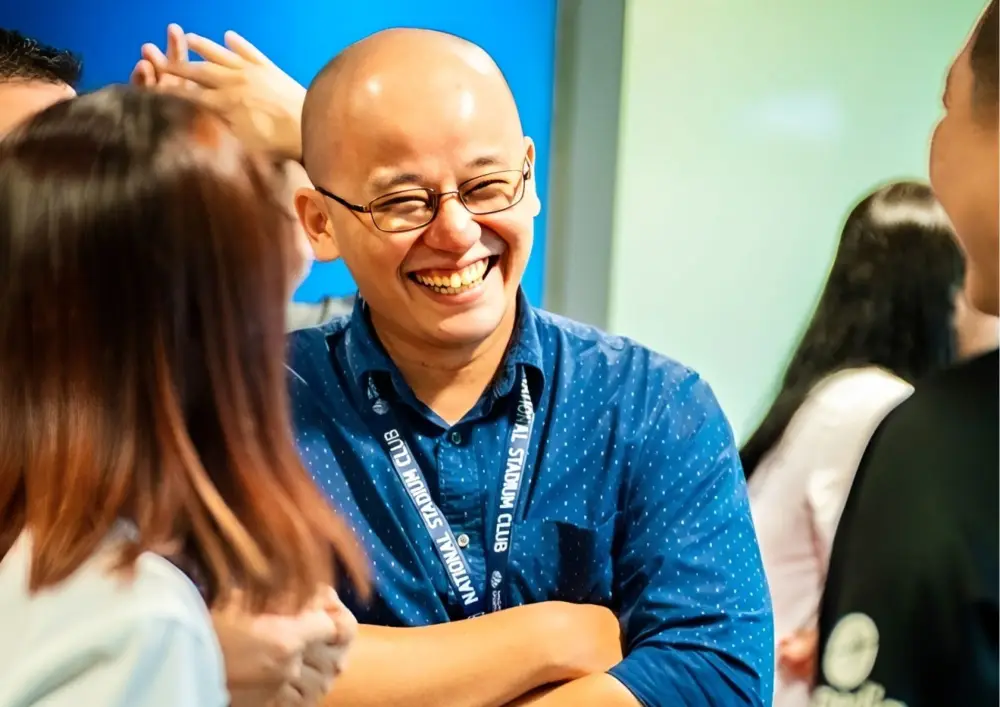
For Haojun See, technology has never been about novelty or hype. It’s about something far more human: time. Time to think, to care, to focus on what actually matters once repetitive, draining work is taken out of the equation.
As the founder of On The Ground SG, Haojun works with organizations to adopt AI in practical, everyday ways — from automating routine processes to improving decision-making and productivity. His work spans very different contexts, from AI tools for small businesses to systems that support caregivers, but the motivation behind it remains consistent.
In this conversation, Haojun reflects on why automation feels deeply personal to him, what teams need to move from hesitation to action, and how empathy and ethics must stay front and center as AI becomes more embedded in daily life.
Highlights
- Automation as Care — Why Making Work Disappear Matters
- From Hesitation to Momentum — Clarity Beats Fear
- When Technology Disappears — Letting Humans Do Human Work
- Learning to Build Better Systems — Lessons From Early Career Experiences
- Designing With Care — Ethics, Empathy, and Honest AI
- Final Thoughts — Technology That Respects Human Time
Automation as Care — Why Making Work Disappear Matters
Q: What drives your commitment to making technology more human, especially across such different contexts like AI tools for SMEs and caregiving systems?
A: I have a simple reason: I genuinely enjoy automating things. There’s something deeply satisfying about taking repetitive, difficult work and making it disappear.
When I automate something, people get their time back. Instead of rushing through their day, they can slow down. They can enjoy a moment. That happiness — that’s what drives me.
I see this principle playing out across every project. For SMEs, automation means they can stop wasting time on busywork and focus on what they do best. For caregivers, it means they’re not drowning in administrative tasks and can spend more energy on the people they’re caring for.
When I talk about “making technology more human,” that’s what I mean. It’s not about flashy AI. It’s about improving someone’s life by removing the friction that keeps them from doing what matters.
From Hesitation to Momentum — Clarity Beats Fear
Q: What mindset or process shift do teams need to adopt to move from hesitation to rapid, practical adoption?
A: Honestly, I don’t see much hesitation about AI itself anymore. What slows teams down is something more basic: lack of clarity.
Teams hesitate when they’re not clear on what problem they’re trying to solve, what success looks like, or what they can realistically achieve together. Purpose gets fuzzy, and suddenly everything feels risky.
The teams that move fast usually have three things in place. They share a common language, so everyone understands what’s being discussed. They have clarity of purpose — they know exactly why they’re automating a specific task. And they have an experimental mindset, where trying is always better than not trying.
The real shift is believing that some problems are actually worth solving. Once you identify a genuine pain point — something repetitive and frustrating — curiosity kicks in. You start experimenting. And that curiosity, combined with clarity, beats hesitation every time.
When Technology Disappears — Letting Humans Do Human Work
Q: How do you keep the principle that “tech should amplify what people do best” front and center in automation-heavy environments?
A: What I’ve learned is that once you’ve automated enough of the repetitive work, something interesting happens: the technology fades into the background.
You stop thinking about the tech entirely — and that’s when the real human work begins. People aren’t managing systems or wrestling with admin tasks anymore. They’re focusing on what only humans can do: relationships, judgment, intuition, care.
So I don’t experience these environments as “automation-heavy.” I experience them as human-focused because the automation has done its job and disappeared. The technology becomes invisible, and what’s left is the human-to-human work that actually matters.
That’s how you keep the principle front and center: build automation so good that you don’t have to think about it anymore.
Learning to Build Better Systems — Lessons From Early Career Experiences
Q: How have your early career experiences in public service and education shaped the way you build systems today?
A: One of my earliest wins was in education. We built a system using Google Forms, Google Sheets, and simple formulas that gave us detailed insights into student understanding before we even taught the lesson. That experience taught me something crucial: there’s always a better tool.
Later, I spent weeks analyzing national exam results in Excel — work that would take hours today with modern AI tools. I wasn’t trained as a statistician or a programmer. I just knew the work was tedious, and there had to be a better way.
Those experiences shaped how I think today. Investing time in learning new tools always pays back in efficiency. Repetitive work is a signal — if you’re doing something over and over, there’s probably an automation waiting to be built. And you don’t need formal technical training to solve problems; you just need curiosity and the willingness to experiment.
When I see teams still doing repetitive work the “old way,” I see my past self. And I know better tools exist. My job is to help people find them and build systems around them.
Designing With Care — Ethics, Empathy, and Honest AI
Q: What role do empathy and ethics play in designing AI-powered tools, especially for caregivers and small business owners?
A: Ethics starts with an uncomfortable truth: as builders, we have access to a lot of data. Users often don’t realize how much developers can see — every submission, every interaction, every piece of information they trust you with.
That requires self-discipline. It means building systems early that protect people’s data, not as an afterthought but as part of the foundation. Clear privacy policies, strict data usage rules, and a commitment to use data only for its stated purpose. Most importantly, it means hiring trustworthy people, because rules only work if people respect them.
On empathy, there’s something counterintuitive I’ve learned. Sometimes the most empathetic choice is transparency.
AI tools can be designed to sound incredibly human. You can make them feel like a friend. But there’s a risk — people might forget they’re interacting with a machine. In those cases, empathy means being honest. Sometimes, the most human-centric decision is to not make AI sound like a person at all.
Being clear about what a tool is — and what it isn’t — builds trust. No surprises. No deception. Just straightforward help.
Final Thoughts — Technology That Respects Human Time
Across every project Haojun works on, a simple philosophy holds steady: technology should serve people, not consume them.
Whether supporting small business owners or caregivers, his focus remains on removing friction, protecting trust, and giving people back the time and mental space to do meaningful work. Automation, in this framing, isn’t about efficiency for its own sake — it’s an act of care.
As AI becomes more capable and more present in daily life, the real differentiator won’t be how advanced a system sounds, but how thoughtfully it’s designed. Haojun’s work reminds us that the most powerful technology is often the kind that quietly steps out of the way — leaving humans freer to focus on what only they can do.
Highlights
- Automation as Care — Why Making Work Disappear Matters
- From Hesitation to Momentum — Clarity Beats Fear
- When Technology Disappears — Letting Humans Do Human Work
- Learning to Build Better Systems — Lessons From Early Career Experiences
- Designing With Care — Ethics, Empathy, and Honest AI
- Final Thoughts — Technology That Respects Human Time
Read the Chinese article here.