By January 2025, India’s Ayushman Bharat Digital Mission had created 730 million health accounts. Malaysia is targeting blockchain integration for medical data by 2030. Singapore’s blockchain healthcare market is projected to reach $4 billion by 2030.
These numbers are impressive — but they don’t explain why adoption still stalls.
The barrier is not technology. It is trust.
Blockchain does not fail because of cryptography. It fails when systems lack credibility. Across Asia, healthcare adoption depends less on technical capability and more on policy frameworks, clinical workflows, and patient confidence.
Governments that build accountability secure clinician buy-in.
Patients engage when they control their data.
Trust is not an added layer. It is the infrastructure.
Highlights
- Trust, Not Technology, Determines Scale
- Malaysia: When Policy Slows Progress
- India: Build Consent First, Then Scale
- Singapore: Regulation as an Enabler of Innovation
- Trust Through Transparency: Rethinking Fraud
- South Korea: Trust Through Patient Ownership
- What Actually Drives Adoption
- What Comes Next: Scaling Trust Across Borders
- Final Thoughts: The Systems That Scale Will Be the Ones People Trust
Trust, Not Technology, Determines Scale
Across Asia, countries are testing different models of trust.
- Malaysia is rewriting data ownership laws
- India is building a consent infrastructure before deploying blockchain
- Singapore is enabling experimentation under clear regulatory frameworks
- South Korea is empowering patients through data marketplaces
Each represents a different approach to the same question: how do you design systems people believe in?
Nisha Meng Ming Li, CEO of Laurea People’s Signature, sees this clearly: “Technical capability alone does not drive scale; trust architecture does. Healthcare is a trust-sensitive ecosystem. Without strong frameworks around consent, interoperability, and governance, even the most advanced blockchain solutions struggle to gain adoption.”
The implication is simple — and often overlooked:
Technology follows trust. Not the other way around.
Malaysia: When Policy Slows Progress
Malaysia illustrates what happens when legal frameworks lag behind innovation.
Despite national ambitions, fewer than 10% of healthcare organisations currently use blockchain. The constraint is not technical — it is structural.
Under existing laws, hospitals and practitioners remain the primary owners of medical records. Patients have limited access to their own data. This physician-centric model directly conflicts with blockchain’s core principle of patient-controlled data.
As shown in the framework below, the benefits of blockchain — cost savings, improved outcomes, and reduced breaches — are offset by legal barriers, high implementation costs, and lack of standardisation.
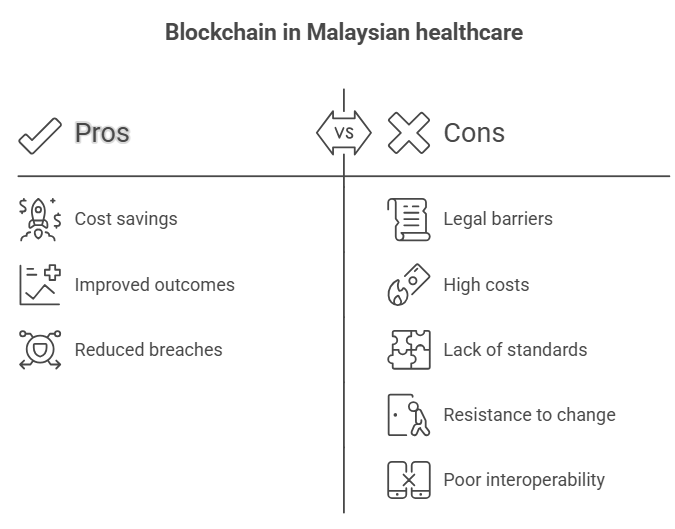
The result is predictable:
- Adoption remains low
- Investment is cautious
- Innovation stays at the pilot stage
Malaysia’s path forward is not technical deployment — it is policy reform. Until data ownership is redefined, blockchain will remain underutilised.
India: Build Consent First, Then Scale
India has taken a different approach — and it is working.
The Ayushman Bharat Digital Mission (ABDM) does not lead with blockchain. It leads with consent, interoperability, and governance.
Blockchain is deployed selectively, supporting:
- Secure consent logs
- Verifiable provider registries
- Transparent data access trails
This design aligns with real-world workflows.
Clinicians do not need to understand blockchain. They need systems that work.
The scale is significant:
- 730 million health accounts
- 787 million linked digital records
- Hundreds of thousands of providers are integrated
This diagram highlights how consent infrastructure underpins adoption — reducing integration costs, supporting clinical workflows, and enabling economic efficiency.
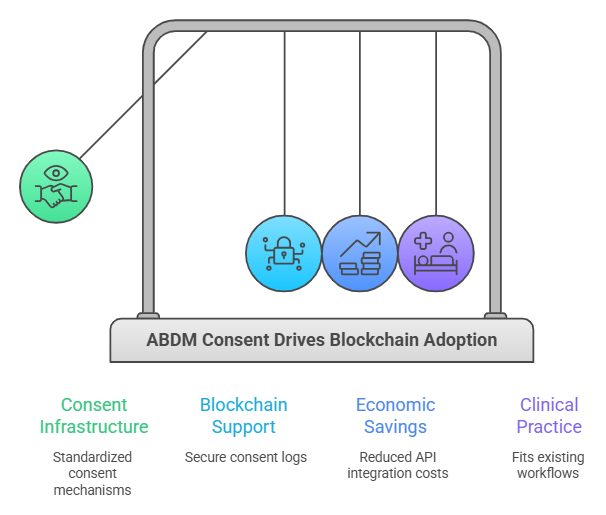
The business case is equally clear.
Custom API integrations in India can cost upwards of $2,500 each. ABDM replaces fragmented systems with a unified framework, allowing providers to redirect savings into care delivery and digital innovation.
This is why adoption is accelerating:
India designed for trust first, and technology followed.
Singapore: Regulation as an Enabler of Innovation
Singapore demonstrates a third model — where clear rules enable private sector experimentation.
Under initiatives such as Smart Nation and RIE2025, the government provides regulatory clarity while allowing startups to test blockchain applications in targeted use cases.
Examples include:
- Clinical trial data integrity
- Pharmaceutical supply chain tracking
- Automated insurance claims via smart contracts
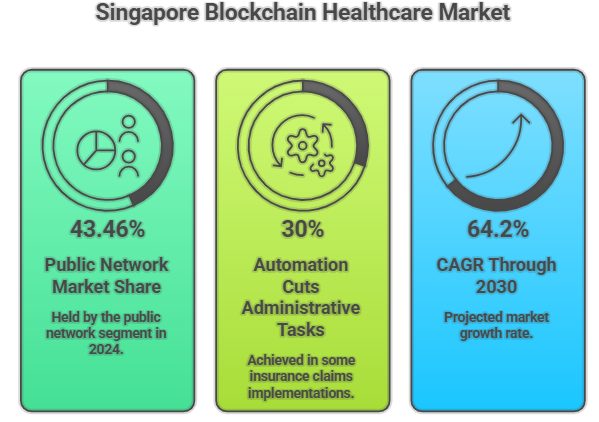
Automation alone has reduced administrative workloads by up to 30% in some implementations.
The market data on page 5 shows:
- $207 million market size in 2024
- 43.46% share held by public blockchain networks
- 64.2% projected CAGR through 2030
What drives this growth is not experimentation alone — but confidence.
Clear data protection laws, strong governance, and transparent frameworks give companies the assurance to invest.
For startups and insurers, Singapore shows that:
Trust reduces friction — and accelerates business models.
Trust Through Transparency: Rethinking Fraud
One of blockchain’s most immediate applications lies in fraud prevention and claims integrity.
As illustrated in this framework, blockchain enables a shift from reactive investigation to proactive trust-building.
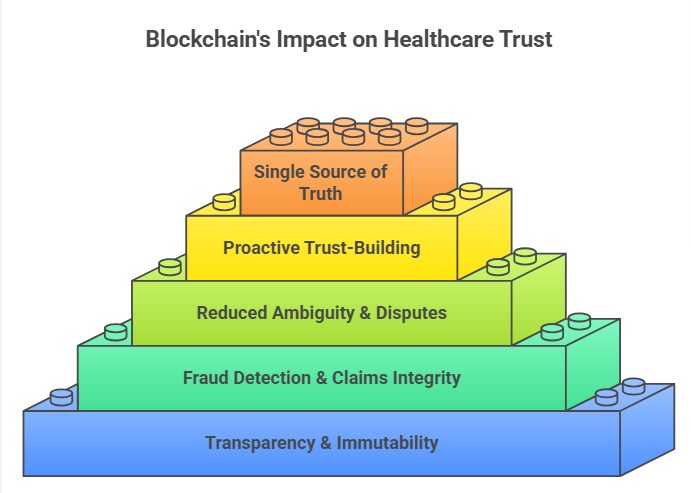
Nisha explains: “When every interaction is traceable and tamper-resistant, it reduces ambiguity and minimises disputes. More importantly, it creates a single source of truth across insurers, providers, and regulators.”
In practice, this means:
- Insurers spend less time investigating fraud
- Providers spend less time defending claims
- Patients gain visibility into how their data is used
The system becomes not just more efficient, but more trusted.
South Korea: Trust Through Patient Ownership
South Korea takes the most user-centric approach — building trust through data ownership.
Government-backed initiatives and private platforms allow individuals to control, share, and even monetise their health data.
Blockchain-based marketplaces enable:
- Secure data exchange
- Transparent usage tracking
- Compensation for patient data
Companies like MediBloc and Cube Medical are enabling interoperable medical records, while research platforms integrate national health data into standardised, blockchain-backed systems.
The model is powerful: Trust is built from the user up — not the institution down.
However, adoption varies across demographics, with stronger uptake among younger, urban populations.
What Actually Drives Adoption
Across these markets, several patterns emerge:
- Policy creates the foundation: Without legal clarity, adoption stalls — regardless of technical capability.
- Culture shapes adoption: Clinicians adopt systems that improve workflows. Patients engage when they retain control.
- Integration determines usability: Technology must fit existing clinical environments — not disrupt them unnecessarily.
- Trust accelerates innovation: When systems are trusted, startups scale faster, and investment follows.
What Comes Next: Scaling Trust Across Borders
The next phase of healthcare innovation in Asia will not be about proving blockchain works.
That question has already been answered.
It will be about scaling trust infrastructure across systems, markets, and populations.
ASEAN discussions on cross-border health data, youth-led innovation ecosystems, and the integration of ESG and climate-health tracking all point toward a more interconnected future.
But expectations must remain grounded.
As Nisha cautions: “The long-term potential is strong, but real value will emerge only when multiple stakeholders operate within a shared trust infrastructure rather than isolated implementations.”
Final Thoughts: The Systems That Scale Will Be the Ones People Trust
Blockchain is not a breakthrough. Trust is.
Across Asia, the pattern is clear. Countries that prioritise governance, consent, and user control are scaling adoption. Those who focus on technology alone are not.
The next phase of healthcare transformation will not be defined by who builds the most advanced systems — but by who builds the most trusted ones.
Because in healthcare, capability does not drive adoption.
Confidence does.
And confidence is built through systems that are transparent, accountable, and designed around the people who use them.
The real competitive advantage will not come from deploying blockchain faster.
It will come from embedding trust deeper — into policy, into workflows, and into every interaction across the ecosystem.
In Asia’s next phase of digital health, trust will not be a feature of the system.
It will be the system.
—
Editor’s Note:
This article was contributed by NewInAsia editorial fellow Dr. Muhammad Faisal, a clinical writer and Pharm-D graduate specializing in digital health, regulation, and patient engagement.
His work explores how trust, governance, and policy design shape the adoption of emerging health technologies — particularly in complex, multi-stakeholder systems across Asia.
To pitch your story or share insights on digital health, healthcare innovation, or the future of health systems in Asia, reach out to the NewInAsia editorial team.
Highlights
- Trust, Not Technology, Determines Scale
- Malaysia: When Policy Slows Progress
- India: Build Consent First, Then Scale
- Singapore: Regulation as an Enabler of Innovation
- Trust Through Transparency: Rethinking Fraud
- South Korea: Trust Through Patient Ownership
- What Actually Drives Adoption
- What Comes Next: Scaling Trust Across Borders
- Final Thoughts: The Systems That Scale Will Be the Ones People Trust
Read the Chinese article here.