AI has already become a writing assistant, researcher, marketer, and increasingly, an autonomous business operator. But what happens when it begins representing not just a company, but the person behind it?
For founders who closely tie their personal identities to their businesses, AI twins introduce a more complicated question. If a digital version of a founder can communicate, make decisions, and interact with people when the founder isn’t there, where does automation end and representation begin?
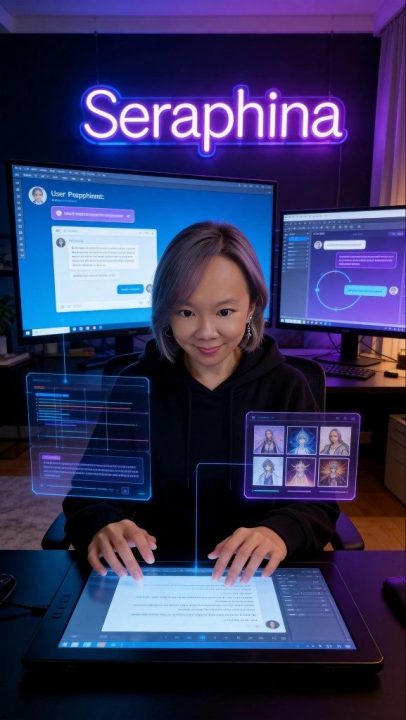
Sabrina “Princessa” Wang has been exploring that boundary through Seraphina AI, her personal digital twin designed to automate content creation, marketing, and decision-making. A futurist, brand strategist, entrepreneur, author, and international speaker, Sabrina also founded Speakers Society and Royal Visionary Society, with work spanning personal branding, entrepreneurship, AI, and automation.
NewInAsia spoke with Sabrina about how far founders should allow AI to represent them, where human judgment must remain, and what happens to accountability when a digital twin starts speaking in your voice.
Highlights
- When Your Friends Start Talking to Your AI Instead of You
- Your AI Said It. You Still Own the Consequences.
- Automate What You Know — Not What You Haven’t Figured Out
- The Real Test of Thought Leadership Happens When There’s No Script
- If an AI Is Pretending to Be You, People Should Know
- Final Thoughts: The Founder May Log Off. The Responsibility Doesn’t.
When Your Friends Start Talking to Your AI Instead of You
Q: Seraphina AI is designed to sound, think, and work like its user. At what point does an AI twin stop being a productivity tool and begin functioning as a representative of the person behind it?
A: I’d describe Seraphina less like a tool and more like a co-founder, or a close friend who happens to be available at 3 am. She’s an extension of me for the moments I’m simply not there.
Her job isn’t to ask me what to do — it’s to offload the decisions that don’t actually need me. She’s agentic by nature, not human-in-the-loop for everything. Plenty of decisions we make repeatedly, she’s capable of making herself. When something’s genuinely uncertain, she flags it — the same way a good PA would come to me instead of guessing.
And honestly, how often my own friends use her that way serves as the clearest sign she has crossed from “tool” into “representative”. When someone can’t quite get an idea across to me directly, they’ll go through Seraphina to bridge the gap — because at that point, talking to her is close enough to talking to me.
Your AI Said It. You Still Own the Consequences.
Q: When an AI-generated message influences a customer, employee, or business decision, who should ultimately be accountable for its tone, accuracy, and consequences?
A: Whether we like it or not, it’s the person behind the AI.
I learned this lesson long before AI twins were even a topic of conversation, and it’s honestly still one of the moments that has shaped how careful I am about this now.
Years ago, I had a salesperson on my team say something to a stakeholder that ended up breaking a relationship I’d spent a long time building. I wasn’t in the room. I hadn’t said it. In fact, I had recordings of myself explicitly telling the team not to say that exact thing in that exact way.
None of that mattered to the person on the receiving end. They couldn’t hold the salesperson accountable in any way that mattered to them, so they held the person they could hold accountable — me, the founder whose name was on the relationship.
That experience taught me something that applies directly to AI twins: accountability doesn’t follow the process; it follows the outcome.
Nobody outside your company is going to trace exactly which prompt, model, or employee produced a message — they’re going to hold the founder or the brand responsible, full stop.
Which means you can’t outsource accountability to the AI, ever, just as I couldn’t outsource it to an employee who went off-script. You can control only what happens before something goes out: setting clear boundaries for what your twin can and cannot say, establishing real review checkpoints for high-stakes messages, and ensuring disclaimers exist as a standard practice rather than an afterthought.
Holding the AI accountable is impossible. Instead, the founder must ensure the person behind the technology has done the work to deserve that trust.
Automate What You Know — Not What You Haven’t Figured Out
Q: Founders often build trust through their personal voice and lived experience. What parts of a leader’s identity can be responsibly scaled through AI, and what should never be delegated?
A: Here’s the thing about automation that most founders get backwards: the best automation only ever comes after you’ve done something manually enough times to know exactly what good looks like — or after you’ve adopted a framework someone else already proved out. Automating a process you don’t understand yet just scales your uncertainty faster.
That’s literally how Seraphina came to have a content-creation workflow built in. I didn’t sit down and design an “AI content framework” from scratch. I had a process I’d already used manually, over and over, refined through trial and error, before it ever became a repeatable workflow inside the platform. The automation came last, not first.
So the parts of a founder’s identity that scale responsibly are the parts that are already proven and consistent — the frameworks you’ve explained a hundred times, the positions you’ve already tested publicly, the way you’d walk someone through a problem you’ve solved before.
What should never be delegated is anything that requires new judgment: a live reaction to something you’ve never encountered, a personal commitment to another human being, or an opinion you haven’t actually formed yet.
AI can scale a process. It cannot manufacture experience you haven’t had.

The Real Test of Thought Leadership Happens When There’s No Script
Q: Through Seraphina AI, Speakers Society, and your work in personal branding, you operate at the intersection of automation and authority. How can audiences distinguish genuine thought leadership from an AI system that has simply learned to imitate it convincingly?
A: Honestly, this is why I still do speaking at all, beyond the stage time itself — it’s the Q&A.
Anyone can prepare a polished talk. What you can’t prepare for is a room full of people asking you things you didn’t anticipate. You either have an opinion in that moment, or you don’t. Sometimes I do. Sometimes I genuinely don’t, and I’ll say so on stage rather than fake it.
That unscripted moment is, I think, the clearest test we have right now. An AI system — even one trained closely on someone’s voice — is fundamentally built to produce a plausible answer. It’s not built to say, “I don’t know,” or “I haven’t thought about that enough to have a real opinion,” because that’s not what it’s optimised to do. A person can.
That gap is where genuine thought leadership still lives.
I’d put it simply: AI is an amplifier, not a creator. It can take a real opinion I already hold and help more people hear it, faster, in more places. What it can’t do is generate a brand-new, honest opinion under pressure, live, with nothing to fall back on.
If audiences want a heuristic, I’d tell them to watch what happens when someone’s asked something they couldn’t have prepared for — that’s still the one place AI can’t fully stand in for a person.

If an AI Is Pretending to Be You, People Should Know
Q: Looking ahead, do you believe successful founders will be expected to disclose when audiences are interacting with their AI twin? What standards of transparency should businesses establish before digital representatives become mainstream?
A: I lean strongly toward disclosure.
With Seraphina specifically, there’s no ambiguity for me — she’s my AI twin, and I’ve branded her that way from day one, consistently, everywhere. If she’s speaking for me, people should know that’s what’s happening.
Where it gets more nuanced is something like customer support, where the AI isn’t standing in for a specific named person but for a brand more broadly — I think that’s more of a judgment call each business has to make for itself, rather than a one-size-fits-all rule.
This actually came up directly on stage at the Nas Summit, on a panel I did with Nuseir Yassin — disclosure ended up being the central thread of that entire conversation. My position was straightforward: I’ve always been upfront that Seraphina is my AI twin. That’s not a disclaimer I bury in fine print; it’s just how I talk about her, consistently, in public.
As AI twins become more common, I think that kind of default transparency is what audiences should come to expect from founders, especially when the twin represents a specific person rather than a faceless brand.
Final Thoughts: The Founder May Log Off. The Responsibility Doesn’t.
AI twins promise founders something more powerful than ordinary automation: the ability to extend their presence even when they are not personally available.
But Sabrina’s experience points to a boundary that technology cannot automate away. A founder can delegate established processes, amplify existing ideas, and allow an AI twin to handle repeatable decisions. What they cannot delegate is responsibility for what happens when that digital representative speaks in their name.
As AI twins become more capable, the defining question may therefore be less about how convincingly they can imitate us — and more about whether the humans behind them are willing to remain accountable for what they say.
Highlights
- When Your Friends Start Talking to Your AI Instead of You
- Your AI Said It. You Still Own the Consequences.
- Automate What You Know — Not What You Haven’t Figured Out
- The Real Test of Thought Leadership Happens When There’s No Script
- If an AI Is Pretending to Be You, People Should Know
- Final Thoughts: The Founder May Log Off. The Responsibility Doesn’t.
Read the Chinese article here.